Tuesday, February 28, 2023

COURTHOUSE REPORTER SERIES: Louisiana Strikes a Blow Against Judicial Review of Arbitral Error

Continuing with the theme of last week’s post, the Louisiana First Circuit Court of Appeal recently upheld a trial court’s confirmation of an arbitration award of over $500,000, even though the award contained two errors of undisputed fact that the dissenting opinion argued, if corrected, would have resulted in an award in favor of the non-prevailing party. Coastal Indus., LLC v. Arkel Constructors, LLC, 2021-0906 (La.App. 1 Cir. 9/1/22); 350 So.3d 912, writ denied sub nom. Coastal Indus., LLC v. Arkle Constructors, LLC, 2022-01489 (La. 11/22/22), 350 So.3d 500.

The Coastal Industries case involved an arbitration between a subcontractor and the general contractor on a project to construct a building at a petroleum refinery. The subcontractor brought a claim to recover for amounts it contended it was due under its subcontract. The general contractor asserted a counterclaim seeking to recover for, among other things, the excess cost of completing the subcontract because of the subcontractor’s alleged abandonment of the project prior to completion. 

After a nine-day arbitration hearing, the arbitrator issued an award in favor of the general contractor. In rendering the award, the arbitrator found that the general contractor was entitled to recover $44,755.98 on its counterclaim.

The arbitrator calculated the award by taking the subcontract amount and subtracting therefrom the amounts the arbitrator determined the general contractor was due for excess completion costs and back charges, as well as the amounts previously paid to the subcontractor, resulting in what the arbitrator determined to be an overpayment of $44,755.98 to the subcontractor.

The arbitrator also awarded the general contractor its attorneys’ fees of $408,772.46 and various costs, for a total award of $530,574.02. The trial court confirmed the arbitrator’s award. 

On appeal, the subcontractor contended that the award should have been vacated because the arbitrator improperly calculated the award on the counterclaim by including back charges that were withdrawn by the general contractor and excess completion costs that the general contractor acknowledged should not have been included in its claim. 

In affirming the trial court’s confirmation of the arbitration award, the majority opinion held that errors in factual or legal conclusions will not invalidate an otherwise fair and honest arbitration award: 

This was a complicated case, with considerable evidence submitted by both parties. Upon review of that evidence, this Court may have reached different conclusions as to the interpretation of the Subcontract or the amount of damages. However, a court may not substitute its conclusions for those of the arbitrator. 

The court then went on to conclude that “the arbitrator's ‘improvident, even silly, factfinding’ does not provide a basis for a reviewing court to refuse to enforce the award.” 

However, the dissent in the case agreed with the subcontractor and found the arbitrator had made two mistakes of undisputed fact in rendering the award by including: 

  • $19,507.50 in excess completion costs, despite the fact that the general contractor acknowledged in its post-hearing brief that amount should not have been included in its claim; and
  • $44,906.67 in back charges that were withdrawn, as shown by the general contractor’s damages summary.

The dissent noted that had those two errors of undisputed fact not been part of the arbitrator’s calculation, the subcontractor would have been the prevailing party and awarded $14,781.31. The dissent went on to note that the arbitrator’s award of attorneys’ fees to the general contractor was founded on the erroneous determination that the general contractor was the prevailing party. 

The dissent found that based on state and federal case law, the arbitration award should have been vacated because of the errors of undisputed fact: "where the record that was before the arbitrator demonstrates an unambiguous and undisputed mistake of fact and the record demonstrates strong reliance on that mistake by the arbitrator in making his award, it can fairly be said that the arbitrator ‘exceeded his powers, or so imperfectly executed them’ that vacation may be proper.” 

Notwithstanding the dissenting view, the Supreme Court of Louisiana has denied the subcontractor’s application for writ of certiorari, meaning any judicial relief from the arbitral errors will not be forthcoming.

_________________________________________________________________

Author and Editor Stu Richeson is an attorney in the litigation section of Phelps Dunbar’s New Orleans office, primarily focusing on commercial litigation with an emphasis on construction matters, intellectual property issues and insurance.

Tuesday, February 21, 2023

COURTHOUSE REPORTER SERIES: Federal Court Confirms Liberal Federal Policy Favoring Arbitration Awards

A recent federal case, Industrial Steel Construction, Inc. v. Lunda Construction Company, is an important reminder that convincing a court of an arbitrator's error is not enough to overturn an arbitral award. 33 F.4th 1038, 1041 (8th Cir. 2022).

The case related to the construction of a bridge over the Mississippi River between Iowa and Illinois. The state of Iowa hired Lunda Construction Company (Lunda) as the general contractor for the project, which contracted Industrial Steel Construction, Inc. (ISC) to fabricate the structural steel for the bridge. A breach of contract dispute arose between Lunda and ISC that resulted in an arbitration pursuant to the contractual dispute resolution provisions. The arbitrator ruled entirely in favor of Lunda, including awarding Lunda its attorneys’ fees and expert costs, and requiring ISC to reimburse Lunda for its half of the cost of the arbitration.

Lunda moved the U.S. District Court for the Southern District of Iowa to confirm the final award. ISC in turn moved to vacate in part or modify the award, specifically challenging the arbitrator’s authority to award Lunda attorneys’ fees and expert costs. The district court ruled that the arbitrator exceeded its authority. Lunda appealed to the U.S. Court of Appeals, Eighth Circuit.

While the contract provided that disputes could be resolved in arbitration and that ISC, if it prevailed, was entitled to its costs, the parallel provisions for Lunda’s costs contained handwritten strikeouts and red text. The paragraph addressing Lunda’s right to damages provided that ISC “shall be liable for incidental and consequential damages (including attorneys fees and liquidated damages) resulting from delays caused solely by Seller in delivery, from the breach of any warranties, from defective goods and from any other breach of the term and conditions.” The stricken and underlined portions appeared in a different font color, and the bottom of the page bore two sets of initials. ISC argued that Lunda was thus not entitled to its arbitration costs.

The court of appeals noted that the Supreme Court has long held a “liberal federal policy favoring arbitration agreements.” It requires courts to enforce the results of arbitration liberally and may only vacate such results “where the arbitrators exceeded their powers, or so imperfectly executed them that a mutual, final, and definite award upon the subject matter submitted was not made.” This is a “heavy burden,” and the “sole question” for the court is whether the arbitrator read and interpreted the parties’ contract, “not whether he got its meaning right or wrong.” An “arbitrator does not ‘exceed his powers’ by making an error of law or fact, even a serious one.”

The court ruled that the arbitrator construed the contract as it related to attorneys’ fees and expert costs. The court gave significant deference to the portion of the award that stated that “the Arbitrator has reviewed R-48 of the Construction Industry Rules of the American Arbitration Association (AAA) and finds that an award of attorneys’ fees and costs is appropriate in this matter” because a contract provision indicated that the AAA’s Construction Industry Rules would govern procedural matters that were not otherwise addressed. Since ISC’s liability for Lunda’s costs was stricken from the contract, the contract arguably did not address the matter, obliging the arbitrator to apply Rule R-48 to fill in the gap. The fact that ISC disagreed with the arbitrator’s interpretation was immaterial due to the “liberal federal policy favoring arbitration agreements.”

The court made clear that it could not examine the accuracy of the arbitrator’s decision, but only whether the arbitrator attempted to interpret the arbitration provision and set forth its logic in its award. Since the arbitrator did so, the court held that the award must be confirmed in full as “convincing a court of an arbitrator's error — even his grave error — is not enough. . . . The potential for those mistakes is the price of agreeing to arbitration.”

Parties must be cognizant of this issue when negotiating arbitration provisions and litigating in arbitral forums. As the court noted here, parties “cannot impose a heightened standard of judicial review even by mutual agreement.”


*This blog article was previously posted on Troutman Pepper Hamilton Sanders LLP's construction law blog, ConstructLaw.com.

Author Matthew Quirin is an associate in Troutman Pepper's construction practice groupHe is a seasoned litigator who represents owners and developers of major construction projects from contract negotiation to complex litigation and trial. 

Editor Jane Fox Lehman is an associate in Troutman Pepper's construction practice group. She has substantial experience representing a variety of construction industry players in disputes arising from industrial, commercial, and multifamily-residential construction projects. Jane is the co-editor of the firm’s construction law blog, ConstructLaw.com.

Tuesday, February 14, 2023

Announcing the 2023 Toolbox Talks Series - Register Now!

We are pleased to announce the schedule for the six Division 1 Toolbox Talk Series (TTS) programs planned for 2023. For those who may not be aware, Division 1 created the TTS to provide a mechanism for a discussion separate and apart from the Forum's three national meetings. It is a great way to learn something new in a collaborative environment and only takes 30 minutes out of your busy day!

To ensure you don't miss a thing, register now for all of the TTS programs now by clicking the links below. You can also access the handout (with links) by clicking on the picture below. Spread the word to your friends and colleagues as these programs are open to anyone that would like to attend.

A special thanks goes out to the 2023 TTS Team which helped put this great program together: Marcus Quintanilla, Manuel del Valle, Stephen Swart, Andrew Vicknair, David Ponte, Jen Millender, Jessica Knox, Mike Martin, and Patricia Thompson. This team was led by Kanita Williams and Tom Dunn. If you have any questions about the TTS series, please feel free to contact Tom at rtdunn@PierceAtwood.com or Kanita at kwilliams@mwc-law.com.  

Improving Arbitration: In-house Counsel's Perspective
March 23, 2023 at 11 pm CST/12 pm ET
Program Description: Interview with Leslie King O'Neal about her perspective, as in house counsel, of how outside counsel can do better in arbitration
Speakers: Patricia Thompson, JAMS and Leslie O'Neal, JAMS
March Registration Link


Optimizing Dispute Resolution Clauses
April 26, 2023 @ 11 pm CST/12 pm ET
Program Description: Guidance on how to make such clauses clear, actionable, and pragmatic -- not illusory. How should the clauses be adjusted based upon contract size, scope, and risks? 
Speakers: Manuel del Valle, Vice President, Peritia Partners
April Registration Link


Strategy in the Hot Tub
May 25, 2023 @ 11 pm CST/12 pm ET
Program Description: Prospects, pitfalls, and best practices for the use of expert-witness conferencing in construction arbitration
Speakers: Marcus Quintanilla, Global Dispute Resolution
May Registration Link


Arbitration Motion Practice -- Is it worth it? 
June 22, 2023 @ 11 pm CST/12 pm ET
Program Description: Do motions actually assist in steamlining the process or are they more likely to be denied without prejudice pending testimony 
Speakers: Jennifer Millender, Director of ADR Services, American Arbitration Association
June Registration Link


5,280: A Measured Mile, Yes...But is the Scheduling Methodology that Straightfoward?
October 26, 2023 @ 11 pm CST/12 pm ET
Program Description: What is and what is NOT a measured mile. The discussion leaders will guide us on how to use the preferred scheduling methodology and ways to effectively counter incorrect applications
Speakers: Andrew Vicknair, Darcy Vicknair, LLC and David Ponte, P.E., CFCC, Ankura Consulting Group, LLC
October Registration Link


Round 'em up: Surveying Your Data for Productive Rule 26(f) Conferences
December 7, 2023 @ 11 pm CST/12 pm ET
Program Description: Best practices for understanding the what and where of clients' data, and the cost to collect it, for a prepared, productive Rule 26(f) conference
Speakers: Stephen Swart, Williams Mullen and Julian Ackert of Discovery Solutions
December Registration Link


Assistant Editor-in-Chief Jessica Knox is an Associate in the Minneapolis office at Stinson LLP. She represents owners, general contractors, and subcontractors in litigation disputes. Jessica can be contacted at jessica.knox@stinson.com. 

Wednesday, February 8, 2023

TOP TAKE-AWAY SERIES: The 2023 Mid-Winter Meeting in Puerto Rico


It was great seeing so many D1 members at FCL's mid-winter meeting in San Juan, Puerto Rico last week!  To help sum up the amazing programming and social events, the Dispute Resolver team has established a new "Top Take-Aways" series  that will run following each of our in-person Forum meetings. Since there is no way a single perspective can possibly capture all the learnings from these events, we encourage our readers to share their own thoughts by adding a comment following the post. Below are my top 10 take-aways from this year's mid-winter meeting. What are yours?

10. Puerto Rico is still recovering from Hurricane Maria. It's not often (if ever) that a sitting governor takes the time to stop by our Forum events. That is likely why this meeting's keynote speaker -- the Honorable Pedro R. Pierluisi, Governor of Puerto Rico -- was particularly noteworthy in his own right. An attorney of 35 years who practiced construction law before pursuing a life in politics,  Governor Pierluisi spoke at length on the widespread infrastructure improvements which are just now getting under way following the widespread devastation caused by Hurricane Maria (a category 5) in 2017. It was difficult to hear that some Puerto Ricans were without power for almost a year following this event. Governor Pierluisi reminded us that, while Puerto Ricans are U.S. citizens, they lack many of the benefits which we take for granted. While Puerto Rico is represented in the U.S. Congress, for example, their representatives can introduce bills but not actually vote on them.

9. Pre-fab and modular construction presents new contractual challenges. Although not by any means a "new" technology, according to Ronald Ciotti, Bruce Merwin, and Kristin Protas, modular construction seems to be having a moment. Of course, COVID could have something to do with that. The use of pre-fab construction allowed builders to rise to the challenge presented by the pandemic by increasing bed capacity in a fraction of the time compared to conventional construction. That said, notwithstanding greater acceptance of pre-fabricated and modular construction techniques, until recently, there was no form contract designed to address the unique issues that may arise when project participants rely on this form of construction. In light of the hybrid nature of what is both a "good" and a "service," particular consideration needs to be given on the applicability of the UCC. Special attention also needs to be given to flow-down considerations, termination clauses, inspection rights, and, the interplay of various legal regimes. If your clients are considering off-site construction and you are looking for form contract language, you might consult ConsensusDocs 753 (standard form agreement between constructor and prefabricator) and ConsensusDocs 253 (standard form agreement between owner and prefabricator) as a starting place.

8. "Private judging" could offer litigators the best of both worlds. Available by stipulation in some jurisdictions, "private judges" can be selected by the parties to preside over cases pending in a court of law. Although the costs of the private judge are split by the parties, they are not the same as an arbitrator, most notably because the legal issues in any opinion rendered by a private judge remain appealable within the court system. According to Luis Pratts, John Freud, and Bobby Moore, the advantages to private judges are many and include greater control over who will be deciding your case and greater control over scheduling. So far, not all states have a private judge statute but, if the trend catches on, this could present a "best of both worlds" scenario where without sacrificing the speed and efficiency traditionally afforded by arbitration.

7. The world's largest distillery of premium rum is in Puerto Rico. Although rum was not invented in Puerto Rico, we were advised that it was most certainly perfected there. I learned this and many other important skills (like how to make the perfect mojito) at the Division 1, 7, and 11 social event at Casa Bacardí. Another fun fact about rum and Puerto Rico: the piña colada was first concocted there. Exactly where on the island the piña colada was first served is hotly disputed so the discriminating traveler would be wise to try them all. Click on the video below to watch D1, D7, and D11 mixing up a hand-shaken piña colada at Casa Bacardí:

6. There is risk with reward when it comes to the Infrastructure Investment and Jobs Act (“IIJA”). While everyone is jumping at the bit to get a piece of the $1.2 Trillion IIJA pie, contractors need to understand how to safely take a slice without exposing themselves to undue risk under the Federal and State False Claims Acts. Andy Howard, Justin Barkowski, and Matt Gillies cautioned that, virtually anything that could justify withholding of payment to the contractor could justify a false claims act. With a whistleblowing provision to tempt disgruntled workers and treble damages for every false "claim" (which itself could be interpreted broadly as every pay app, every RFI, etc.) the panelists aptly referred to these acts as "company-killing statutes."

5. The best trial attorneys are good storytellers. There's a reason why it is important to have a compelling theme/theory of your case and, as it turns out, it's grounded in science. According to Jeffrey Isler and Professors Carlos Concepción and Laura Rose, compelling story creates an emotional response in your listener. Emotion releases dopamine which helps your factfinder remember things. By using "functional MRI" studies (which image the brain while it is working), we know that memories are broken down and stored in different parts of the brain. A good story can be the "glue" that helps a factfinder accurately reassemble the various pieces of the case. Story aids in retention, invests the factfinder in the outcome, and helps the factfinder test the veracity of the witness against their own real life experience.

4. The labor and supply chain issues which we saw during COVID are not over. The manufacturing industry is still experiencing a labor shortage, caused in part by COVID and in part by reduced labor force participation. Danny Jarrett, Jennifer Therrien, and Mike Cortez spoke of the economic factors leading to price escalation on construction materials. There is scarcity due to the reduced capacity leading to higher prices. Manufacturers have been forced to increase wages to entice good workers which, in turn, leads to increased prices. While increased wages for laborers may seem like a positive development for the laborers, the inconvenient truth is that these workers actually have less purchasing power than before after taking into account inflation and price increases.

A photo of Arecibo from our site visit
3. Puerto Rico will likely never recover from the loss of the Arecibo Observatory. On December 1, 2020, the Arecibo radio telescope collapsed after almost 60 years in operation. As critical as it was to mapping asteroids and pulsars, we learned that the telescope represents much more than the sum of its science to the Puerto Rican people. John Abruzzo of Thornton Tomasetti provided an informative presentation on the cause of the collapse and the post-event clean-up. I was surprised to learn that the collapse of the telescope was anticipated and that, at the time of the collapse, Thornton Tomasetti was making plans for the telescope's intentional demolition. Thanks to the generosity of John Abruzzo, a small group of meeting attendees were able to visit the Arecibo site and hear first-hand from the scientists that still work there (mostly analyzing historic data that the telescope had collected before the collapse). The sadness in the room was palpable when we were told that, rather than spend the $750 million or so that it would cost to repair the telescope, the National Science Foundation has announced that it intends to permanently close the facility in August.

2. Artificial intelligence presents a double-edged ethical sword for attorneys. Attorneys can no longer afford to stick their head in the sand when it comes to understanding the artificial intelligence revolution and what benefits (and risks) it may present for their clients. This was but one of the messages conveyed by the ethics panel, comprised of Jim Doppke, Sanjay Kurian, and Catherine Delorey. Attorneys have an ethical duty under Model Rule 1.1 to educate themselves on what AI is and how it can be most effectively employed. And, when attorneys choose to employ these tools, they invoke another ethical duty under Model Rule 5.3 to supervise the AI tool as “nonlawyer assistance” and ensure it is performing correctly. To avoid being caught in this Catch 22, attorneys should strive to gather a keen understanding of the workings of AI tools.

1. Puerto Rico is an amazing place! Attending Forum events is not ALL about the great CLE and amazing networking. If one of the reasons these events rotate from location to location is to give us all a chance to experience different cultures, then Puerto Rico takes the cake. Karen Denys and Jason Quintero did an amazing job putting together a wonderful program and schedule of activities. Puerto Rico was full of excellent food and endless adventure. Thankfully, my memories of rainforest rope swings and colorful coral reefs will remain long after my bruises from these exciting adventures finally subside.


Author Marissa L. Downs is a construction attorney in Chicago, Illinois where she has been practicing law since 2009. Marissa is a partner at Laurie & Brennan, LLP and represents owners, general contractors, and subcontractors in all phases of project procurement, claim administration, litigation, and arbitration/trial. Marissa can be contacted at mdowns@lauriebrennan.com.

Tuesday, January 31, 2023

COURTHOUSE REPORTER SERIES: Not Everything Is Bigger in Texas... Court of Appeals Reverses Trial Court’s Expansive Interpretation of Indemnity Clause


A recent decision by the Court of Appeals of Texas, RKI Exploration & Production, LLC v. Ameriflow Energy Services, LLC, highlights the perils of failing to properly assert a demand for contractual indemnity. No. 02-20-00384-CV, 2022 Tex. App. LEXIS 4331 (Tex. App. June 23, 2022).

In 2014, a piece of equipment, known as a sand separator, exploded at an oil well in Loving County, TX, killing two individuals and injuring three others. RKI Exploration & Production LLC operated the oil well. RKI contracted with Ameriflow Energy Services LLC and Crescent Services LLC through two master service agreements (MSAs) and a series of work orders.

Ameriflow supplied equipment and services to the wellsite, including the explosive sand separator. Crescent provided safety training and management services to Ameriflow. Notably, it was unclear whether Crescent supplied those services under a subcontract agreement with Ameriflow or whether the two entities were somehow affiliated. It was undisputed Crescent did not perform those services under its MSA with RKI or an associated work order.

The explosion and resulting dispute produced a “maze-like series of indemnity demands, settlements, and judgments” among the injured individuals, RKI, Ameriflow, and Crescent. The dispute culminated in tri-party litigation to determine RKI’s indemnity obligations to Ameriflow and Crescent under their respective MSAs. Broadly construing the indemnity language of the Crescent MSA, the trial court held that Crescent was entitled to indemnity from RKI and awarded Ameriflow and Crescent approximately $11 million.

The Court of Appeals considered, inter alia, whether the lower court had erred by broadly construing the Crescent MSA indemnity clause to encompass claims against Crescent, even though Crescent was not performing under the MSA at the time of the explosion.

RKI argued that because the MSA contemplated that Crescent would perform work pursuant to RKI work orders, and RKI had not issued any work orders at the time of the explosion, Crescent was not performing under the MSA, and therefore, it was not entitled to contractual indemnity from RKI.

Crescent argued that the MSA provided that RKI was to indemnify Crescent against all claims “arising in connection herewith” and a claim arising from Crescent’s supply of safety training and management services to Ameriflow “arose in connection with” — if not under — the Crescent MSA. According to Crescent, the phrase “arising in connection herewith” obligated RKI to indemnify Crescent for any claim arising from “all activities reasonably incident [to] or anticipated by the principal activity of the MSA, which is oil well operation.”

The court began with an extensive review of Texas and federal case law, interpreting the terms “arising” and “in connection herewith.” The court then reasoned that the phrase “arising in connection herewith” meant “originating from the document or writing in which the phrase is contained” rather than the broader view espoused by Crescent and adopted by the trial court. Applying this definition to the MSA, the court concluded that RKI’s indemnity obligations to Crescent were limited to Crescent’s performance under the MSA.

The court explained that the trial court’s interpretation was overly broad because it “untether[ed] the indemnity obligation from the contract containing the provision and [brought] activities independent of the contract within the scope of the indemnity provision simply because they relate to the general subject of the contract.” Such an interpretation would allow Crescent to perform “work for anyone at the wellsite, in as slipshod a manner as it wished, and still claim that RKI owed it indemnity.” The court concluded that because RKI’s indemnity obligation to Crescent was limited to Crescent’s performance under the MSA and because Crescent’s services to Ameriflow were not authorized by an RKI work order, Crescent was not entitled to indemnification from RKI.

The court noted that Crescent may have been entitled to contractual indemnity from RKI as an Ameriflow subcontractor under the terms of the Ameriflow MSA. But because Crescent did not raise this argument and because the precise relationship between Crescent and Ameriflow was unclear, the court could not rule on the issue. Thus, Crescent’s failure to assert its claim through the framework of its relationship with Ameriflow may have barred it from recovering contractual indemnity to which it would otherwise be entitled.


*This blog article was previously posted on Troutman Pepper Hamilton Sanders LLP's construction law blog, ConstructLaw.com.

Author Brendan Kirwin is an associate in Troutman Pepper's construction practice group. He focuses his practice on representing and counseling owners and developers in all manner of complex construction transactions.

Editor Jane Fox Lehman is an associate in Troutman Pepper's construction practice group. She has substantial experience representing a variety of construction industry players in disputes arising from industrial, commercial, and multifamily-residential construction projects. Jane is the co-editor of the firm’s construction law blog, ConstructLaw.com.

Tuesday, January 24, 2023

Meet D1’s Neutrals Series: JESSE HOWARD WITT


Company:
 Frascona, Joiner, Goodman & Greenstein
Location: Boulder, Colorado
Email: jesse@frascona.com
Webpagehttps://frascona.com/jesse-witt/
Law School: University of Denver School of Law (JD 2001)
Types of ADR services offered: Mediation, arbitration, neutral evaluation
Areas served: Colorado, California, and others as requested


Q: Describe the path you took to becoming an ADR neutral.

A: As my career has progressed, I find myself more interested in helping parties find solutions than “winning.”

Q: What percentage of your current legal practice is spent on ADR work?

A: 10%. When not serving as a neutral, I work as an advocate and represent parties in litigation.

Q: Describe your background and experience mediating and arbitrating construction cases.

A: I worked in the construction field before and during law school. Since then, I have focused on construction law over the last twenty years as an attorney. I feel this gives me a helpful perspective when mediating disputes, with an understanding of the parties’ diverging perspectives and the realities of litigation.

Q: Mediators are oftentimes described as “facilitative,” “evaluative,” or “transformative.” Do you have a style?

A: I tend to be evaluative in my assessment of the parties’ claims and defenses.

Q: What should attorneys and their clients take into consideration when selecting a mediator?

A: Seeking someone with experience in the given area of law is always a good starting point. I feel that my experience both in the construction field and as a trial attorney makes me an effective mediator of construction disputes.

Q: What are your thoughts on requiring mediation as a contractual prerequisite to litigation or arbitration?

A: I think it is prudent to include such a term to encourage resolution, but parties must be committed to the process. If either side views mediation as a perfunctory requirement, the ADR process is unlikely to be successful. I recommend that parties attempt mediation as soon as they have a clear understanding of the claims at issue.

Q: What can attorneys do to best position their clients for a successful mediation outcome?

A: Provide their clients with a realistic assessment of their cases’ strengths and weaknesses.

Q: Are virtual mediations as effective as in-person mediations? What are their advantages/limitations?

A: I prefer in-person sessions, but virtual mediations can be effective as well, so long as the parties commit to the process. The advantages of virtual sessions are that they can be easier to schedule and feature reduced travel expenses, both of which may encourage earlier resolution. Disadvantages include the difficulty in building rapport with the parties and the risk that parties will be less committed to the process. In this regard, the ease and cost savings of a virtual session can ironically become a disadvantage.

Q: Do you think limits should be placed on discovery in the arbitration context?

A: Yes. When drafting arbitration clauses, I often adopt Colorado’s discovery parameters for simplified procedure cases (Rule 16.1) regardless of the amount in controversy. I have found that these strike a good balance for most disputes.

Q: What is the biggest problem you see with arbitration today?

A: Parties too often view arbitration as little more than a limitation on liability to consumers, under the belief that arbitrators will award less than juries. This leads to poorly drafted arbitration clauses that incorporate court rules and result in proceedings that amount to little more than private bench trials. Arbitration is most effective when used as a tool to facilitate resolution using expedited procedures, focused discovery, and neutrals with experience in a given field. Arbitration should not feel skewed against consumers; if done properly, arbitration can be beneficial to both sides and produce a just outcome for many construction disputes.

Q: What are some of your interests or hobbies outside of your ADR Neutral practice?

A: Tennis, running, film.

Thursday, December 22, 2022

What's Up With Division 1 (No. 18) -- Happy Holidays and Happy New Year!

Quite a bit has occurred since my last message from the Division 1 Chair, which was just before the Fall 2022 Meeting in Memphis, TN.  I will do my best to summarize the highlights but I wanted to start by saying HAPPY HOLIDAYS to all of Division 1's leaders and members.  I hope you are able to take some time off and enjoy the holidays with your family and friends.  I am very proud of what we have accomplished in 2022 and look forward to further collaboration with you all about construction litigation and dispute resolution into 2023 and beyond! 

Fall Meeting -- Memphis, TN (Sept. 28-30)

The Peabody Hotel was awesome!  The lobby was huge and very comfortable.  Full of southern charm.  The Forum Chair, Cary Wright, served as honorary duck warden (forget the real name).  A video of that is below:


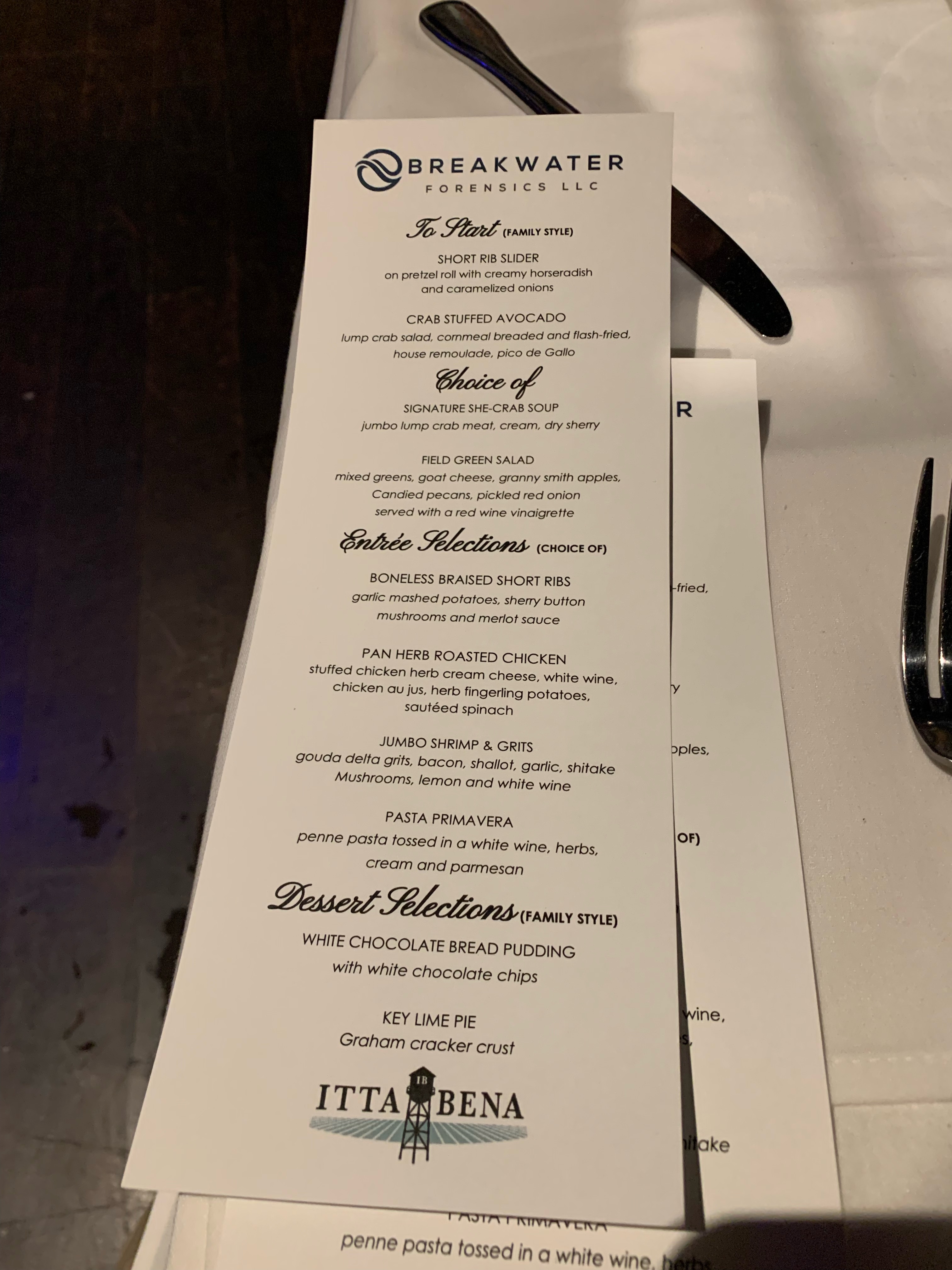
We had a great dinner at Itta Benna, a hidden away restaurant located at the top floor of BB Kings.  Thanks to Mike Lane for scheduling this fabulous dinner and Breakwater Forensics LLC for sponsoring it.  Here are some photos:


We held the first of the 3-part trial advocacy practicums in Memphis.  They focused on jury selection.  Jason Rodgers-da Cruz led the planning effort for this program.  He was joined by Stu Sobel (last minute substitute due to Lu Prats having to deal with the Hurricane), Galina Davidoff, and Terry Brookie. 


Our lunch program, planned by Brett Henson and Jade Davis, on early dispute resolution was postponed because they are both based out of Florida and were dealing with Hurricane Ian.  We split up into different division lunches.  

We held Division 1’s annual planning retreat in Memphis.  We came up with a ton of excellent ideas for the concepts book and discussed some new ventures to try out.  Thanks to everyone who attended!  

Here are some other photos from the meeting.


Division 1 — Extreme Winds Program

Speaking of natural disasters involving wind, shortly after my last message, we held a fantastic virtual program on wind events.  This was a technical program.  It was very interesting and is full of videos.  I recommend you watch it if you have not already done so.  Thanks to Mike Lane for coordinating this program!


Division 1’s Toolbox Talk Series Programs - Sept, Oct, Dec

Just before the Fall Meeting, on September 22, 2022, we held a Toolbox Talk Series program on Ethical Conduct for Advocates and Neutrals (Rules and Remedies for Mediation Misconduct).  Thanks to Patricia Thompson and Deborah Ballati for leading this discussion.  Check out the video here:


We held Toolbox Talks in October and December as well.  October’s was on the Design-Build Standard of Care and led by Thanh Do and Joel Heard (partnership with Division 4).  I tagged along with Catherine Delorey and Mark Johnson for the December TTS on Strategies to Defeat or Mitigate Attorney’s Fee Prevailing Party Provisions.  


Both were great programs.  Kanita Williams, our most recent steering committee member, is going to lead the 2023 Toolbox Talk Series of programs.  Thanks to all the volunteers who made these programs a success.  

Division 1’s Arbitration Program with Division 8 - Nov. 10th

Division 1 and Division 8 agreed to collaborate on some programs.  The first of the programs was a virtual program on arbitration comparing domestic vs. international practices.  Pasha Ameli has been the D8 leader/liaison working hard to make these programs a success.  He moderated the panel of speakers (R. Zachary Torres-Fowler, Marcus Salvatore Quintanilla, Merra Kurubalan, and Patricia H. Thompson).  Thanks to Pasha, the speakers, and Division 8 for this program! 

The Dispute Resolver Posts

I am assuming you know about the TDR posts if you are reading this message, but I would be remiss if I didn’t mention that the following has been posted on TDR since the Fall Meeting:
  • D1 Neutral Feature - Robbie MacPherson
  • View from the Field Part 5 - Field Labor Disruption
  • Jurisdiction - Employee Training, Alone, May Subject You to a Foreign State’s Jurisdiction 
  • Pennsylvania Superior Court Places Time Limit on Good Faith Withholding Under Prompt Pay Act
  • Contractual Claims Protection: A Checklist for Owners
  • D1 Neutral Feature - John Bulman
  • Twists and Turbines - A New York Case Highlights an Owner’s Risk When Not Using Full-Wrap EPC Delivery
I want to thank all of the authors, editors and contributors of TDR.  After serving as the editor in chief of TDR for the past years, Catherine Delorey is going to hand-off the lead editor role to Marissa Downs.  Thanks very much Catherine for your work for TDR.  We launched some fun and different series since you have served as editor.  Congrats Marissa and I look forward to working with you on TDR as well as the new editors we are bringing on board.  

If anyone has an interest in being published in The Dispute Resolver, please reach out to Marissa Downs (mdowns@lauriebrennan.com) or Tom Dunn (rtdunn@pierceatwood.com).  

Forum’s Midwinter Meeting — Feb 1-3, 2023 (Caribe Hilton Puerto Rico)

Join us at the midwinter meeting (just about 1 month away!).  REGISTER HERE.


Joe Imperiale is leading the second practicum in the trial advocacy series on openings and direct examination.  Arrive early so you can attend the practicum on Wednesday.  


Marissa Downs is planning our social event which will be at the Casa Bacardi on Wednesday afternoon.  Be on the lookout for the registration info for that program, but it will include a mixology class, a tour, and reception sponsored by our friends at Construction Discovery Experts.  

Have a great end of 2022!   

Tom Dunn, Division 1 Chair
rtdunn@pierceatwood.com
401-490-3418


Monday, December 19, 2022

COURTHOUSE REPORTER SERIES: Twists And Turbines: A New York Case Highlights an Owner's Risk When Not Using Full-Wrap EPC Delivery

 New York State Thruway Auth. v. CHA Consulting, Inc., 165 N.Y.S.3d 832 (Albany Co., Sup. Ct. 2022).

This case involved a dispute over a wind turbine project. The root cause of the dispute was a bust between the “wind turbulence” at the site, and the wind turbulence that the turbines installed could withstand. Once the project was completed and commissioned, the overworked turbines prematurely failed.

The New York State Thruway Authority (the owner) sued CHA Consulting, Inc. (the designer), the Kadney Company (the general contractor), Vergnet (the turbine supplier), and two different site engineers: Prudent Engineering, and Ravi Engineering and Land Surveying (the engineers). The New York Supreme Court (New York’s trial court) dispatched all of the owner’s claims on summary judgment.

The designer, which had specified the wrong type of turbine, invoked New York’s three-year statute of limitations to defeat the owner’s professional negligence claim. The owner argued that the statute should run from the date of its acceptance of the work and issuance of a final certificate. But the statute makes clear that it runs from the professional’s “completion of performance under the contract.” With the designer out of the picture based on the timing of its work, the owner’s creative attempts to hold others responsible fell flat.

The general contractor defeated the owner’s claims because the designer specified the exact make and model of turbine, and the general contractor procured and installed those exact turbines. It was not the general contractor’s responsibility to verify that the turbines were suitable for the site, therefore the general contractor could not be held responsible. Even if the general contractor was somehow responsible for the verification, the owner accepted the general contractor’s work during inspection, and found it in general conformance with the contract plans and specifications.

The turbine supplier defeated the owner’s warranty claim because its warranty contained an exclusion when the site conditions were the cause of the issue. The owner argued that the turbine supplier should be estopped from taking advantage of the exclusion because it did not verify that the turbines were suitable for the site conditions. The Court disagreed, finding that the warranty did not create any duty for the turbine supplier to independently verify suitability. The various disclaimers in its contract were a further backstop against this argument.

The engineers defeated the owner’s claims because the Court found that their obligations were limited to confirming that the turbines supplied were the same as the turbines specified. The Court made this ruling primarily because the specification at issue was a “closed proprietary specification, with no substitutions allowed.” Had a less-detailed and more traditional performance specification been used, the engineers would have had greater responsibility to verify conformance.

In conclusion — it is not uncommon for an owner to separately contract with the major players on a construction project, as opposed to entering a full-wrap EPC agreement, but such an arrangement presents certain risks. Two of the most notable risks are scope gaps, and as demonstrated in this case, liability gaps. The designer in this dispute was able to avoid liability because its work was complete long enough before the problem was discovered that the statute of limitations had run, which left the owner without a party to pursue. A full-wrap EPC agreement would likely have allowed the owner to avoid this situation.

*This blog article was previously posted on the Troutman Pepper website.

Author Todd Heffner is an Associate with Troutman Pepper in its Atlanta office.  His practice covers construction matters, including in federal court and arbitration.

Wednesday, December 7, 2022

Meet D1’s Neutrals Series: JOHN E. BULMAN


Company:
 Pierce Atwood LLP
Location: Providence, Rhodes Island
Email: jbulman@pierceatwood.com
Webpage:  https://www.pierceatwood.com

Law School: Georgetown University Law Center, J.D., cum laude;Editor, Law and Policy in International Business (1984)
Types of ADR services offered: Mediation, Arbitration, Dispute Review Boards, Online Dispute Resolution (ODR)
Areas served: Nationwide
Affiliated ADR Organizations:
        American Arbitration Association (AAA)
International Institute for Conflict Prevention & Resolution (CPR)
International Centre for Dispute Resolution (ICDR)
College of Commercial Arbitrators (CCA)
Chartered Institute of Arbitrators (CiArb)
Rhode Island Superior Court
Rhode Island Federal District Court
International Chamber of Commerce (ICC)


Q: Describe the path you took to becoming an ADR neutral.

A: Early in my career, I was an advocate in several AAA construction-related arbitrations.  The AAA saw fit to add me to its Panel of arbitrators around 1990.  Since then, I have served as an arbitrator or mediator in approximately twenty states.

Q: What percentage of your current legal practice is spent on ADR work?

A: 90% or more of my time is spent as a neutral.

Q: Describe your background and experience mediating and arbitrating construction cases.

A: I have served as a mediator in over 100 construction cases since 1990. I have served as an arbitrator and rendered awards in at least fifty arbitrations, ranging from $500,000 to $220,000,000 in controversy.   Most of the larger cases have been three-arbitrator panels; I have served as chair in the majority of those cases.

Q: Mediators are oftentimes described as “facilitative,” “evaluative,” or “transformative.” Do you have a style?

A: Each case calls for a specific emphasis and/or technique but I certainly lean toward facilitative negotiation.

Q: Do you have any practices that you find make you particularly effective as a mediator?

A: Asking open-ended questions to prompt each party to fully articulate not only the merits of the case but also how counsel expects to meet the other side’s defenses or counterclaim.

Q: Do you recommend individual preparatory meetings with the parties and counsel prior to the joint session?

A: Yes. Gaining a better understanding of the dispute background and prior settlement discussions saves time and energy at the mediation session itself.  It also preempts “going down the wrong road” at the mediation.

Q: What should attorneys and their clients take into consideration when vetting and/or selecting an arbitrator?

A: The arbitrator’s subject matter expertise and ability to manage the process efficiently.

Q: What advice do you have for parties when considering whether to choose a single arbitrator or a panel?

A: Cases with a large amount in controversy or where the technical expertise of a particular arbitrator is important are cases where a three-member panel is effective and appropriate.  Cases with several parties are also situations where a three-member panel is appropriate.

Q: Do you think limits should be placed on discovery in the arbitration context?

A: There should be limits since arbitration is not supposed to be a mirror image of litigation.

Q: What role should traditional rules of evidence play in the arbitration hearing?

A: By the time hearings take place, there should be a limited number of exhibits that are in controversy.  This is the only time when the “rules of evidence” have a bearing, and they have a limited bearing.

Q: What are some of your interests or hobbies outside of your ADR Neutral practice?

A: Furniture making and fly-fishing.