Using a creative presentation approach (and apropos for the upcoming 2018 Winter Olympics), Joshua, Bill, and Mary Jay set the scene for a dispute between Olympic Mechanical and Bobsled Contractors over the mechanical subcontractor's claimed costs for extra work and delay. Joshua served as counsel for the defendant Bobsled Contractors and Bill was Bobsled's expert. Over the course of three acts marshaled by Mary Jay, Joshua and Bill held mock meetings to discuss the claims, exchange of documentation, initial opinions, written reports, and preparation for depositions and trial. The pair offered important and practical reminders to ensure the expert testimony will meet the requirements of the rules of evidence and civil procedure. As a coda to the presentation, Eric J. Meier also from Husch Blackwell LLP, played the opposing expert for Olympic and faced stiff cross-examination from Joshua. This mock cross-examination illustrated the worst case scenario if best (or even good) practices for preparing experts are not followed.
Articles on Construction Litigation & Dispute Resolution by Division 1 of the ABA Forum on Construction Law
Wednesday, January 24, 2018
Midwinter Meeting - D1 Breakfast Program - Getting it Right Early: Expert Retention Best Practices
It's no secret that construction disputes frequently involve one or more expert witnesses on each side. Our Division 1 panel -- Joshua B. Levy of Husch Blackwell LLP and Bill Manginelli and Mary Jay Torres-Martin both from Trauner Consulting Services, Inc. -- offered some best practices for those expert engagements starting at the initial meeting through the expert's trial testimony.
Saturday, January 20, 2018
Risky (shifting) Business: Pay-if-Paid Provision Enforced to Subcontractor's Detriment
In Baker Concrete Const., Inc. v. A. Pappajohn Co., No. FSTCV166028187S, 2017 WL 4106383, at *1 (Conn. Super. Ct. 2017), at issue was the age-old dispute of non-payment for work performed.
The Baker Court first recounted the direct avenues for collecting on a construction project when payment is not made in the regular course: "[A] mechanic's lien may be available, and in connection with public works projects, a payment bond is statutorily required given the unavailability of a mechanic's lien in such projects." That said, "[d]epending upon the equity in the property . . . a mechanic's lien may be insufficient (especially if a project has been financed with a mortgage placed on the property as a first lien)." Even with these direct avenues along with filing suit, insolvency of the parties in the project chain can thwart any collection efforts of the lower tier contractors. In addition, contractual language, for example a pay-if-paid provision, too can arrest an unpaid party's effort to be paid. The Baker Court considered the requirements for applying such provisions.
In Baker, the general contractor-subcontractor contract stated, in pertinent part, that:
Progress payments to the Subcontractor for satisfactory performance of the Subcontractor's Work shall be made only to the extent of and no later than ten (10) working days after the receipt by the Contractor of payment from the Owner for the Subcontractor's Work. The Subcontractor agrees that the Contractor shall be under no obligation to pay the Subcontractor for any Work until the Contractor has been paid by the Owner . . . The Subcontractor expressly acknowledges and agrees that payments to it are contingent upon the Contractor receiving payments from the Owner.
By its plain language, this pay-if-paid provision appeared to foist all risk of the owner's potential insolvency onto the subcontractor. For its part, the subcontractor argued that "the provision is a timing issue (or should be interpreted and applied as such) rather than a risk-shifting provision." In other words, notwithstanding that the general contractor was not paid by the owner in a reasonable period of time after the work was performed by the subcontractor, the subcontractor was still entitled to be paid. The court disagreed.
After disposing of a burden of proof argument raised by the subcontractor, the Baker Court resolved the contract interpretation question. It examined the caselaw and observed that where the provision does not explicitly "creat[e] a condition precedent to payment" the courts will construe the provision as "setting the time of payment" rather than establishing a defense to payment. However here, the contingency was explicit and moreover the contract provision also put the risk of insolvency explicitly onto the subcontractor: "The Subcontractor expressly accepts the risk that it will not be paid for the Work performed by it if the Contractor, for whatever reason, is not paid by the owner for such Work. The Subcontractor states that it relies primarily for payment for Work performed on the credit and ability to pay off the Owner and not of the Contractor[.]"
In light of the foregoing the Baker Court held that there was no ambiguity in the terms and therefore the contract's pay-if-paid provision would be enforced as written. The court summed up the reality of working in the construction industry (and frankly any industry): "It is clear that the defendant [contractor] took advantage of its superior bargaining position in this contract; the plaintiff [subcontractor], however, seemingly made a conscious decision to [get the job by] sign[ing] a contract containing this risk-assumption provision which, in these unfortunate circumstances, has come into play."
As an aside, observe that Connecticut's statutory prompt payment provisions do not preclude contractual pay-if-paid clauses. See Conn. Stat. 42-158i et seq.
---------------------------------------
The author, Katharine Kohm, Esq. is a committee member for The Dispute Resolver. She is an associate at Pierce Atwood, LLP in Providence, Rhode Island.
Sunday, January 14, 2018
Court Finds Arizona’s Prompt Payment Act does not Apply to Federal Projects in a Subcontractor Payment Dispute
In 2013, The National Park Service (NPS) contracted with Caymus Corporation (Caymus) in the amount of $292,300 to furnish and install road signs within the Grand Canyon National Park. Caymus was prepared to furnish bonds for the project in accordance with the Miller Act, but the NPS told Caymus bonds were not required as it was services contract, not a construction contract. Caymus then subcontracted the actual sign fabrication and installation activities to Zumar Industries (Zumar) in the amount of $92,793. In March 2014, Zumar delivered sign panels to the jobsite and NPS immediately identified deficient and missing sign panels which lead to a multi-month discussion among the parties regarding the sign work. On June 30, 2014, Caymus submitted a payment application to NPS where it certified the sign installation work was 100% complete. Caymus issued $59,278 in payment to Zumar, withholding $35,632 pending satisfactory performance.
In response to Caymus withholding its contract balance, Zumar entered into discussions with NPS to recover the funds, even proposing a series of joint-checks for work completed at one point. Caymus would not agree to any payment terms unless Zumar warrantied the sign panels or NPS agreed to accept them as is. In December 2014, NPS issued a punch list for the sign scope of work that included twenty-two signs in need of repair with an additional three that were missing. Zumar completed the punch list work at a cost of $15,000. Earlier in September, Zumar filed the present breach of contract claim against Caymus, seeking $35,632 and prevailed in compulsory arbitration. Caymus appealed and Zumar was awarded summary judgement for violations of state and federal prompt payment laws which constituted a material breach of the contract. Caymus again appealed.
The Court began its analysis by defining the purpose of the Arizona prompt payment act (PPA) as, “a framework for ensuring timely payments from the owner to the contractor and down the line to the subcontractors and suppliers whose work has been approved." Stonecreek Bld’g. Co., Inc. v. Shure, 216 Ariz. 36, 39, (App. 2007). The Court then presented the competing arguments. First, Caymus argued that federal agencies are not “owners” within the context of the PPA. Conversely, Zumar argued that the provisions of the PPA are not dependent on who the owner of a project is, but rather the PPA applies to the contractor-subcontractor relationship. Furthermore, Zumar argued that the PPA does not impinge upon federal supremacy because “it does not regulate, compel, or otherwise apply to the federal government.”
In its analysis, the Court examined the contractual relationship between Caymus and Zumar within the language of the PPA. The Court found Caymus is a “contractor” because it has a "a direct contract with an owner to perform work under a construction contract” as the PPA defines. Zumar is a subcontractor because it has a “"direct contract with a contractor...to perform a portion of the work under a construction contract" as the PPA further defines. The Court then presented the PPA’s definition of an “owner” as a “person; firm; partnership; corporation; association or other organization; or any combination of those previously listed.” The Court points out that absent from the definition is “any form of government, government agency, or political subdivision.” Against these definitions, the Court rejected Zumar’s argument that the PPA is a contractor-subcontractor based statute. The Court found at the crux of the legislation is the owner-contractor contractual relationship and any payment responsibilities that may flow down from contractor to subcontractor, start with the owner-contractor relationship. Accordingly, if the federal government cannot be an “owner” within the definition of the statute, then the statute is not applicable to lower tiers of contracts between contractors and subcontractors.
The Court next found that Zumar was not entitled to summary judgment for its breach claim based upon the Federal Prompt Pay Act (FPPA). The Court stated that the FPPA applies to federal construction projects and requires payment from contractor to subcontractor with seven days of payment from the government. The Court pointed to the fact that the bond requirements of the Miller Act were not required by the NPA for the project, and as a result it was not a construction project. Therefore, the FPPA was not applicable and summary judgment should not have been granted.
In conclusion, the Court reversed and remanded the trial court and awarded Caymus its costs and reasonable attorneys' fees.
---------------------------------
The author, Brendan Carter, is a contributor to The Dispute Resolver and a former Student Division Liaison to the Forum on Construction Law. He is the Director of Industry Advancement & Labor Relations with the AGC of Massachusetts based in Wellesley, MA. He may be contacted at 781.786.8916 or carter@agcmass.org.
Saturday, December 23, 2017
Suit Up: Fla. Supreme Court Holds Statutory Defect Notice is a "Suit" Under CGL Policy
![]() |
| https://www.getrefm.com/wp-content/uploads/2015/03/condo_construction.jpg |
The 11th posed this certified question to the Florida Supreme Court:
Is the notice and repair process set forth in chapter 558, Florida Statutes, a “suit” within the meaning of the commercial general liability policy?The Court, in Altman Contractors, Inc. v. Crum & Forster Specialty Ins. Co., No. SC16-1420, 2017 WL 6379535, at *1 (Fla. Dec. 14, 2017), answered yes, Chapter 558 defect notice is a suit for purposes of CGL coverage. As such there insurer had a duty to defend. The holding has potential implications for insurers in other states that subscribe to similar defect notice schemes or rights to repair. See, e.g., Cal. Civ. Code §§ 895 et seq.; Colo. Rev. Stat. § 13-20-801 et seq.; Tex. Prop. Code. Ann. §§ 27.001 et seq. There are upwards of 30 states nationwide.
First of all, what is Fla. Stat. chapter 558? In Florida, before suit can be commenced by any owner claiming that a construction defect exists, the owner must follow a certain notice and response procedure. Basically the owner must give notice to the contractor or design professional of the alleged defect. Then those receiving notice provide notice to any lower-tier subcontractors that may have responsibility for the defect in question and all recipients can respond to the owner. If the owner does not receive adequate responses, it then can file suit. The legislative findings specifically identified this process as an "alternative dispute resolution mechanism" such that the inspections involved and any findings or settlement offers made as a result of the inspections become inadmissible if there are future proceedings.
Under the CGL policy, the insurer has the "right and duty to defend the insured against any 'suit' seeking those damages [of personal or property damage]." The definition of a "suit" is a "civil proceeding in which damages . . . to which this insurance applies are alleged." It also includes "an arbitration proceeding . . . to which the insured must submit or does submit with our consent" or "any other alternative dispute resolution proceeding . . . to which the insured submits with our consent."
Therefore, the question was whether Fla. Stat. ch. 558 notice is a "suit." The Court analogized the notice to "other alternative dispute resolution proceeding" (especially given the legislative history) and confirmed it was indeed a suit. The issue of insurer "consent" was a hurdle that the Court did not need to cross in the decision. The Court observed that "whether [the insurer] consented to [the general contractor's] participation in the chapter 558 process . . . is outside the scope of the certified question and an issue of fact disputed by the parties."
---------------------------------------
The author, Katharine Kohm, Esq. is a committee member for The Dispute Resolver. She is an associate at Pierce Atwood, LLP in Providence, Rhode Island. Katharine thanks Anthony Lehman, Esq. of Hudson Parrott Walker in Atlanta, Georgia for his input on this post.
Saturday, December 16, 2017
Are Your Punch Lists Signed Off and O&Ms Submitted? NJ Court Rules not Delivering all Closeout Items Could be a Basis for Withholding Final Payment for Over Two Years
General Contractor
Wallace Brothers, Inc. (Wallace) entered into a contract with the East
Brunswick Board of Education (Board) for the construction of the New Memorial
School in the amount of $18,233,000. During the course of the project,
the Board paid Wallace a total of $19,713,664.11 through the change process.
Even though the school had been in use by the Board for two years, it was
holding a contract balance of $366,130.26 that it refused to issue to Wallace.
The Board claimed that it had issued several punch lists for Wallace to
complete but were still outstanding. Conversely, Wallace claimed that it
did not receive a final punch list from the Board until this current action was
initiated. The trial court granted summary judgment to Wallace finding that the
Board had delayed the issuance of punch lists and then only provided punch
lists full of maintenance related items wholly separate from the
contract. The Board appealed.
As there were numerous
material facts disputed at trial, the Court began its analysis by reviewing
some of the conflicted details. At trial, the Board presented evidence
that its architect issued two signed Certificates of Substantial Completion,
one in November 2012 and another in October 2013. In the certificates,
the architect struck language from the forms that denoted a punch list was
enclosed. The architect claimed that the strike-through merely
represented that the punch list was not attached. Wallace countered the strike-through
language meant that construction was in fact complete.
The Board further
claimed Wallace was issued a punch list in April 2013, before litigation ensued
in March 2014. That April 2013 punch list was referred to as the “Final Punch
List” by the architect and it contained about 300 yet to be completed items. Updates to this punch list were released in August 2013, October 2013, and November 2014. Items
that remained on the updates included:
“caulking all exposed steel, removing "stub
conduit," touching up paint on a door frame, repairing a damaged wall,
installing the vinyl base at a casework counter, removing paint from an entry
frame, installing a "backer rod," patching bolts at a side-court
basket, sanding and painting "hose bibbs," replacing crumbling grout,
and installing concrete floor sealer.”
The trial court was not
swayed by the Board’s argument on the April 2013 punch list or its contents
stating that its items were “maintenance things that would occur in the
ordinary course of using the premises, but basically it sounds like you're
holding their money hostage to make them come and do repairs that they would
not have been called upon to do.”
Notwithstanding the
above, the Board additionally argued that the trial court had disregarded
material disputes of fact such as the final payment balance contained almost
$56,000 worth of back charges and approximately $170,000 of liens on the
project. Wallace’s contract required it to refund any lien amounts
back to the Board. The Board further stated it was within its rights to
withhold the contract balance as the trial court ignored the fact that
contractually required close out documents such as “proof of payment of all
vendors, proof of insurance, subcontractor waivers, recorded drawings, proof of
tests and inspections, and the maintenance package containing manufacturers'
warranties” were never submitted by Wallace to the Board. Finally, the
Board pointed to the November 2014 punch list which denoted $163,890 worth of
work remained and the architect had yet to issue its final Certification for
Payment, which is a condition precedent for final release of all contract sums
per Wallace’s contract.
Ultimately, the Court
reversed and remanded finding that there were material facts in dispute as to
whether Wallace fully completed the contract.
---------------------------------
The author, Brendan Carter, is a contributor to The Dispute Resolver and a former Student Division Liaison to the Forum on Construction Law. He is the Director of Industry Advancement & Labor Relations with the AGC of Massachusetts based in Wellesley, MA. He may be contacted at 781.786.8916 or carter@agcmass.org.
Thursday, December 7, 2017
The
early bird deadline to sign up for the Midwinter Meeting in Fort Myers,
Florida, is tomorrow! This program, which is focused around
issues particularly relevant to subcontractors, will be an excellent
opportunity to hear the latest issues and trends that subcontractors across the
country are dealing with. You can save $60 by signing up before the end of the
day tomorrow. The brochure can be viewed at this
link.
The
Division 1 practicum featuring Jason Rodgers-da Cruz, Joe Imperiale, Stuart
Sobel, Terry Brookie, and Esther Mignanelli is limited to 60 attendees and is going to be a great program. The details are as follows:
Wednesday, January 17, 2018
2:00 P.M - 5:00 P.M.
Young Lawyer Practicum
Construction cases are technical and complex matters that may not be easily understood by the Jury or even the Judge or Arbitrator. As construction trial lawyers, we must distill such technical and complex matters and present them in easily understood and relatable concepts. While we develop the case, we must also navigate the evidentiary and presentation issues that, as trial lawyers, routinely confront us. The practicum focuses on utilizing the fundamental building blocks to build your construction case whether prosecuting or defending one. Separate Registration Fee: $75 per person
Sponsored by: Division 1 - Litigation and Dispute Resolution, Young Lawyers Division, and the Forum Leadership Circle
Please sign up for the practicum and make your travel arrangements now to arrive in time for the practicum.
Montana Supreme Court Holds That a Waiver of Consequential Damages and a Partial Limitation of Liability in a Design Contract Are Not Contrary to Montana Law
Zirkelbach Constr., Inc. v. DOWL, LLC, 2017 Mont. Lexis 591 (Mont., Sept. 26, 2017)
In interpreting a state statute which makes contractual limitations on a party’s liability unenforceable in certain instances, the Supreme Court of Montana recently upheld the validity of a contract provision in a professional services agreement between a general contractor and a designer in which the parties waived consequential damages against each other and limited the liability of the designer to $50,000.00.
Zirkelbach Constr., Inc. (“Zirkelbach”) and DOWL, LLC (“DOWL”) entered into a professional services agreement (the “Agreement”), whereby DOWL agreed to provide design work to Zirkelbach, a general contractor, for the construction of a FedEx Ground facility in Billings, Montana. The original contract price was $122,967, but was adjusted to approximately $665,000 after the parties made several addenda to the Agreement to account for additional services.
The Agreement contained a provision (the “limitation of liability clause”) – which the parties did not renegotiate when they modified the Agreement through addenda – in which the parties agreed to waive against each other “any and all claims for or entitlement to special, incidental, indirect, or consequential damages arising out of, or resulting from, or in any way related to the Project,” and also agreed that DOWL’s total liability to Zirkelbach under the Agreement “shall be limited to $50,000.”
After Zirkelbach brought suit against DOWL asserting claims of negligence and breach of contract in the amount of $1,218,197.93 for problems allegedly caused directly by DOWL’s design plans, DOWL filed a motion for partial summary judgment arguing that DOWL could not be liable to Zirkelbach in any amount exceeding $50,000 due to the limitation of liability clause. The District Court granted DOWL’s motion and Zirkelbach appealed.
On appeal, Zirkelbach argued that the limitation of liability clause was unenforceable as against public policy under Section 28-2-702, MCA, which provides:
The Supreme Court disagreed. In holding that the limitation of liability clause was valid under § 28-2-702, the Supreme Court emphasized the importance of the freedom of parties to mutually agree to the terms governing their private conduct, provided those terms do not conflict with public laws, and emphasized that Zirkelbach and DOWL were two experienced, sophisticated business entities with equal bargaining power. The Court relied on case law in both Montana and California, which has an identical statute, in concluding that “it would be difficult to imagine a situation where a contract between relatively equal business entitles would be able to meet the required characteristics of a transaction that implicated public interest.”
Additionally, the Court noted that the limitation of liability clause only capped damages and did not exempt DOWL from all liability under the Agreement, as the Court had previously held that § 28-2-702, is not violated when business entities contractually limit liability, but do not eliminate liability entirely, or when a limitation of liability applies only to a narrow type of damages, but not all damages. DOWL remained exposed to liability on the negligence claim asserted by Zirkelbach and for $50,000 under the Agreement.
Finally, the Court rejected Zirkelbach’s argument that the $50,000 limitation of liability indirectly exculpated DOWL from liability because it was a nominal amount compared to DOWL’s total adjusted fee. The Court pointed out that the limitation was a much larger percentage of DOWL’s fee before the parties modified the Agreement to add additional services by addenda, and stressed that it would not “allow Zirkelbach to avoid a term of the contract simply because it [had] become more burdensome due to its own failure to renegotiate.” Each time the Agreement was modified, Zirkelbach had an opportunity to renegotiate the cap on liability, but did not.
Accordingly, the Supreme Court affirmed the grant of summary judgment in DOWL’s favor.
The author, Emily D. Anderson, is an associate in the New York City office of the Pepper Hamilton Construction Practice Group.
In interpreting a state statute which makes contractual limitations on a party’s liability unenforceable in certain instances, the Supreme Court of Montana recently upheld the validity of a contract provision in a professional services agreement between a general contractor and a designer in which the parties waived consequential damages against each other and limited the liability of the designer to $50,000.00.
Zirkelbach Constr., Inc. (“Zirkelbach”) and DOWL, LLC (“DOWL”) entered into a professional services agreement (the “Agreement”), whereby DOWL agreed to provide design work to Zirkelbach, a general contractor, for the construction of a FedEx Ground facility in Billings, Montana. The original contract price was $122,967, but was adjusted to approximately $665,000 after the parties made several addenda to the Agreement to account for additional services.
The Agreement contained a provision (the “limitation of liability clause”) – which the parties did not renegotiate when they modified the Agreement through addenda – in which the parties agreed to waive against each other “any and all claims for or entitlement to special, incidental, indirect, or consequential damages arising out of, or resulting from, or in any way related to the Project,” and also agreed that DOWL’s total liability to Zirkelbach under the Agreement “shall be limited to $50,000.”
After Zirkelbach brought suit against DOWL asserting claims of negligence and breach of contract in the amount of $1,218,197.93 for problems allegedly caused directly by DOWL’s design plans, DOWL filed a motion for partial summary judgment arguing that DOWL could not be liable to Zirkelbach in any amount exceeding $50,000 due to the limitation of liability clause. The District Court granted DOWL’s motion and Zirkelbach appealed.
On appeal, Zirkelbach argued that the limitation of liability clause was unenforceable as against public policy under Section 28-2-702, MCA, which provides:
All contracts that have for their object, directly or indirectly, to exempt anyone from responsibility for the person’s own fraud, for willful injury to the person or property of another, or for violation of law, whether willful or negligent, are against the policy of the law.
Additionally, the Court noted that the limitation of liability clause only capped damages and did not exempt DOWL from all liability under the Agreement, as the Court had previously held that § 28-2-702, is not violated when business entities contractually limit liability, but do not eliminate liability entirely, or when a limitation of liability applies only to a narrow type of damages, but not all damages. DOWL remained exposed to liability on the negligence claim asserted by Zirkelbach and for $50,000 under the Agreement.
Finally, the Court rejected Zirkelbach’s argument that the $50,000 limitation of liability indirectly exculpated DOWL from liability because it was a nominal amount compared to DOWL’s total adjusted fee. The Court pointed out that the limitation was a much larger percentage of DOWL’s fee before the parties modified the Agreement to add additional services by addenda, and stressed that it would not “allow Zirkelbach to avoid a term of the contract simply because it [had] become more burdensome due to its own failure to renegotiate.” Each time the Agreement was modified, Zirkelbach had an opportunity to renegotiate the cap on liability, but did not.
Accordingly, the Supreme Court affirmed the grant of summary judgment in DOWL’s favor.
The author, Emily D. Anderson, is an associate in the New York City office of the Pepper Hamilton Construction Practice Group.
Federal Court Holds That, Under Louisiana Law, a Contractor Need Not Show a Total Work Stoppage to Recover Extended Home Office Overhead Under Eichleay
Team Contrs., L.L.C. v. Waypoint NOLA, L.L.C., No. 16-1131, 2017 U.S. Dist. LEXIS 162172 (E.D. La. Oct. 2, 2017).
Waypoint NOLA (“Waypoint”) was the owner of a hotel construction project in New Orleans (the “Project”). Waypoint contracted with Team Contractors (“Team”) to serve as the Project general contractor and HC Architecture (“HCA”) to serve as the Project architect. HCA, in turn, subcontracted with KLG to prepare the mechanical, electrical, and plumbing (“MEP”) plans.
HCA delivered a complete set of specifications, including KLG’s MEP plans, to Team, and Team began work. It was later discovered that the MEP plans did not comply with code requirements. Team was forced to remove and reconstruct the MEP work before proceeding with its work as scheduled.
Team filed suit for breach of contract against Waypoint and for negligence against Waypoint, HCA, and KLG. Team alleged it experienced delay and incurred damages when it was forced to remove and reconstruct the MEP work. Its damages included extended home office overhead related to the delay. Team’s expert used the Eichleay formula to calculate these damages.
In Louisiana, courts apply a three-prong test to determine if a claimant is entitled to recover damages under Eichleay: First, the contractor must demonstrate that there was an unexcused delay. Second, the contractor must show that it incurred additional overhead expenses. Third, the contractor must establish that it was required to remain “on standby” during the delay. To show that it was “on standby,” a contractor must show (1) the delay was of an indefinite duration, (2) the contractor was required to return to work at full speed and immediately during the delay, and (3) most, if not all, of the contract work was suspended.
The Defendants filed a motion for summary judgment, arguing that Team could not recover damages under Eichleay, because there was no suspension or stoppage of the work. In response, Team presented evidence that there was, at minimum, a “functional” stoppage of “all or most of the work performed” pursuant to the contract.
The District Court determined that Louisiana court decisions had not decided whether a “functional” work stoppage would satisfy Eichleay, and if so, what degree of work stoppage would be sufficient. As such, the District Court was required to predict how the Louisiana Supreme Court would resolve the issue. The District Court noted that the Louisiana courts which had decided the application of Eichleay had adopted the doctrine from the federal courts without alteration, and accordingly, federal analyses of this issue should weigh heavily in a prediction of what the Supreme Court of Louisiana would hold.
Because the federal courts applying Eichleay had held that a claimant need not show a total stoppage of work to recover extended overhead damages, the District Court held that it is sufficient, for purposes of establishing standby, if a contractor can demonstrate that work has stopped or significantly slowed. Because Team had presented evidence of such a functional stoppage, the District Court denied the Defendants’ motion for summary judgment.
The author, Jane Fox Lehman, is an associate in the Pittsburgh, Pennsylvania office of the Pepper Hamilton Construction Practice Group.
Waypoint NOLA (“Waypoint”) was the owner of a hotel construction project in New Orleans (the “Project”). Waypoint contracted with Team Contractors (“Team”) to serve as the Project general contractor and HC Architecture (“HCA”) to serve as the Project architect. HCA, in turn, subcontracted with KLG to prepare the mechanical, electrical, and plumbing (“MEP”) plans.
HCA delivered a complete set of specifications, including KLG’s MEP plans, to Team, and Team began work. It was later discovered that the MEP plans did not comply with code requirements. Team was forced to remove and reconstruct the MEP work before proceeding with its work as scheduled.
Team filed suit for breach of contract against Waypoint and for negligence against Waypoint, HCA, and KLG. Team alleged it experienced delay and incurred damages when it was forced to remove and reconstruct the MEP work. Its damages included extended home office overhead related to the delay. Team’s expert used the Eichleay formula to calculate these damages.
In Louisiana, courts apply a three-prong test to determine if a claimant is entitled to recover damages under Eichleay: First, the contractor must demonstrate that there was an unexcused delay. Second, the contractor must show that it incurred additional overhead expenses. Third, the contractor must establish that it was required to remain “on standby” during the delay. To show that it was “on standby,” a contractor must show (1) the delay was of an indefinite duration, (2) the contractor was required to return to work at full speed and immediately during the delay, and (3) most, if not all, of the contract work was suspended.
The Defendants filed a motion for summary judgment, arguing that Team could not recover damages under Eichleay, because there was no suspension or stoppage of the work. In response, Team presented evidence that there was, at minimum, a “functional” stoppage of “all or most of the work performed” pursuant to the contract.
The District Court determined that Louisiana court decisions had not decided whether a “functional” work stoppage would satisfy Eichleay, and if so, what degree of work stoppage would be sufficient. As such, the District Court was required to predict how the Louisiana Supreme Court would resolve the issue. The District Court noted that the Louisiana courts which had decided the application of Eichleay had adopted the doctrine from the federal courts without alteration, and accordingly, federal analyses of this issue should weigh heavily in a prediction of what the Supreme Court of Louisiana would hold.
Because the federal courts applying Eichleay had held that a claimant need not show a total stoppage of work to recover extended overhead damages, the District Court held that it is sufficient, for purposes of establishing standby, if a contractor can demonstrate that work has stopped or significantly slowed. Because Team had presented evidence of such a functional stoppage, the District Court denied the Defendants’ motion for summary judgment.
The author, Jane Fox Lehman, is an associate in the Pittsburgh, Pennsylvania office of the Pepper Hamilton Construction Practice Group.
Tuesday, November 21, 2017
Make Sure Delay Claims are Timely and Discrete: MI Court Finds $3,000/Day Liquidated Damages are Enforceable on a Project 644 Days Late
ASI began work on the painting project but missed the contractually required finish date with MDOT ultimately determining completion of the project on August 5, 2011. Accordingly, MDOT assessed LDs for 644 days worth of delay. During the course of construction, ASI contends that it and MDOT engaged in an ongoing dialogue that led it to believe, “MDOT would fairly and equitably address these issues at the end of the project.” ASI filed suit against MDOT claiming that LDs should not have been assessed in whole or in part because of MDOT’s own obstructionist actions and environmental conditions that were beyond ASI’s control.
At trial, ASI argued that 515 days were improperly assessed
due to 56 days of delay being the result of MDOT’s failure to approve work task
prerequisites in a timely manner, with a further 459 days of work being
excusable due to: 1) site conditions being “substantially worse” than could
have been anticipated; 2) additional stripe coating work outside of the
original contract scope; and 3) the impossibility of working in the winter (even
though winter work was allowed in the contract). ASI also argued in the alternative that LDs
should not be applied to the winter shutdown’s 362 days where MDOT could not
have experienced any losses, or that LDs should be void as an unenforceable
penalty for failing to be a good faith estimate of potential losses
incurred. The trial court ruled for MDOT
finding that the LDs were not an unenforceable penalty and that ASI had not
submitted a proper request for time extension in compliance with the contract
documents, thereby waiving any right to relief. ASI appealed the lower court’s ruling.
The Michigan Court of Appeals began its review with ASI’s
assertion that the LDs were an unenforceable penalty which would make any
assessment impermissible. In its argument, ASI pointed to a progress schedule
it attached to the contract that explicitly identifies a “winter shutdown” of
work activities. ASI contended that any calculation of LDs which included dates
when work was not schedule to be performed was not an honest attempt to
ascertain actual damages incurred. The
Court rejected ASI’s argument by pointing to the fact that MDOT’s damages were
not based upon if work was completed on a specific day during the course of the
project, but rather the impact of the total delay on MDOT’s organization. The
Court stated:
“The implied logic behind plaintiff’s
argument would suggest that if it had simply taken a day off work in the middle
of an ordinary week, defendants would have suffered some kind of harm
irrespective of the timeliness of the entire project. In fact, the opposite is
true: the liquidated damages clause reflects the parties’ agreement that
defendants would suffer harm if the project was incomplete after a certain
date, irrespective of how or why it was incomplete.”
The Court ruled that the LD’s provision was not a penalty
and was based upon MDOT’s administrative overhead for the project and concluded
LDs were “clearly based on the total delay.”
The Court next reviewed ASI’s claim that MDOT’s inability to
approve its scaffold plan in a timely manner caused a domino effect of other
delays that resulted in the project’s late delivery. The Court examined the term “delay” within
the contract and Standard Specification and whether it refers to a discrete impediment
to the work, or to the entire duration of the lateness of the project. The Court concluded that “delay” “refers to individual,
specific, discrete impediments to ongoing work.” The Court pointed to the fact that the
Standard Specification contemplates multiple delays occurring during the course
of project. The Court further muses that
the only reasonable reading of the Specification would be after every individual
and discreet occurrence of delay, the contractor would have 14 days after work
resumes to submit a delay claim or a time extension request. The Court found that ASI did not submit a credible
request for an extension of time in accordance with the Standard Specification’s
time frame and as a result waived its right to any extension of time or relief
to LDs.
The Court affirmed the lower court's rulings in full.
---------------------------------
The author, Brendan Carter, is a contributor to The Dispute Resolver and a former Student Division Liaison to the Forum on Construction Law. He is the Director of Industry Advancement & Labor Relations with the AGC of Massachusetts based in Wellesley, MA. He may be contacted at 781.786.8916 or carter@agcmass.org.
Friday, October 27, 2017
Enjoy the post from I'Ashea Myles-Dihigo:
Money for Women and Minority Owned Contracting Businesses… An Introduction to Winning Government Contracts - Part 1: Certifying as a Small Business
I can’t help but think of the song
by The O’Jays, “For the Love of Money” when writing this piece, so let that
soundtrack play in your mind’s ear as you read this.
I
get together with a group of my friends about every 6-8 weeks for “Wine and
Woodworking,” the brain-child of my talented friend, Natalie. As a construction lawyer, I felt the need to
be able to at least attempt to build something with my hands. I get to interact with a cross-section of
women. We laugh, drink wine, use table saws and various other tools and build
amazing furniture pieces. At one of
these events, a friend of mine approached me about starting her own construction
company. I was all about helping her out.
The information I found in walking her through the process is useful for
any general contractor or sub-contractor that is looking to start or grow her
or his business.
The current administration spoke
very boisterously on the campaign trail about its plans to “revitalize” the
country’s infrastructure. There is also
a large push in many areas of the country for housing and new construction as
affordable housing shrinks across the nation.
This series will be used to introduce minority and women owned
contractors, and those aspiring contractors to the United States Small Business
Administration (SBA). It will provide a
broad overview of the programs it offers to small businesses and specifically
the certifications and set-asides for women and minority owned businesses which
are in place to position those companies to win some of those government
contracts.
In 2016, the U.S. Bureau of Labor
Statistics reported that women in construction related fields represented about
9% of the workforce. Latinos and/or
Hispanic Americans 28.9%, African Americans made up 5.8% and Asian Americans
1.9%. These statistics are shocking, especially when new construction is booming
in almost every quadrant of the country.
As the statistics show, construction is an often missed and lucrative
field for minority and women owned businesses.
According to the SBA, the U.S. government awards about $500 billion in
contracts annually, and at least 23% of those contracts are awarded to small businesses. There are additional federal mandates that
some of those dollars and contracts must
flow to businesses that are owned by women and minorities.
Size Matters:
Certifying as a Small Business
The SBA has identified various
programs to encourage women and minorities to enter into federal government
contracting. For the record, the
business registration process for minorities, women and service-disabled and/or
veterans does not differ at all from the standard process that all businesses
must follow. You will need to register
your business with the state, choose a name for your business, obtain a federal
tax identification number, and secure any pertinent certifications and/or
permits for your business to legally operate under the rules and laws of your
state.
You must also ensure that your
business is a small business as defined by the SBA. For most industries, small business is
defined by either the average number of employees over the past 12 months or
average annual receipts over the past three years. U.S.
Small Business Administration (October 2, 2017), available at http://www.sba.gov. This is the definition used for the
construction industry. This information will be used in the System for Award
Management (SAM) when you register as a government contractor in addition to
your self-certification as a small business. Id. Additionally, the SBA
defines a small business as one that:
- Is organized for profit;
- Has a place of business in the U.S.;
- Operates primarily within the U.S. or makes a significant contribution to the U.S. economy through payment of taxes or use of American products, materials or labor;
- Is independently owned and operated;
- Is not dominant in its field on a national basis. Id.
All
federal agencies must use the SBA defined size standards for contracts
identified as small businesses. Once you have gone through the process to
determine if you’re in fact a small business, you may register and certify your
business as such. The small business
standards are the ceiling on how large your business can be and still remain
classified as a small business under the SBA guidelines.
NAICS for General Contractors
Once you’ve determined your business
size, you have to determine the classification under which your service would
fall. The North American Industry
Classification System (NAICS) is a system used to classify businesses to collect,
analyze and publish statistical data related to the U.S. economy. United
States Census Bureau (October 2, 2017), available at https://www.census.gov. The NAICS industry codes define
establishments based on the activities in which they are primarily engaged in
and services and/or goods a business produces.
The 2017 NAICS code for new
single-family construction is 236115. Id.
This code is used for general contractor establishments that are responsible
for the entire construction of new single-family housing that is separated from
neighboring houses by a ground-to-roof wall and has no housing units
constructed above or below the unit.
This code would cover firms working in single-family design for firms
handling the construction management for single family homes.
The 2017
NAICS code for commercial and industrial construction is 236220. Id.
This code is for contractors focused on the construction of commercial and
institutional buildings and related structures, such as parking garages,
airports, office buildings and schools.
This code would also cover design firms and commercial and institutional
construction management firms. There are
also specialty codes within the construction subsection for contractors that
specialize in trades like flooring (238330), electrical (238210), structural
and foundation (238190) and roofing (238170).
Id. The NAICS defines the size of the business by monies earned
in annually in millions of dollars. Id. For instance, if you are a
framing contractor (23810), your size standards are calculated in either the number
of employees or average annual receipts; therefore, if your business, inclusive
of subsidiaries and affiliates, makes less than $15 million in receipts
annually, then you are considered a small business. Many small start-up to
mid-sized construction companies would qualify under this definition of small
business. So, some of the governmental
contracts for construction work on roads, infrastructure, natural disaster
relief and many other areas could go to businesses of this size.
Next time, I will talk about the
government set-asides that are specifically designed to be awarded to
businesses that self-certify to be women and minority owned and how to qualify
for those contracts.
For
more information on the SBA visit www.sba.gov.
I'Ashea Myles-Dihigo
Monday, October 23, 2017
In a matter of first impression, California Court declares subcontractor's CGL coverage includes subcontractor's work & delay to general contractor
![]() |
| https://www.steelconstruction.info/Modular_construction |
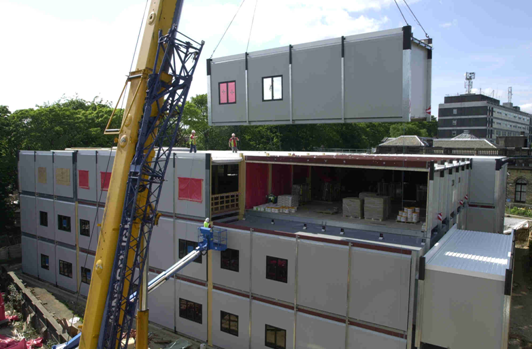
The California Appeals Court concluded that the CGL insurance policy was not limited to risk of damage to third party property. The Court explained that the policy language referred to ‘property damage‘ without any reference to who owned the property. Also there was no impediment to coverage due to the exclusion for "faulty workmanship." There was no indication that the exclusion applied broadly to any damage to the subcontractor's work before project completion.
More specifically, and as a matter of first impression, the Court held that the CGL policy's exclusion for damage to property on which the subcontractor is “performing operations” applied only to damage caused during the subcontractor's physical construction activities. Therefore, this exclusion did not bar coverage for the repair or replacement costs incurred to the units from rain and flooding damage to the units after they were delivered to the site. Although the units were unfinished, because the subcontractor was not working on the units once delivered to the site, the subcontractor was not performing "active physical construction activities." Accordingly the exclusion did not apply.
As for the exclusion of "[t]hat particular part of any property that must be restored, repaired or replaced because ‘your work’ was incorrectly performed on it,” the Court held that "your work" referred only to the specific part of subcontractor's work, not broadly to the general area of the construction site where the subcontractor was working. The Court explained that this exclusion "applies only to the particular component of the insured's work that was incorrectly performed and not to the [subcontractor's] entire project. Here . . .the only arguably defective components or parts of [subcontractor's] work are the plastic tarps, as they failed to keep the water out." Importantly, "there was no allegation the items for which [general contractor] sought repair and replacement costs—the drywall, insulation, framing, and ducting [inside the units]—were defective. [Rather,] those items were acceptable until it rained and they suffered water damage." Accordingly the exclusion did not apply.
The author, Katharine Kohm, is a committee member for The Dispute Resolver. Katharine practices construction law and commercial litigation in Rhode Island and Massachusetts. She is an associate at Pierce Atwood, LLP in Providence, Rhode Island. She may be contacted at 401-490-3407 or kkohm@PierceAtwood.com.
Friday, October 20, 2017
Federal Court Rules Presence of “Orange Saw Horses” During a Site Visit was Sufficient Notice to Contractor that Worksite was Structurally Deficient
The Naval Facilities
Engineering Command (NAVFAC) issued a solicitation (Solicitation) for bids for
a project at the Naval Stations in Newport, Rhode Island (Newport Naval
Station) on May 18, 2009 and later conducted site visits with prospective bidders
in June of 2009. The solicitation
contained bid documents for the demolition of an existing bulkhead (Bulkhead, Wharf)
between two piers, removal of underwater
obstructions, and then the construction of a new bulkhead and parking area to
support ship berthing. Missing from the bid
documents were two reports (Report, Reports) NAVFAC was in possession of, one
from 2005, the other from 2008 which both identified the Bulkhead had deteriorated
to the point that it was structurally deficient and not able to support vehicles. The Report identified that the Bulkhead concrete
deck showed signs of deterioration along with the presence of a sinkhole at the
adjacent shoreline. The Report further
identified that the marine H-piles and concrete encasement has significantly deteriorated
and required replacement because “catastrophic collapse was possible”.
RDA Construction Corp (RDA)
of Canton, Massachusetts attended the site visits but did not submit any RFI’s
to NAVFAC on the condition of the Bulkhead and Wharf, despite its testimony that
is paid special attention to the condition of the H-piles at the site visit. RDA was ultimately awarded the project due to
an extremely low price as compared to other bidders and NAVFAC’s estimate. After asking RDA to confirm its pricing,
NAVFAC executed a contract with RDA on October 13, 2009. On November 18, 2009, NAVFAC furnished the
Reports to RDA in response to RDA’s submitted demolition plan in which it
planned to utilize the Wharf as platform to set excavators and cranes on and then
demolish working outside in from either direction. Eventually after much back and forth on this
and other schedule issues, RDA submitted a certified claim to NAVFAC in the
amount of $1.9 million to reflect the additional costs to change its demolition
means and methods from its bid.
After a contentious
project and other certified claims filed by RDA against NAVFAC, RDA’s contract
was ultimately terminated for default on February 21, 2013 and on April 15,
2015 NAVFAC determined that RDA was responsible for $2.2 million in liquidated
damages. On May 7, 2015, RDA filed a
complaint that alleged, among other counts, NAVFAC breached its duty to
disclose material information regarding the extreme deterioration of the Wharf
that was known by NAVFAC but not disclosed to RDA. RDA further alleged:
1) The
Report concluded the existing Wharf could not support the weight of equipment,
thus affecting work activities and added cost.
2)
NAVFAC
was aware of the Wharf’s deterioration which could only be observed from an
underwater inspection.
3) The
solicitation did not reference the poor condition of the Wharf, H-piles, and Bulkhead.
4) NAVFAC
only advised RDA on the existence of the Report until the contract was
executed.
RDA argued that as a
result of NAVFAC’s failure to disclose the above, it violated the implied duty
to disclose the existence of the Reports and was in material breach of the
contract at the time of its signing in October 2009. Accordingly RDA argues the termination for
default should be converted into a termination for convenience.
NAVFAC responded that it
had no duty to disclose the Reports and the Solicitation did include notice to
inquire about the current condition of the wharf through the inclusion of the
comment that the Wharf, “was likely not in good condition.” Furthermore,
structural deficiencies were identified in the bid documents and should have
been readily identifiable during the pre-bid site visits. Finally, NAVFAC contended that RDA’s means
and methods were inconsistent with the bid document’s direction that the Wharf
was to be completely demolished before work could commence on the Bulkhead.
The Court began its
analysis by presenting the standard for a violation of the implied duty to
disclose “superior knowledge” by the government. An implied duty to disclose is
violated when:
1)
A
contractor undertakes to perform [the contract] without vital knowledge of a
fact that affects performance costs or duration;
2)
The
government was aware the contractor had no knowledge of and had no reason to
obtain such information;
3)
Any
contract specification supplied misled the contractor or did not put it on
notice to inquire; and
4)
The
government failed to provide the relevant information.
Hercules
Inc. v. United States,
24 F.3d 188, 196 (Fed. Cir. 1994)
The Court then found
that NAVFAC had indeed violated both the first and fourth elements of the test
by not furnishing the Report to RDA until a month after the contract had been
executed. The record showed and NAVFAC personnel confirmed that NAVFAC did not
disclose to RDA the Wharf was subject to severe load restrictions until
November 2009. Therefore, the first
element was met when the Court concluded that RDA undertook to perform the
project in October 2009 without “vital knowledge” of the load restrictions
which effected performance costs and duration. The Court found the fourth
element was also satisfied because NAVFAC admitted it did not provide that
knowledge until after the contract was executed.
The Court next examined
the second element of the violation test and presented RDA’s argument that a
bidder could only learn of structural deficiencies of the Wharf through the bid
documents or through a site visit. RDA
contended the bid documents were silent on the extent of the Wharf’s deterioration
and the only means to truly view it during the site visit would be through an
underwater investigation. The Court
rejected RDA’s arguments by pointing to the fact that during the site
investigation, there were “indicia of the Wharf’s limited loading capacity”
through “orange saw horses and concrete barriers lining the perimeter of the
wharf indicating that vehicles could not drive there.” The Court further pointed to the presence of
large sinkholes adjacent to the Bulkheads “suggesting the land around the Wharf
was not stable.” Therefore, despite the
fact that NAVFAC was aware RDA had no knowledge of the Report, the physical
condition of the Wharf during the inspection should have given RDA “reason to
obtain [additional] information” about the structural capacity of the Wharf
through an independent engineer’s report or underwater investigation. Accordingly, the Court found that the second
prong was not satisfied and RDA’s claim failed the test.
Despite the Court’s
finding that the second element of the “superior knowledge test” was not met, thus
rejecting the violation of the duty to disclose, the Court continued its
analysis reviewing the third element. RDA argued that the bid documents
affirmatively misrepresented that the Wharf could be used to support the weight
of cranes and excavators required for demolition because the bidders were
instructed to “locate demolition equipment” throughout the structure so as to
not overload the framing. The Court stated
that even though RDA defined “demolition equipment” to mean cranes and
excavators, the bid documents do not define that term. Instead, the bid documents did contain the
American Society of Safety Engineer's 2006 Safety and Health Program
Requirements for Demolition Operations which stated demolition equipment that
“each structure can withstand should be determined by the contractor.” The Court stated this definition contained
within the bid documents required due diligence by RDA to perform an
engineering analysis before it placed equipment on the wharf and RDA was on
notice to inquire about the structural integrity of the Wharf.
Accordingly, the Court ruled that NAVFAC did not have a
duty to disclose the Reports prior to entering into a contract with RDA and
dismissed the count.
---------------------------------
The author, Brendan Carter, is a contributor to The Dispute
Resolver and a former Student Division Liaison to the Forum on Construction
Law. He is the Director of Industry Advancement & Labor Relations
with the AGC of Massachusetts based in Wellesley, MA. He may be contacted
at 781.786.8916 or carter@agcmass.org.
Monday, October 9, 2017
Thanks to Benjamin J. Morris from the San Diego office of Foley & Lardner LLP for his contribution to the Dispute Resolver:
California Court of Appeal Affirms Finding that Additional Insured Endorsements in Subcontractors’ Policies did not Clearly Exclude Completed Operations Coverage for an Additional Insured (Developer/Contractor) and the Insurer Acted in Bad Faith in Denying Coverage and Defense
Pulte Home Corp. v. American Safety
Indemnity Co., No.
D070478, 2017 WL 3725045 (Cal. Ct. App. Aug. 30, 2017)
The
California Court of Appeal recently issued a broad coverage decision in favor
of a developer/contractor and affirmed punitive damages against the insurance
carrier for its bad faith denial of a defense. The case arose from Pulte’s
development of two residential projects in Southern California beginning in
2003. The homes were sold in 2005-2006. Pulte was named as an additional
insured on certain subcontractors polices issued by American Safety in
2003-2006.
After
residents of the developments filed construction defect suits against Pulte in
2011 and 2013, Pulte tendered the claims to American Safety, which denied
Pulte’s request for a defense based on a position (among others) that the AI
endorsements excluded the subcontractors’ completed operations. Pulte then
filed suit against American Safety. The trial court found that the language of
the AI endorsements on the relevant policies was ambiguous on the potential for
coverage of the alleged claims; therefore, American Safety was required to
provide a defense to Pulte. Pulte was awarded $455,238.45 for defense fees,
costs, and prejudgment interest for the defense of the two underlying
construction defect suits. The trial court also awarded $500,000 in punitive
damages against American Safety finding that its decision to deny coverage was
unreasonable and in bad faith. On appeal, the Pulte court affirmed the trial court’s award of contract damages
and Pulte’s entitlement to punitive damages.[1]
The relevant
subcontractors’ insurance policies all identified the aggregate limit for
“products-completed operations” as $1 million; however, the policies contained
multiple manuscript AI endorsements—that American Safety and Pulte agreed were
substantially similar. The key AI endorsement cited in Pulte granted AI coverage, “but only with respect to liability arising
out of ‘your work’ which is ongoing and which is performed by the Named Insured
for the Additional Insured on or after the effective date of this Endorsement.”[2]
Relying
on Pardee Construction Co. v. Insurance Co. of the West, 77 Cal. App. 4th 1340 (2000),
the Pulte court stated that “the initial issue for policy
interpretation is whether the additional insured endorsements explicitly
exclude coverage for the subcontractors’ completed operations.” After reviewing the relevant
policy language and endorsements and the parties’ arguments, the Pulte court held that the AI endorsement
did not clearly exclude “completed operations” coverage for the AI because
liability for harm caused by the subcontractors “completed operations” could
arise from the work performed after the policy was effective. Moreover, the specific language of the AI
endorsement did not clearly limit the coverage to liabilities which arose while
the subcontractors were performing construction work. American Safety had “failed
to expressly limit covered completed operations as to time or particular
project in their policy and endorsement language.”
Writing
for the panel, Justice Huffman stated that “[b]oth sets of insureds could
reasonably have expected that if the subcontractors had bought completed
operations coverage for the work, it also applied to vicarious liability of the
developer, if property damage problems appeared.” He further noted that“[t]hese
AIEs do not clearly restrict coverage to only ongoing operations, simply by
linking the ongoing operations phrase to the ‘liability arising out of the
work’ clause.” Based on the facts surrounding the preparation of the manuscript
AI endorsements and applicable legal precedent, doubts about whether a duty to
defend existed should have been resolved in favor of Pulte.
After
addressing whether American Safety had a duty to defend, the Pulte court went on to review the trial
court’s finding that the insurer had acted unreasonably and in bad faith when
it denied Pulte coverage for the alleged defects. The court affirmed the trial
court’s decision finding there was substantial evidence that American Safety:
(1) knew the policies were purchased to satisfy contractual requirements
to provide completed operations coverage; (2) had a “pattern and practice
of using every conceivable argument to deny coverage, whether the arguments are
weak or strong, valid of invalid”; (3) routinely issued form letters
denying AI coverage without reasonable case-by-case investigation; (4) denied
coverage despite awareness of prior federal court decisions against its
coverage interpretation; and (5) had continued these practices over a
course of years. Justice Huffman concluded that “[s]uch conduct showed the
company was primarily protecting its own interests in refusing to defend its
additional insureds in construction defect cases.” Based on the above conduct,
the Pulte court approved of Pulte’s entitlement
to a punitive damages award, which would be recalculated on remand using an approximate
one-to-one ratio after the trial court recalculated Pulte’s Brandt fees and costs.
_______________
The
author, Benjamin J. Morris, is a senior counsel in the San Diego office of
Foley & Lardner LLP. His practice focuses on representing owners,
developers, engineers, lenders, contractors, subcontractors, and consultants
throughout all phases of construction projects and construction litigation.
[1]
The amount of punitive
damages was remanded for adjustment following the trial court’s recalculation
of Brandt fees, which were remanded
only as to amount, not entitlement.
[2]
Two other noted versions of the AI endorsements stated that the AI was insured:
(1) “but only with respect to liability arising out of ‘your work’ and
only as respects ongoing operations performed by the Named Insured for the
Additional Insured on or after” the endorsement’s effective date; and (2) “but
only with respect to liability arising out of ‘your work’ which is performed at
the project designated above. This Endorsement applies only to ongoing
operations performed by the Named Insured on or after” the endorsement’s
effective date.
Subscribe to:
Posts (Atom)