Showing posts with label Expert. Show all posts

Thursday, July 21, 2022

TIAs: Does the Timing Matter?

This article is part of The Dispute Resolver’s series “Consultant Corner.” We invite ABA Forum on Construction Law member consultants to submit articles on topics important to the Litigation & Dispute Resolution Division (D1).

Construction scheduling specifications regularly include provisions for dealing with time extension requests, often referencing use of a Time Impact Analysis (TIA) methodology. According to guidance provided by an industry recommended practice, AACE International Recommended Practice No. 29R-03, a TIA is a modeled technique used for proving entitlement for time extensions. While TIAs are well known in our industry and commonly used, the scheduling specifications sometimes fail to prescribe the timing of when a TIA must be submitted. This lack of information can further exacerbate a time extension dispute between the owner and contractor.

TIAs can be employed either prospectively (real time, before or at the same time as a delay event) or retrospectively (after the delay event has occurred). These two different applications of TIAs are not equally useful to the owner in evaluating delay entitlement. Nor do they present a contractor with the same opportunity to receive early relief (and potentially compensation) from excusable project delays. Because the timing of the TIA can lead to different outcomes, it is important to understand the differences in employing a prospective or retrospective analysis to allow parties to make better decisions when project delays are encountered.

We will review two case examples (below) to show some of the differences between a prospective and retrospective TIA analysis. To aid in understanding these examples, it is helpful to have the following working knowledge of the TIA methodology. A TIA creates a new set of activities to detail the added or changed work being evaluated. These new activities are inserted into the contemporaneous CPM schedule, creating an 'impacted' schedule. After this impacted schedule is re-calculated, using the schedule software, the completion date of the impacted schedule is compared to the unimpacted schedule. If the impacted completion date is later than the unimpacted schedule, a time extension for the increased time may be warranted. If the impacted completion date remains the same as the unimpacted schedule, then the changed or added work being evaluated can be performed within the original contract time and no time extension is warranted. This is a very simplified explanation of TIAs to aid the reader’s understanding of the two case examples that follow. The evaluation of real-world TIAs often deals with more complex situations and schedule models that complicate decision making about warranted time extensions.

Case Study 1:

The first case study presents a prospective TIA analysis for a bridge project. During pile installation the contractor encountered two differing site conditions. Figure 1 shows the bridge project’s contemporaneous CPM schedule update immediately prior to encountering the differing site conditions (“impact events”). At that time, the project was 29 days late (reference Activity ID A1130 with -29 days of total float).


Figure 1 – Bridge project schedule before impacts

The contractor submitted its TIA analysis to request a time extension after discovering the differing site condition issues. In its TIA analysis (Figure 2), the contractor inserted activities (TIA001 and TIA002) representing each differing site condition impact event into the Figure 1 schedule. The contractor also re-sequenced its remaining contract work activities and rescheduled the project. [Note: Rescheduling the project means using the schedule software to re-calculate the schedule, including the inserted impact activities, to determine the revised activity dates and project completion date.


Figure 2 – Bridge project TIA schedule with inserted delay activities

The Figure 2 impacted schedule shows that the project completion activity (A1130) is now forecast to be 115-days late. This is 86 days later than the unimpacted schedule (115 days less 29 days). The contractor’s prospective TIA analysis demonstrated that the differing site conditions impacted the project’s critical path and extended project completion by 86 days. And, because its narrative included a thorough explanation of the contractor’s re-sequencing and mitigation efforts, the contractor was able to successfully negotiate an appropriate time extension before starting the remedial work.

Case Study 2:

The second case study presents a contractor’s retrospective TIA analysis for a luxury condominium project.  This project experienced delay impacts due to the owner’s design changes and added city holidays. In the months after the impacts, the contractor submitted 5 separate TIAs, requesting a total of 43 days of time extension.  In the owner’s review of the TIAs, it was determined that the contractor did not accurately represent the work performed on the project in its TIA submissions. Further, three of the five separately submitted TIAs had overlapping time periods. In response to the owner’s initial review, the contractor revised its TIA submissions and reduced its time extension request to 27 days.

Figure 3 shows the project’s contemporaneous CPM schedule update at the time the design changes occurred. The project was 2 days early (reference Activity ID A1150 showing 2 days of float) just prior to the impact events.


Figure 3 – Condo project schedule before impacts

Once the design change impacts occurred, the contractor chose to hold off submitting a TIA analysis until late in the project, rather than promptly submitting it. In its retrospective TIA analysis, the contractor inserted schedule impact activities shown in Figure 3 for each design change and new city holiday. Figure 4 shows the contractor’s recalculated TIA schedule, including these impacts and holiday changes.
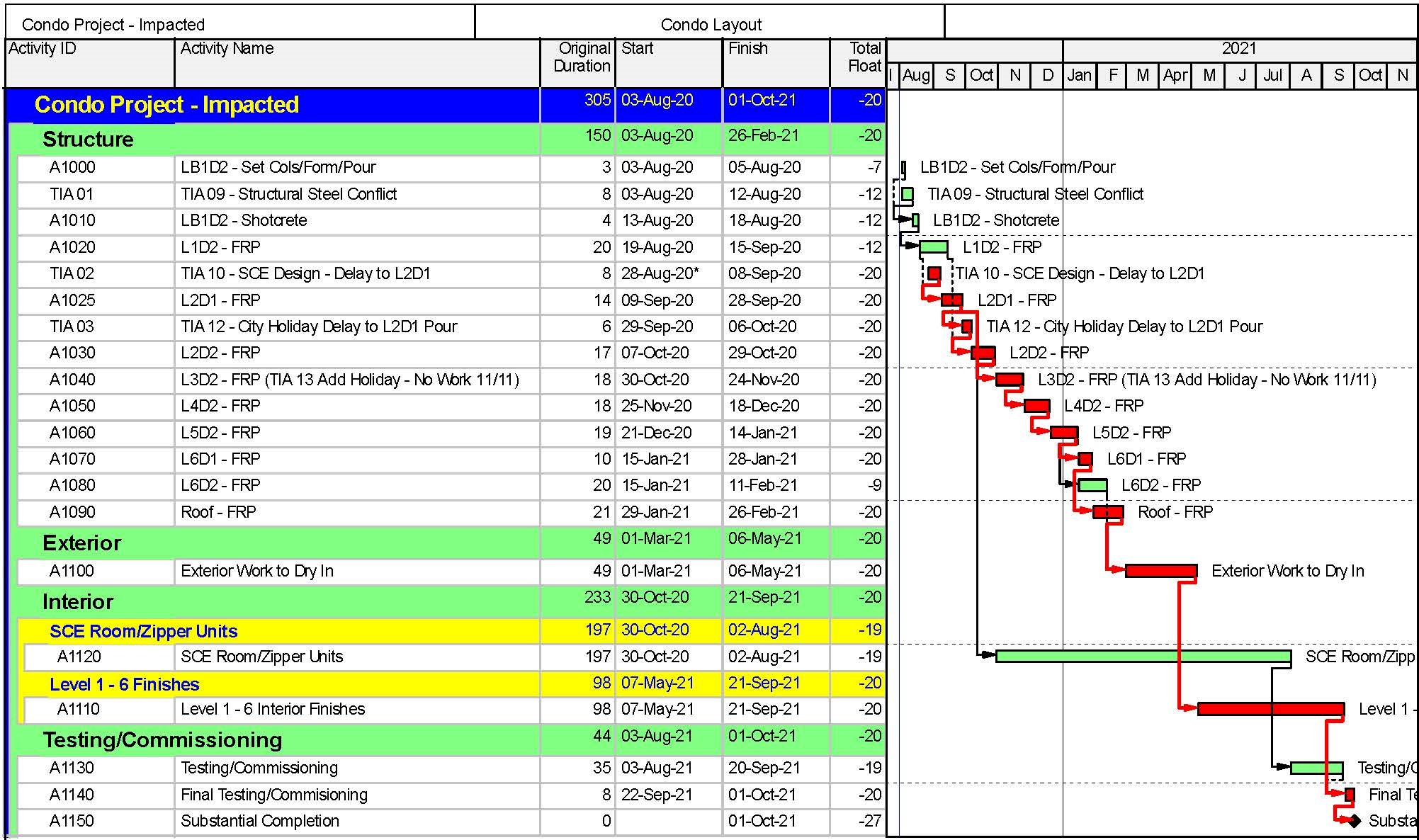


Figure 4 – Condo Project TIA schedule with inserted delay activities

In its time extension request, the contractor submitted the impacted schedule in Figure 4 showing the updated project completion forecast as 27 days late. In its TIA review, the owner evaluated the accuracy of the contractor’s impacted TIA schedule (Figure 4) by updating the submitted schedule with as-built dates and recalculating the schedule. Figure 5 shows the results of the owner’s analysis of the impacted schedule with as-built dates.


Figure 5 - Condo Project TIA schedule updated with as-built dates

Figure 5 shows that once the submitted TIA schedule was updated with as-built dates, project completion was actually forecast to be 5 days late, not 27. In this example, the contractor only received 5 days of time extension of the 27 requested days. Because the contractor’s TIAs were submitted after the delay events, the contractor and owner had the benefit of hindsight, so the use of as-built dates was both possible and appropriate. The contractor did not consider extended durations of other contract work or mitigation efforts it was able to achieve as part of its TIA analysis. The retrospective TIA analysis in this case example required that the contractor evaluate more aspects of the project work than in the prospective analysis in Case Study 1. 

What is the Takeaway?

While the cases presented in this blog post were simplified, the discussions offer appropriate conclusions in comparing TIA retrospective analysis with prospective analysis. A TIA that is done prospectively has the benefit of being simpler. Impact activities are typically inserted into update schedules already accepted by the owner. A prospective analysis is a forecast. It represents the contractor’s best estimate at that time as to impacts on the affected work, while assuming other downstream activities happen as planned. Performing retrospective TIA analyses often require more evaluation by the contractor of other project conditions and delays. The benefit of hindsight can cut both ways being a positive or a negative in these situations, depending on the specifics of a project. 

When creating or reviewing contracts, counsel should always carefully review the TIA clauses. Consider the timing of when TIAs need to be submitted relative to the triggering events. Paying attention to this seemingly small detail at the start of the project can help owners and contractors eliminate unnecessary aggravation in addressing time extension issues during a project. It may also save both parties time and money in negotiating time extensions by eliminating unnecessary timeliness disputes associated with the TIA analysis. 

If you are interested in learning more about TIAs, please reach out to the below authors of this blog post or visit www.hka.com

Kandace Zimmerman, PSP, Director at HKA (kandacezimmerman@hka.com): Kandace is a construction consultant in Seattle, Washington where she has been providing claims consulting, dispute resolution and advisory services to owners, general contractors, and subcontractors for nearly two decades. Her expertise lies in delay analysis, analysis of labor productivity, and quantification of damages on large, complex construction projects.

Julia Villalobos, PE, Associate Director at HKA (juliavillalobos@hka.com): Julia has over 10 years of experience in construction, project controls, and claims. She provides claims consulting and project advisory services for challenges related to schedule, damages, productivity, standard of care, and technical issues on construction projects of all sizes.

This material is intended for general educational purposes only, and should not be relied upon for any other purpose.  The opinions expressed are those of the authors alone and should not be attributed to HKA Global, Inc. or any of its employees.

Sunday, June 26, 2022

Consultant Corner: Rethinking the Role of Technical Experts in Pre-litigation Dispute Resolution

Welcome to the launch of The Dispute Resolver’s new series “Consultant Corner.” We invite article submissions from ABA Forum member consultants on topics important to the Litigation & Dispute Resolution Division (D1). In this article, the authors explore the role of technical experts in early dispute resolution. A combination of earlier engagement and more technical involvement could potentially help the dispute resolution process be more effective.


Construction disputes do not always require an expert; however, an expert is typically sought if the dispute involves particularly technical or complex issues that a lay person (including counsel and triers of fact) cannot readily understand. When is the most appropriate time to call upon a technical expert in a construction dispute? Most will turn to technical experts only after the dispute has advanced to the point where damages are high and litigation or a more formal ADR process is the likely path to resolution. Many also believe that a technical expert is required mainly for testimony in court, and therefore, late appointment of an expert shortly before trial is the most economical decision, but in many cases this may not be true. It is becoming more and more common for attorneys to retain an expert early, and the pre-litigation phase is arguably the best time to do so.

Pre-litigation Phase

During a pre-litigation or claim preparation phase, a technical expert typically serves as a “consulting expert” for one of the parties in the dispute, someone who can help evaluate any technical issues in dispute and opine on the relative strengths and weaknesses of proposed claims or positions. Another way an expert may be involved is to serve as an “independent evaluator” or a member of a “dispute review board,” jointly appointed by the involved parties, to advise on the merits of each party’s position based on the position papers and supporting information provided by the parties. Regardless of the role the expert may take and by which party the expert is retained, this process usually kicks off “after the fact” that is, when the dispute has led to large damages and/or delays. In many cases, it may already be too late for the expert to show value because the parties may already have experienced a significant economic loss, both parties may share significant fault in the escalation, and neither party is likely to clearly prevail in a settlement or litigation.

Rather than wait until this point in the dispute, we have seen the dispute resolution process be more effective when parties like owners, construction managers, design-build entities, and others retain experts earlier, even before a claim is fully formulated and a formal dispute resolution process has begun. Ideally, this kicks off when the dispute is just starting to rear its head as a disagreement, damages may not be fully formed or realized just yet, and the sides may not yet be entrenched in their positions. In this situation, the technical expert serves as a neutral third party who can weigh in on the cause of a problem and help to mitigate or resolve it (such as by performing independent design peer-review and developing a remediation plan to address the identified problems) before it escalates into a full-blown dispute in need of trial, arbitration, or formal mediation.

In this role, the expert serves as a neutral fact finder, as well as a source of technical insight. The expert plays the role of an independent evaluator or a dispute review board member by hearing each side and weighing the merits of each position, but at the same time, gets more involved in the technical nuts and bolts like a consulting expert to get to the bottom of the cause. And ideally, rather than just stop at finding the cause of the problem, the expert becomes part of the solution by proposing ways to get things under control, and potentially avoid similar problems from arising during the remainder of the project. The use of an expert in this setting has the potential to be highly cost-effective because one of the objectives is to prevent escalation of the damages that initiated the dispute in the first place. If damages are low to begin with, and stay below reasonable cost contingency levels, there may be little sense in pursuing costly recovery. A skilled and amiable expert, combined with a measured facilitator (perhaps inside or outside counsel for the owner or construction manager), can also encourage all sides to engage in solving the problem collaboratively, which can further expedite the resolution and help heal the bruises of any initial finger pointing. It can turn what might have been a failure into a success story and a triumph of teamwork.

Case Study

As an example of this sort of early expert involvement, the author was engaged by a construction manager at risk to help resolve a pair of disagreements between the project structural engineer and steel subcontractor, both of which threatened increasingly large repair costs and delays. One dispute involved widespread, seemingly random weld cracking throughout the project, for which each side blamed the other, with proposed or attempted repairs (most failing) often reflecting this finger-pointing. The other dispute involved steel assemblies that were surveyed to be out of level after installation, alternately being blamed on improper design and improper fabrication. The author was given an opportunity to review relevant documents, tour the site, speak to both parties, and perform some analysis. The author was able to discover a pattern in the seemingly random weld cracking that allowed the engineer and fabricator to focus their attention and develop alternative weld procedures and details to repair existing cracks and prevent future cracks. They also performed an analysis and facilitated load testing and surveying of the questionable assemblies to show that the appearance of out-of-level assembly was a result of benign construction tolerance issues, avoiding the need for costly replacement or retrofit. The final result was cooperation between the engineer and steel subcontractor, a halt to the escalating repair costs and delays, and a much less painful process in the long run for all sides.

Food For Thought

Before implementing this strategy, there are several questions that the involved parties and their counsel might consider:

  • How should parties that propose this type of dispute resolution broach the subject to their at-odds colleagues?
  • Like the engagement of an independent evaluator or dispute review board, can this type of process be written into contracts or teaming agreements?
  • Should everyone involved have a say in selecting the technical expert, or a right to veto the proposed expert?
  • What agreements need to be in place to encourage open and honest cooperation in the resolution process while protecting the rights of each party should litigation occur down the road? Is the potential for reducing the damage of the dispute enough encouragement for the parties to participate openly?
  • What happens if the involved parties do not cooperate or willingly provide necessary information to the jointly appointed technical expert?
  • If negotiation is unsuccessful and the claim proceeds to subsequent proceedings, such as litigation, what role might the technical expert be able to take? Might they hold any liability?

Conclusion

Regardless of the potential challenges, this kind of early expert engagement has the potential to facilitate dispute resolution and is worth exploring further by consultants and attorneys, as it aims to help all involved parties toward a positive outcome and to minimize costs before they become excessive. For us experts who are also practicing designers, this is also an opportunity to take lessons learned and apply them to future projects, preventing future disputes and bringing a type of deep satisfaction that our more traditional expert engagements cannot quite match.

Authors Thanh Do, Ph.D., P.E. and David Ojala, S.E., P.E., LEED AP, CWI are structural engineers at Thornton Tomasetti specializing in structural failure investigations and standard of care assessments. They assist attorneys, general contractors, design professionals, and owners at various phases of construction dispute resolution. In addition, both are active structural designers, with a focus on performance-based seismic design, existing building retrofit, and risk consulting.

Wednesday, January 24, 2018

Midwinter Meeting - D1 Breakfast Program - Getting it Right Early: Expert Retention Best Practices

It's no secret that construction disputes frequently involve one or more expert witnesses on each side. Our Division 1 panel -- Joshua B. Levy of Husch Blackwell LLP and Bill Manginelli and Mary Jay Torres-Martin both from Trauner Consulting Services, Inc. -- offered some best practices for those expert engagements starting at the initial meeting through the expert's trial testimony.

Joshua Levy and Bill Manginelli

Using a creative presentation approach (and apropos for the upcoming 2018 Winter Olympics), Joshua, Bill, and Mary Jay set the scene for a dispute between Olympic Mechanical and Bobsled Contractors over the mechanical subcontractor's claimed costs for extra work and delay.  Joshua served as counsel for the defendant Bobsled Contractors and Bill was Bobsled's expert.  Over the course of three acts marshaled by Mary Jay, Joshua and Bill held mock meetings to discuss the claims, exchange of documentation, initial opinions, written reports, and preparation for depositions and trial. The pair offered important and practical reminders to ensure the expert testimony will meet the requirements of the rules of evidence and civil procedure.  As a coda to the presentation, Eric J. Meier also from Husch Blackwell LLP, played the opposing expert for Olympic and faced stiff cross-examination from Joshua.  This mock cross-examination illustrated the worst case scenario if best (or even good) practices for preparing experts are not followed.