Showing posts with label commercial general liability. Show all posts

Saturday, December 23, 2017

Suit Up: Fla. Supreme Court Holds Statutory Defect Notice is a "Suit" Under CGL Policy

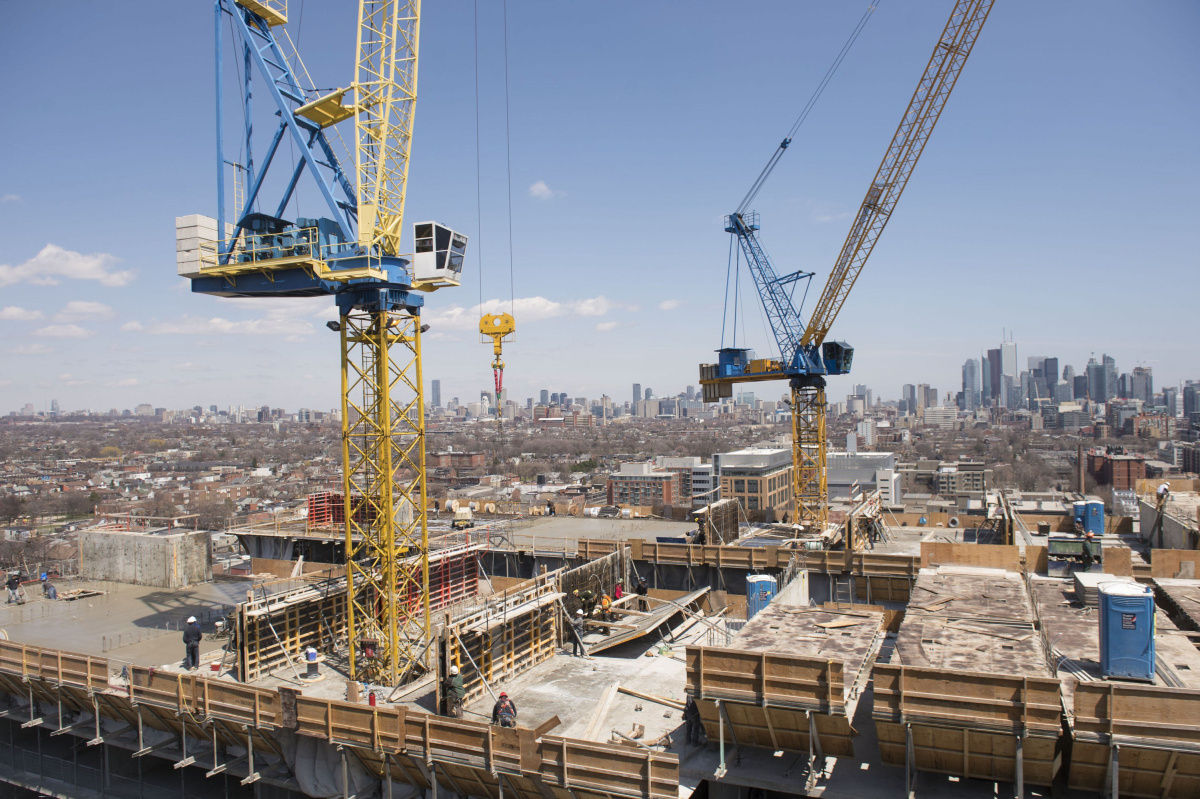
https://www.getrefm.com/wp-content/uploads/2015/03/condo_construction.jpg
Recently, the 11th Circuit was presented with an appeal concerning a commercial general liability ("CGL") insurer's duty to defend a general contractor.  At issue was whether statutory-required notice from an owner to the general was a "suit" under the policy triggering the defense duty.

The 11th posed this certified question to the Florida Supreme Court:
Is the notice and repair process set forth in chapter 558, Florida Statutes, a “suit” within the meaning of the commercial general liability policy?
The Court, in Altman Contractors, Inc. v. Crum & Forster Specialty Ins. Co., No. SC16-1420, 2017 WL 6379535, at *1 (Fla. Dec. 14, 2017), answered yes, Chapter 558 defect notice is a suit for purposes of CGL coverage. As such there insurer had a duty to defend. The holding has potential implications for insurers in other states that subscribe to similar defect notice schemes or rights to repair. See, e.g., Cal. Civ. Code §§ 895 et seq.; Colo. Rev. Stat. § 13-20-801 et seq.; Tex. Prop. Code. Ann. §§ 27.001 et seq. There are upwards of 30 states nationwide.

First of all, what is Fla. Stat. chapter 558?  In Florida, before suit can be commenced by any owner claiming that a construction defect exists, the owner must follow a certain notice and response procedure. Basically the owner must give notice to the contractor or design professional of the alleged defect.  Then those receiving notice provide notice to any lower-tier subcontractors that may have responsibility for the defect in question and all recipients can respond to the owner.  If the owner does not receive adequate responses, it then can file suit.  The legislative findings specifically identified this process as an "alternative dispute resolution mechanism" such that the inspections involved and any findings or settlement offers made as a result of the inspections become inadmissible if there are future proceedings.

Under the CGL policy, the insurer has the "right and duty to defend the insured against any 'suit' seeking those damages [of personal or property damage]." The definition of a "suit" is a "civil proceeding in which damages . . . to which this insurance applies are alleged." It also includes "an arbitration proceeding . . . to which the insured must submit or does submit with our consent" or "any other alternative dispute resolution proceeding . . . to which the insured submits with our consent."

Therefore, the question was whether Fla. Stat. ch. 558 notice is a "suit."  The Court analogized the notice to "other alternative dispute resolution proceeding" (especially given the legislative history) and confirmed it was indeed a suit.  The issue of insurer "consent" was a hurdle that the Court did not need to cross in the decision.  The Court observed that "whether [the insurer] consented to [the general contractor's] participation in the chapter 558 process . . . is outside the scope of the certified question and an issue of fact disputed by the parties."

---------------------------------------
The author, Katharine Kohm, Esq. is a committee member for The Dispute Resolver.  She is an associate at Pierce Atwood, LLP in Providence, Rhode Island.  Katharine thanks Anthony Lehman, Esq. of Hudson Parrott Walker in Atlanta, Georgia for his input on this post.

Monday, October 23, 2017

In a matter of first impression, California Court declares subcontractor's CGL coverage includes subcontractor's work & delay to general contractor

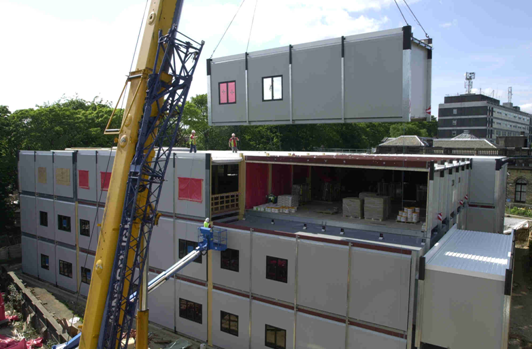
https://www.steelconstruction.info/Modular_construction
In Glob. Modular, Inc. v. Kadena Pac., Inc., 222 Cal. Rptr. 3d 819 (Cal. Ct. App. 2017) the underlying dispute concerned construction of 53 roof-less modular units for a rehabilitation center.  The Plaintiff-subcontractor constructed the units and another contractor planned to install the roofs. The subcontractor sued for non-payment and the general contractor counterclaimed that the units were defective. After a partial settlement, the remaining issue was whether the subcontractor's commercial general liability (CGL) insurer must cover the general contractor's claim for water damage to the tarp-covered, but roof-less units caused by heavy rains or if exclusions barred recovery.

The California Appeals Court concluded that the CGL insurance policy was not limited to risk of damage to third party property. The Court explained that the policy language referred to ‘property damage‘ without any reference to who owned the property.  Also there was no impediment to coverage due to the exclusion for "faulty workmanship." There was no indication that the exclusion applied broadly to any damage to the subcontractor's work before project completion.

More specifically, and as a matter of first impression, the Court held that the CGL policy's exclusion for damage to property on which the subcontractor is “performing operations” applied only to damage caused during the subcontractor's physical construction activities. Therefore, this exclusion did not bar coverage for the repair or replacement costs incurred to the units from rain and flooding damage to the units after they were delivered to the site.  Although the units were unfinished, because the subcontractor was not working on the units once delivered to the site, the subcontractor was not performing "active physical construction activities." Accordingly the exclusion did not apply.

As for the exclusion of "[t]hat particular part of any property that must be restored, repaired or replaced because ‘your work’ was incorrectly performed on it,” the Court held that "your work" referred only to the specific part of subcontractor's work, not broadly to the general area of the construction site where the subcontractor was working. The Court explained that this exclusion "applies only to the particular component of the insured's work that was incorrectly performed and not to the [subcontractor's] entire project. Here . . .the only arguably defective components or parts of [subcontractor's] work are the plastic tarps, as they failed to keep the water out." Importantly, "there was no allegation the items for which [general contractor] sought repair and replacement costs—the drywall, insulation, framing, and ducting [inside the units]—were defective.  [Rather,] those items were acceptable until it rained and they suffered water damage."  Accordingly the exclusion did not apply.

In addition, the Court determined that delay damages for the 131 days the general contractor spent remediating the water damage did constitute “property damage” within meaning of insuring clause of CGL policy.  The Court explained that the remediation was extra time that general contractor spent. And had the units not been damaged, the general contractor would not have needed to spend that time and instead could have been working to finish the project.  The delay therefore constituted a consequential loss and was deemed part of the damages insurer must pay “because of” the property damage.

---------------------------------------
The author, Katharine Kohm, is a committee member for The Dispute Resolver. Katharine practices construction law and commercial litigation in Rhode Island and Massachusetts. She is an associate at Pierce Atwood, LLP in Providence, Rhode Island. She may be contacted at 401-490-3407 or kkohm@PierceAtwood.com.