Thursday, October 20, 2022

View from the Field Part 5 – Field Labor Disruption - Effective Project Management & Strategies

The Series – View from the Field

View from the Field is a series of blog posts providing a practitioner’s view of the management processes and challenges associated with construction megaprojects as well as large and complex projects. Addressed by both Edward W. Merrow of Independent Project Analysis, Inc. (IPA) and construction lawyer Andy Ness at a recent ABA Forum on Construction Law conference, their high-level perspectives are elaborated herein. This multi-part series has and will expand upon some practical aspects of the many challenges facing managers as well as highlight suggestions for implementation by inside or outside counsel.

Summary – Forensic Labor Productivity Management and Disruption

Purpose – The importance / value of this post:

  • Protect Clients / Direct Hire Contractors from compensable losses due to overruns in Field Labor Direct Labor Hours.

  • Protect Clients / Owners (reimbursable cost contracts) from improper charges for unproductive Field Labor Direct Labor Hours by the direct hire party.

  • Enhance probability of success and amount of damage recovery in dispute resolution processes.

Disruption

By the terminology Forensic Labor Productivity Management, I refer to productivity issues / losses or disruption that occur during changed work or that has occurred in a completed project.

Field Labor Disruption – the other “D” (Delay)

It is crucial to differentiate between delay and disruption.  While the two may exist concurrently or on the same project, either (delay or disruption) can occur or be present without the presence of the other.  Further, either (delay or disruption) can be recovered (through dispute resolution process) without reliance on the other being recovered or recoverable.

This has several important implications.  In dispute resolution process, a two (or more) paths forward to recovery of damages enhance the probability of recovery.  Potentially, Disruption and Delay are two separate paths.  Recovery of damages from one (delay or disruption) does not necessarily rely on entitlement or recovery of damages from the other.  Further, since the two derive damages from different cost pools or cost accounts, the potential recovery is increased.

The following table differentiates between the Disruption and Delay at a relatively high level:

Parameter

Disruption

Delay

Stakeholders

Owners, Construction Managers, General Contractors, Non-Direct Hire Contracors, Direct Hire Contractors

Owners, Construction Managers, General Contractors, Subcontractors, Vendors

Contract Provisions*

Assumptions about construction contracts – contractor entitled to economical operations, Implied Duty to Cooperate, contractor acts reasonably in planning**

Time, Schedule Specifications, Changes, others

Fact Set

Factors that impact the field labor productivity baseline (planned or experienced during project execution)

Facts that impact variances from the As-Planned schedule

Cause

Derived from Fact Set

Derived from Fact Set

Effect

Variances resulting from the “Causes”

Variances resulting from the “Causes”

Entitlement

Derived from Contract provisions and Fact Set / Cause

Derived from Contract provisions and Fact Set / Cause

Analytical Methodologies

Lost Labor Productivity – measured mile, for example

Forensic Schedule Analysis – typically Critical Path Analysis

Impacts

Labor Direct Work Hours exceed baseline without increased productivity / production / output

Project Completion later than originally planned date

Damages / Cost Pool

Direct Costs – labor and equipment

Indirect Costs – site and home office

Many Others

See References

See References

*M&M is a consulting firm.  We are not attorneys.  These are practitioner views.

Changes and Variances – this is basic project “blocking and tackling.”

The presence and need for changed work provisions within larger projects is a necessary managerial and contract administration tool.  Scope of Work, external conditions, other factors depart from the contract baseline.  Equitably adjusting the contract for variances makes the stakeholders whole.  Regarding disruption, the party(ies) taking the risk of labor Direct Work Hour quantities must be compensated for change-related variances.  This includes one-off impacts such as cumulative impact.

Pricing changed work will use contemporaneous project productivity from the Field Labor Productivity curve (see below).  This ensures full compensation for changed work.

Change Order releases must be skillfully implemented.  Specificity and completeness are key.  For example, if productivity impacts and costs are to be resolved by the change, it is essential that the intent is clear and that the releases are consistent with the intent.  If cumulative impacts are not resolved (generally, cumulative impact cannot be resolved until project completion), make sure that the release is clear in this regard.

Process

Productivity Key Performance Indicators (KPI)

During the execution of the work, contemporaneous Productivity Ratio (PR) should be calculated, graphed and reported (in Monthly Progress Report – MPR).  This Field Labor Productivity graph serves to detect variances over time, compile the data, report results (Cumulative and Incremental – 3-week moving average).

Time Periods 1, 2 and 3 indicate (possibly) differing cause(s) of reduced Field Labor Productivity.  Hence, the fact set / evidence for each Time Period must be established / compiled.  An effective compilation tool is shown below:

Contract Types and Stakeholder Considerations

In his ABA Forum on Construction Law presentation, Mr. Merrow, IPA presented the following regarding Contract Types and Outcomes:

Focusing on disruption, in any of the Contracting Approaches:

  • Fixed Price – generally the direct hire contractor is at risk for labor overruns due to disruption.

  • Reimbursable Cost – generally the owner is at risk for labor overruns due to disruption.

The at-risk / aggrieved party must have a mechanism for recovering damages that are caused by others.  This is particularly true in the Reimbursable Cost Contracting Approach.  Hence, contract provisions must be fashioned such that the risk profile has processes for recovering damages.  This is particularly tricky when the risk is Field Labor Disruption.

Single Source of Truth (SSOT) 

The data management associated with field labor productivity is a key consideration.  A major limitation on both the recognition and recovery potential of disruption damages is the lack of data.  More specifically, the data needs to establish output or progress per Direct Work Hour.

Define the productivity-related data in the Project Execution Plan. Gather the data on a contemporaneous basis (needed regardless), and control access to the editing or changing of this data. This ensures availability if claims for additional compensation for productivity-related losses become desirable.

Analytical Methodology
Analytical methodologies, along with order of preference, are thoroughly discussed in AACE International Recommended Practice No. 25R-03, ESTIMATING LOST LABOR PRODUCTIVITY IN CONSTRUCTION CLAIMS.

Damage Calculation Options and Methods

Guidance regarding damages in general may be found in ABA Forum on the Construction Industry CONSTRUCTION DAMAGES AND REMEDIES, 2nd edition.  Another useful reference is ASCE Identifying, Quantifying, and Proving Loss of Productivity; ANSI/ASCE/Cl 71-21.

Reconciliation to Actual As-Built Conditions

Delay – When performing schedule analyses, the analyst typically reconciles from the schedule baseline (As-Planned) to As-Built schedule.

Disruption – When performing disruption analyses, the analyst should reconcile to Actual Direct Work Hours.  Payroll data is a typical source.  The reconciliation can be displayed graphically using a pie chart where the entire pie represents Actual Direct Work Hours.  Slices of the pie are groupings of key allocations such as: As-Planned, Issue #1 DWH’s, Issue #2 DWH’s, Contractor Responsible or Unallocated.

References

Useful references are available through: CII, AACE, ASCE, MCAA, NECA, USACE, SCL, BRT, Ibbs, Bramble & Callahan, Wickwire, Dale & D’Onofrio, ABA, Schwartzkopf and others.

Conclusions (Part 5)

Forensic Direct Labor Productivity management focused on field labor productivity can have many business and dispute resolution considerations: 

  • Using proper Key Performance Indicators (KPI’s) during project execution can achieve timely recognition of field labor productivity issues as well as facilitate contemporaneous gathering of data and documentation to support a potential change order request or claim (see prior post – Part 4 for suggestions).

  • Incorporating a disruption claim into a dispute resolution package can enhance probability of a successful outcome.

  • Costs of dispute resolution process can be mitigated by spreading the elements over the elements of the claim / complaint.

  • For the direct hire contractor, disruption recovery becomes a potential Competitive Edge.

  • For the owner (cost reimbursable type contracts), disruption recovery becomes a potential leverage or claim relative to the managing entity.

View from the Field – Scope of Work Management (Part 6)

Having discussed Retrospective Labor Productivity Management, Part 6 of this series will address managing the scope basis / baseline including changes thereto.

Author George T. McLaughlin PMP CCM has worked worldwide in this industrial marketplace since the early 1980’s. He serves Owners, Prime Contractors, and Subcontractors. For the most part, Mr. McLaughlin’s work is performed on-location where the relevant work is being performed hence the title “View from the Field.” Mr. McLaughlin is a testifying expert, speaker and author.  Mr. McLaughlin is a principal of McLaughlin & McLaughlin out of Austin, Texas.

Wednesday, September 21, 2022

Meet D1’s Neutrals Series: ROBBIE MACPHERSON


Company:
 Cokinos | Young
Location: Manasquan, New Jersey
Email: rmacpherson@Cokinoslaw.com 
Webpagehttps://www.cokinoslaw.com/attorney/robert-j-macpherson/
Law School: Seton Hall Law J.D. 1980
Types of ADR services offered: Arbitration, Mediation, DRB and custom designed processes
Affiliated ADR Organizations: AAA
Areas served: Primarily New York and New Jersey but will travel


Q: Describe the path you took to becoming an ADR neutral.

A: My first major matter was acting as second chair at an arbitration in 1981. I began to arbitrate cases in 1985 and mediate cases in 1990.

Q: What percentage of your current legal practice is spent on ADR work?

A: I spend 30-40% of my time doing neutral work and the balance as a construction lawyer representing clients in transactions and disputes.

Q: Describe your background and experience mediating and arbitrating construction cases.

A: I have been mediating construction cases since 1990. Matters range from multi-family defects cases to industrial, power plant, and heavy civil public and private projects. I have 35+ years’ experience as a construction arbitrator in a wide range of cases as a single panel member, member of a panel, and panel Chair.

Q: Mediators are oftentimes described as “facilitative,” “evaluative,” or “transformative.” Do you have a style?

A: Evaluative and facilitative as required.

Q: Do you have any practices that you find make you particularly effective as a mediator?

A: I believe I am a good listener, understand the mediation process and honestly believe any dispute can be settled.

Q: What are your thoughts on requiring mediation as a contractual prerequisite to litigation or arbitration?

A: To the extent such a provision gets a reluctant party to at least talk to the mediator they help. However, if the mediator gets the impression a party just wants to “check the box” saying they complied, the mediator should let the other party know as soon as possible.

Q: What can attorneys do to best position their clients for a successful mediation outcome?

A: Helping the client understand mediation is all about compromise, not winning.

Q: Are virtual mediations as effective as in-person mediations?

A: While in person mediations are the best practice, virtual does work. Many cases were successfully mediated in virtual proceedings during the COVID pandemic. When in-person sessions are not possible use of a virtual platform should be considered. I also recommend the consideration of a mix of in-person and virtual sessions.

Q: What techniques and strategies do you use to help parties overcome impasse?

A: I’ve used reality testing, playing devil’s advocate, bracketing, providing an advisory opinions on discrete issues, and baseball arbitration. There is also just old-fashioned listening and answering questions about why a settlement is the best alternative.

Q: What ingredients are required for a successful mediation?

A: Mediation should be a conversation between individuals committed to resolving the dispute, who have knowledge of the issue in dispute, the authority to resolve those issues, and access to the necessary expertise regarding technical issues. This is known as the late John P. Madden’s CAKE Recipe for Mediation.

Q: What advice do you have for parties when considering whether to choose a single arbitrator or a panel?

A: A single, experienced arbitrator should suffice for all but the most complex cases. An alternative to a three-member panel is a two-member panel, with one member designated as the tie breaker in the event of the two cannot reach a consensus, which most arbitrators will tell you is a very rare occurrence. The identity of the tie breaker is not known to the two members until they advise the parties, they have reached an impasse. This is known as “The Bastianelli Solution.”

Q: Do you think limits should be placed on discovery in the arbitration context?

A: Yes. I think limits should be placed on discovery in both arbitration and litigation. Discovery is an expensive process that does not necessarily deliver value commensurate to the cost. The only way to ensure arbitration will be less costly and more efficient to litigation is if we treat it as arbitration, not litigation, and make sure the attorneys involved know the difference.

Q: What role should traditional rules of evidence play in the arbitration hearing?

A: Other than privilege, the traditional rules of evidence expressly do not apply under most arbitration rules. Of course, there may be the rare exception, but understand they are rare, and you must make a very compelling case to apply the rules of evidence.

Q: In what way do you use technology in the arbitration process?

A: I encourage the use of technology to make the presentation of evidence effective and efficient. For example, using a virtual platform makes sense to present the testimony of a witness who will only be on the stand for a few hours, but who most travel a full day to appear in person.

Q: Do you have any words of wisdom for parties who are contemplating exercising a contractual right to appeal an arbitration award?

A: Yes… be careful what you ask for. Someone is going to lose. Never make the decision to appeal without also considering the possibility of a cross appeal.

Q: What are some of your interests or hobbies outside of your ADR Neutral practice?

A: Rock-n-roll; current events; biographies and history.

Wednesday, September 14, 2022

VIDEO IS AVAILABLE -- Extreme Winds on Built Environment and Recent Changes in Building Codes

Here is the link to Division 1's Extreme Winds program from September 8, 2022.  


To learn more about this topic, please contact Mike Lane (mike@lanelaw.co) or Can Simsir (csimsir@walkerconsultants.com).  

To learn more about planning virtual or in-person programs with Division 1 (Litigation & Dispute Resolution), please contact Tom Dunn, Chair of Division 1 at rtdunn@PierceAtwood.com.  

Tuesday, September 13, 2022

What's Up at Division 1 (No. 17) -- SEE YOU IN MEMPHIS!

The Forum is going to Memphis, TN (for the first time I think) from September 28-30th.  Register here for the meeting and practicum.  If you cannot make it in person, you can sign-up for the virtual program to receive the great CLE.  

Division 1 is holding its annual planning retreat on September 28th at 9am.  Please email me (Tom Dunn, rtdunn@PierceAtwood.com) to learn of the room name/location and/or receive the Teams invite to participate remotely.   Come and bring your ideas to plan out the 2022/2023 Bar Year which started at the beginning of September.  We will have some new Division 1 braded gifts at this meeting for D1 leadership so please try your best to travel early to attend.  

We will be hosting a construction trial skills practicum in the afternoon on September 28th.  Jason Rodgers-da Cruz lead our team to plan this practicum on openings and jury selection.  The space is limited to 25 people and it is almost sold out so register as soon as possible.  

We are doing our social event also on Wednesday night at 6:30PM in Memphis.  We are going to Itta Bena just down the road from The Peabody.  It is part of BB King's Blue's Club and is fine southern dining.  This dinner will cost $75/person thanks to the generous sponsorship of Breakwater Forensics LLC.  Register for the dinner here.  


Our lunch program will be on Thursday, September 29th.  Brett Henson and Jade Davis coordinated this lunch program on early dispute resolution with their colleague, Peter Silverman, from Shumaker


You can join this meeting via zoom by clicking on this link on 9/29 at 12:30pm CT. 

Extreme Wind Virtual Program -- 9/8/2022

Our speakers and moderator (Mike Lane) did a great job on the extreme wind / building code program on September 8th.  The video will be ready soon and I will post it.  Here is the flyer and some screenshots for now:


Next Toolbox Talk - 9/22 at 12PM ET

Such a great program is scheduled for Thursday, September 22nd.  Register Here.  It is on ethical conduct in mediation.  


Pretty soon we will be planning our our TTS programs for 2023.  If you want to join the committee putting these 30 minute programs together, contact me.  

Concepts Book Team

We formed a concepts book team led by Marissa Downs and Brett Henson.  If you want to join that team to propose programs / publications for next Bar Year, please email me and we will add you to this committee.  This is a great way to get in the pipeline for speaking opportunities.  

End of Summer / Start of the Fall

Summer went by TOO QUICKLY for me this year.  I went to the Forum's Summer Conference in Lake Tahoe, NV and attended the Forum's Leadership Planning Retreat there as well.  In addition to the CLE, we had a fantastic time with other Forum members and their families including parasailing, white water rafting, and other fun stuff.  I hope you all had a relaxing summer and I look forward to kicking off a productive ABA Bar Year with you in Memphis.  Here are some photos from Tahoe:


Thursday, September 8, 2022

Are Dispute Boards the Solution for Good Flow in Construction Projects?

The construction world is a complex one where each piece and/or phase should align with one another. Like in a washing machine, if one gear does not comply with its function properly, it will affect the rest of the system.

Subcontractors, suppliers, vendors, and others are important factors in construction projects. Even disputes have their role in construction projects because if a dispute affects the continuity of the project, it will affect the subsequent phases.

Unfortunately, it is all too often common for that to occur. A subcontractor not performing its work correctly or on time will sometimes result in a legal dispute. How to correct the subcontractor’s fault? The first option usually used by contractors (at least in Mexico) is a lawsuit.

This reactive method affects more parts of the washing machine. The natural consequence of filing a lawsuit not only hurts the commercial relationship, it further affects the on time delivery of the project.

One potential solution may be the use of dispute boards. Three factors to consider:

  1. The early find and notification of a rift. Under some model contracts (like FIDIC), the contractor who finds an issue has a short time for notice. The failure to notice the issue on time may result in losing rights to arbitration. Early notice may help to find early on specific situations that can affect the project, and may force contractors to manage the project more strictly.
  2. No suspension of work. One potential benefit of dispute boards is that the project work continues. In other words, the project will continue while the parties are attempting to resolve the dispute.
  3. Impartial members appointed by the parties. The board resolution or recommendation is typically by a panel, usually three members, who the parties appoint at the beginning of the project. The panel is impartial in nature because the members are typically external to the project and to the parties.

The three points above are typical of many dispute boards. These are three good reasons to increase the use of dispute boards in complex construction projects. However, there are still jurisdictions (like Mexico) that continue to reject the use of this kind of alternative dispute resolution.

From my perspective, the increased use of dispute boards would benefit public projects due to the complexity and urgency of those projects.  It would be very helpful to have a board, external to the interest of the parties, conscious of the flow of the project, knows the background, and is ready to solve a claim without stoppage of work.

What are then the reasons to reject the use of dispute boards? One potential answer (at least in Mexico) will be provided in the next submission.

Author Juan Pablo Sandoval is a Jr. Partner at COMAD, S.C. His email address is jpsandoval@comad.com.mx.

Thursday, July 21, 2022

TIAs: Does the Timing Matter?

This article is part of The Dispute Resolver’s series “Consultant Corner.” We invite ABA Forum on Construction Law member consultants to submit articles on topics important to the Litigation & Dispute Resolution Division (D1).

Construction scheduling specifications regularly include provisions for dealing with time extension requests, often referencing use of a Time Impact Analysis (TIA) methodology. According to guidance provided by an industry recommended practice, AACE International Recommended Practice No. 29R-03, a TIA is a modeled technique used for proving entitlement for time extensions. While TIAs are well known in our industry and commonly used, the scheduling specifications sometimes fail to prescribe the timing of when a TIA must be submitted. This lack of information can further exacerbate a time extension dispute between the owner and contractor.

TIAs can be employed either prospectively (real time, before or at the same time as a delay event) or retrospectively (after the delay event has occurred). These two different applications of TIAs are not equally useful to the owner in evaluating delay entitlement. Nor do they present a contractor with the same opportunity to receive early relief (and potentially compensation) from excusable project delays. Because the timing of the TIA can lead to different outcomes, it is important to understand the differences in employing a prospective or retrospective analysis to allow parties to make better decisions when project delays are encountered.

We will review two case examples (below) to show some of the differences between a prospective and retrospective TIA analysis. To aid in understanding these examples, it is helpful to have the following working knowledge of the TIA methodology. A TIA creates a new set of activities to detail the added or changed work being evaluated. These new activities are inserted into the contemporaneous CPM schedule, creating an 'impacted' schedule. After this impacted schedule is re-calculated, using the schedule software, the completion date of the impacted schedule is compared to the unimpacted schedule. If the impacted completion date is later than the unimpacted schedule, a time extension for the increased time may be warranted. If the impacted completion date remains the same as the unimpacted schedule, then the changed or added work being evaluated can be performed within the original contract time and no time extension is warranted. This is a very simplified explanation of TIAs to aid the reader’s understanding of the two case examples that follow. The evaluation of real-world TIAs often deals with more complex situations and schedule models that complicate decision making about warranted time extensions.

Case Study 1:

The first case study presents a prospective TIA analysis for a bridge project. During pile installation the contractor encountered two differing site conditions. Figure 1 shows the bridge project’s contemporaneous CPM schedule update immediately prior to encountering the differing site conditions (“impact events”). At that time, the project was 29 days late (reference Activity ID A1130 with -29 days of total float).


Figure 1 – Bridge project schedule before impacts

The contractor submitted its TIA analysis to request a time extension after discovering the differing site condition issues. In its TIA analysis (Figure 2), the contractor inserted activities (TIA001 and TIA002) representing each differing site condition impact event into the Figure 1 schedule. The contractor also re-sequenced its remaining contract work activities and rescheduled the project. [Note: Rescheduling the project means using the schedule software to re-calculate the schedule, including the inserted impact activities, to determine the revised activity dates and project completion date.


Figure 2 – Bridge project TIA schedule with inserted delay activities

The Figure 2 impacted schedule shows that the project completion activity (A1130) is now forecast to be 115-days late. This is 86 days later than the unimpacted schedule (115 days less 29 days). The contractor’s prospective TIA analysis demonstrated that the differing site conditions impacted the project’s critical path and extended project completion by 86 days. And, because its narrative included a thorough explanation of the contractor’s re-sequencing and mitigation efforts, the contractor was able to successfully negotiate an appropriate time extension before starting the remedial work.

Case Study 2:

The second case study presents a contractor’s retrospective TIA analysis for a luxury condominium project.  This project experienced delay impacts due to the owner’s design changes and added city holidays. In the months after the impacts, the contractor submitted 5 separate TIAs, requesting a total of 43 days of time extension.  In the owner’s review of the TIAs, it was determined that the contractor did not accurately represent the work performed on the project in its TIA submissions. Further, three of the five separately submitted TIAs had overlapping time periods. In response to the owner’s initial review, the contractor revised its TIA submissions and reduced its time extension request to 27 days.

Figure 3 shows the project’s contemporaneous CPM schedule update at the time the design changes occurred. The project was 2 days early (reference Activity ID A1150 showing 2 days of float) just prior to the impact events.


Figure 3 – Condo project schedule before impacts

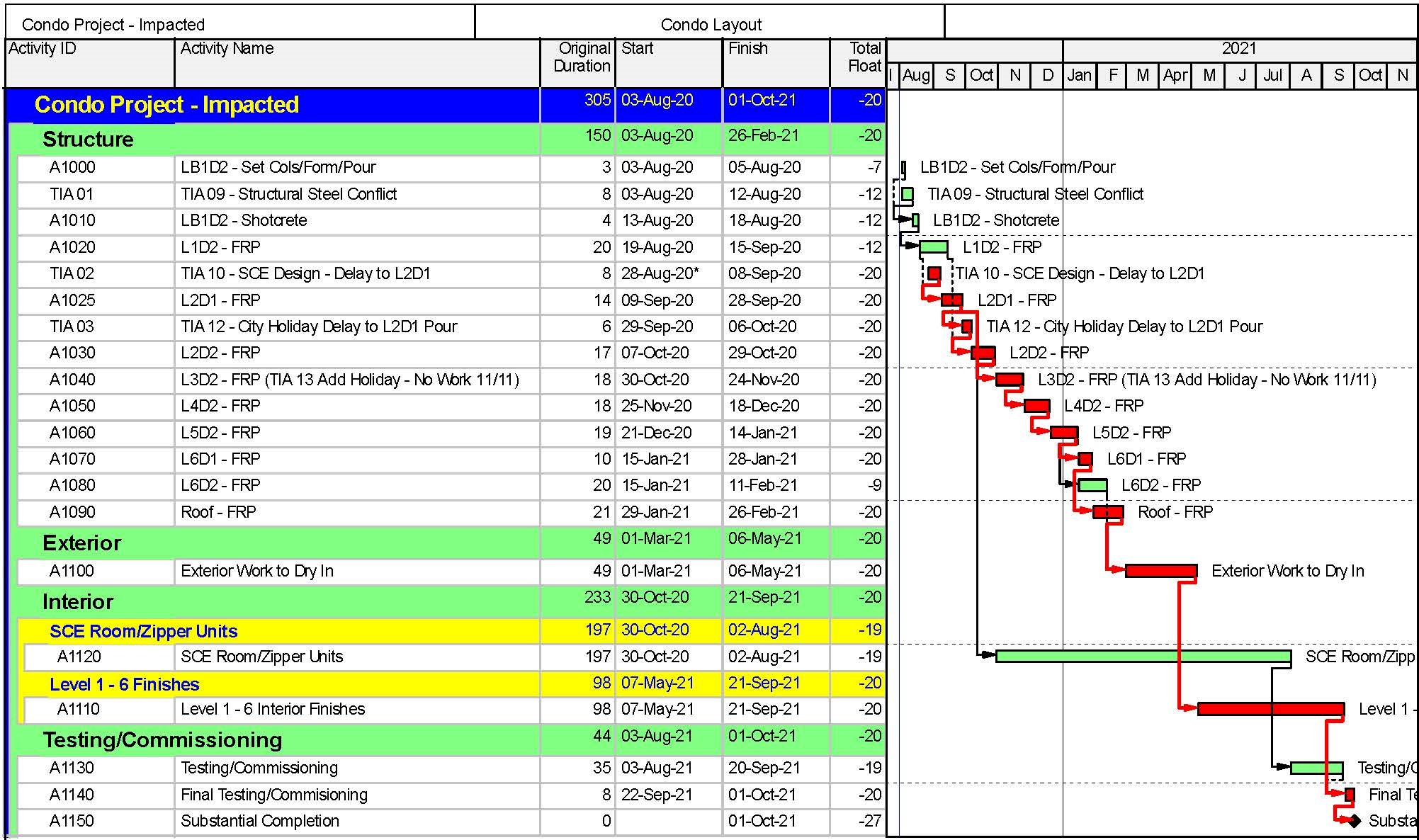
Once the design change impacts occurred, the contractor chose to hold off submitting a TIA analysis until late in the project, rather than promptly submitting it. In its retrospective TIA analysis, the contractor inserted schedule impact activities shown in Figure 3 for each design change and new city holiday. Figure 4 shows the contractor’s recalculated TIA schedule, including these impacts and holiday changes.


Figure 4 – Condo Project TIA schedule with inserted delay activities

In its time extension request, the contractor submitted the impacted schedule in Figure 4 showing the updated project completion forecast as 27 days late. In its TIA review, the owner evaluated the accuracy of the contractor’s impacted TIA schedule (Figure 4) by updating the submitted schedule with as-built dates and recalculating the schedule. Figure 5 shows the results of the owner’s analysis of the impacted schedule with as-built dates.


Figure 5 - Condo Project TIA schedule updated with as-built dates

Figure 5 shows that once the submitted TIA schedule was updated with as-built dates, project completion was actually forecast to be 5 days late, not 27. In this example, the contractor only received 5 days of time extension of the 27 requested days. Because the contractor’s TIAs were submitted after the delay events, the contractor and owner had the benefit of hindsight, so the use of as-built dates was both possible and appropriate. The contractor did not consider extended durations of other contract work or mitigation efforts it was able to achieve as part of its TIA analysis. The retrospective TIA analysis in this case example required that the contractor evaluate more aspects of the project work than in the prospective analysis in Case Study 1. 

What is the Takeaway?

While the cases presented in this blog post were simplified, the discussions offer appropriate conclusions in comparing TIA retrospective analysis with prospective analysis. A TIA that is done prospectively has the benefit of being simpler. Impact activities are typically inserted into update schedules already accepted by the owner. A prospective analysis is a forecast. It represents the contractor’s best estimate at that time as to impacts on the affected work, while assuming other downstream activities happen as planned. Performing retrospective TIA analyses often require more evaluation by the contractor of other project conditions and delays. The benefit of hindsight can cut both ways being a positive or a negative in these situations, depending on the specifics of a project. 

When creating or reviewing contracts, counsel should always carefully review the TIA clauses. Consider the timing of when TIAs need to be submitted relative to the triggering events. Paying attention to this seemingly small detail at the start of the project can help owners and contractors eliminate unnecessary aggravation in addressing time extension issues during a project. It may also save both parties time and money in negotiating time extensions by eliminating unnecessary timeliness disputes associated with the TIA analysis. 

If you are interested in learning more about TIAs, please reach out to the below authors of this blog post or visit www.hka.com

Kandace Zimmerman, PSP, Director at HKA (kandacezimmerman@hka.com): Kandace is a construction consultant in Seattle, Washington where she has been providing claims consulting, dispute resolution and advisory services to owners, general contractors, and subcontractors for nearly two decades. Her expertise lies in delay analysis, analysis of labor productivity, and quantification of damages on large, complex construction projects.

Julia Villalobos, PE, Associate Director at HKA (juliavillalobos@hka.com): Julia has over 10 years of experience in construction, project controls, and claims. She provides claims consulting and project advisory services for challenges related to schedule, damages, productivity, standard of care, and technical issues on construction projects of all sizes.

This material is intended for general educational purposes only, and should not be relied upon for any other purpose.  The opinions expressed are those of the authors alone and should not be attributed to HKA Global, Inc. or any of its employees.

Sunday, June 26, 2022

Consultant Corner: Rethinking the Role of Technical Experts in Pre-litigation Dispute Resolution

Welcome to the launch of The Dispute Resolver’s new series “Consultant Corner.” We invite article submissions from ABA Forum member consultants on topics important to the Litigation & Dispute Resolution Division (D1). In this article, the authors explore the role of technical experts in early dispute resolution. A combination of earlier engagement and more technical involvement could potentially help the dispute resolution process be more effective.


Construction disputes do not always require an expert; however, an expert is typically sought if the dispute involves particularly technical or complex issues that a lay person (including counsel and triers of fact) cannot readily understand. When is the most appropriate time to call upon a technical expert in a construction dispute? Most will turn to technical experts only after the dispute has advanced to the point where damages are high and litigation or a more formal ADR process is the likely path to resolution. Many also believe that a technical expert is required mainly for testimony in court, and therefore, late appointment of an expert shortly before trial is the most economical decision, but in many cases this may not be true. It is becoming more and more common for attorneys to retain an expert early, and the pre-litigation phase is arguably the best time to do so.

Pre-litigation Phase

During a pre-litigation or claim preparation phase, a technical expert typically serves as a “consulting expert” for one of the parties in the dispute, someone who can help evaluate any technical issues in dispute and opine on the relative strengths and weaknesses of proposed claims or positions. Another way an expert may be involved is to serve as an “independent evaluator” or a member of a “dispute review board,” jointly appointed by the involved parties, to advise on the merits of each party’s position based on the position papers and supporting information provided by the parties. Regardless of the role the expert may take and by which party the expert is retained, this process usually kicks off “after the fact” that is, when the dispute has led to large damages and/or delays. In many cases, it may already be too late for the expert to show value because the parties may already have experienced a significant economic loss, both parties may share significant fault in the escalation, and neither party is likely to clearly prevail in a settlement or litigation.

Rather than wait until this point in the dispute, we have seen the dispute resolution process be more effective when parties like owners, construction managers, design-build entities, and others retain experts earlier, even before a claim is fully formulated and a formal dispute resolution process has begun. Ideally, this kicks off when the dispute is just starting to rear its head as a disagreement, damages may not be fully formed or realized just yet, and the sides may not yet be entrenched in their positions. In this situation, the technical expert serves as a neutral third party who can weigh in on the cause of a problem and help to mitigate or resolve it (such as by performing independent design peer-review and developing a remediation plan to address the identified problems) before it escalates into a full-blown dispute in need of trial, arbitration, or formal mediation.

In this role, the expert serves as a neutral fact finder, as well as a source of technical insight. The expert plays the role of an independent evaluator or a dispute review board member by hearing each side and weighing the merits of each position, but at the same time, gets more involved in the technical nuts and bolts like a consulting expert to get to the bottom of the cause. And ideally, rather than just stop at finding the cause of the problem, the expert becomes part of the solution by proposing ways to get things under control, and potentially avoid similar problems from arising during the remainder of the project. The use of an expert in this setting has the potential to be highly cost-effective because one of the objectives is to prevent escalation of the damages that initiated the dispute in the first place. If damages are low to begin with, and stay below reasonable cost contingency levels, there may be little sense in pursuing costly recovery. A skilled and amiable expert, combined with a measured facilitator (perhaps inside or outside counsel for the owner or construction manager), can also encourage all sides to engage in solving the problem collaboratively, which can further expedite the resolution and help heal the bruises of any initial finger pointing. It can turn what might have been a failure into a success story and a triumph of teamwork.

Case Study

As an example of this sort of early expert involvement, the author was engaged by a construction manager at risk to help resolve a pair of disagreements between the project structural engineer and steel subcontractor, both of which threatened increasingly large repair costs and delays. One dispute involved widespread, seemingly random weld cracking throughout the project, for which each side blamed the other, with proposed or attempted repairs (most failing) often reflecting this finger-pointing. The other dispute involved steel assemblies that were surveyed to be out of level after installation, alternately being blamed on improper design and improper fabrication. The author was given an opportunity to review relevant documents, tour the site, speak to both parties, and perform some analysis. The author was able to discover a pattern in the seemingly random weld cracking that allowed the engineer and fabricator to focus their attention and develop alternative weld procedures and details to repair existing cracks and prevent future cracks. They also performed an analysis and facilitated load testing and surveying of the questionable assemblies to show that the appearance of out-of-level assembly was a result of benign construction tolerance issues, avoiding the need for costly replacement or retrofit. The final result was cooperation between the engineer and steel subcontractor, a halt to the escalating repair costs and delays, and a much less painful process in the long run for all sides.

Food For Thought

Before implementing this strategy, there are several questions that the involved parties and their counsel might consider:

  • How should parties that propose this type of dispute resolution broach the subject to their at-odds colleagues?
  • Like the engagement of an independent evaluator or dispute review board, can this type of process be written into contracts or teaming agreements?
  • Should everyone involved have a say in selecting the technical expert, or a right to veto the proposed expert?
  • What agreements need to be in place to encourage open and honest cooperation in the resolution process while protecting the rights of each party should litigation occur down the road? Is the potential for reducing the damage of the dispute enough encouragement for the parties to participate openly?
  • What happens if the involved parties do not cooperate or willingly provide necessary information to the jointly appointed technical expert?
  • If negotiation is unsuccessful and the claim proceeds to subsequent proceedings, such as litigation, what role might the technical expert be able to take? Might they hold any liability?

Conclusion

Regardless of the potential challenges, this kind of early expert engagement has the potential to facilitate dispute resolution and is worth exploring further by consultants and attorneys, as it aims to help all involved parties toward a positive outcome and to minimize costs before they become excessive. For us experts who are also practicing designers, this is also an opportunity to take lessons learned and apply them to future projects, preventing future disputes and bringing a type of deep satisfaction that our more traditional expert engagements cannot quite match.

Authors Thanh Do, Ph.D., P.E. and David Ojala, S.E., P.E., LEED AP, CWI are structural engineers at Thornton Tomasetti specializing in structural failure investigations and standard of care assessments. They assist attorneys, general contractors, design professionals, and owners at various phases of construction dispute resolution. In addition, both are active structural designers, with a focus on performance-based seismic design, existing building retrofit, and risk consulting.

Wednesday, June 22, 2022

View from the Field Part 4 - Labor Productivity Management - Prospective

View from the Field is a series of blog posts providing a practitioners view of the management processes and challenges associated with construction megaprojects as well as large and complex projects. Addressed by both Edward W. Merrow of Independent Project Analysis, Inc. (IPA) and construction lawyer Andy Ness at a recent ABA Forum on Construction Law conference, their high-level perspectives are elaborated. This multi-part series has and will expand upon some practical aspects of the many challenges facing managers as well as highlight suggestions for implementation by inside or outside counsel.

Summary – Prospective Labor Productivity Management

Labor productivity issues and challenges in the construction industry have been studied, analyzed and chronicled for decades. Highly respected sources of strategic and managerial thinking such as McKinsey & Company have offered extensive macro-level perspectives on labor productivity in the construction industry. This practitioner-level review and analysis offers a micro-level perspective with an emphasis on managerial pragmatism. Even further, labor productivity can be bifurcated into prospective and retrospective considerations. This first offering is prospective – with managerial tools and techniques that can be implemented promptly with potential for significant benefits for the direct hire contractor. For the direct hire contractor, Labor Productivity can be your Competitive Edge or your Curse. This is your tool kit to achieve Competitive Edge.

Part 5 of this series will address Retrospective Labor Productivity Managerial Options.

Labor Productivity Management – Elevated Importance

In many industries, the project delivery contracting strategy has shifted from Design/Build (D/B) or Engineer, Procure, Construct (EPC) to Design-Bid-Build (DBB). IPAs recommended strategy for large and complex projects is DBB. For the construction contractors (subcontractors), DBB places heavy reliance on the management of direct labor, hence labor productivity. 

For the direct hire contractor, the risk profile of the individual project/contract can be quite high. When direct labor costs are a high percentage of the contractors direct cost pool, labor overruns can have serious consequences. Schedule-centric managerial approaches, such as Lean Construction, Advanced Work Packaging (AWP), Installation Work Packing (IWP) and others must be combined with labor productivity management techniques. Together, this combination optimizes the time/duration to perform the work as well as sizing of the labor crew. This harmonizes time and related schedule management with labor productivity management. Thus, direct labor-related costs.

Finally, craft labor shortages in the construction industry are well recognized and highly problematic. Improving the labor productivity of existing direct hire workforce serves to mitigate shortfalls as well as to enhance the competitiveness of the contractors construction business. 

Direct Hire Contractor Management Recommendations

Key Performance Indicators (KPIs)

KPI is the best leading indicator of project conformance with or variance from the project baseline. Measure your actual field labor productivity weekly. Productivity KPI’s can be calculated using Earned over Burned” (Earned Work Hours / Actual Work Hours). Since Actual Work Hours are determined weekly for payroll, weekly assessment or calculation of earned value (e.g., billing quantities) or related Earned Work Hours budgeted is all that is needed. Weekly assessment of labor productivity on the path of construction provides a leading indicator” of project success or problems. McLaughlin & McLaughlin has managed projects with serious labor productivity issues and found that they can be resolved efficiently during erection and/or resolved with greater certainty when using dispute resolution processes.

Peak Labor Reduction

In times of construction craft labor shortages and individual skill shortfalls, the direct hire contractor can achieve a competitive edge by managing to achieve a reduction in the contractors peak labor count on the job. For example, a job budgeted at 100,000 direct labor hours over one year duration would have a peak labor force of approximately 72 workers. If labor productivity (PR) was .75 (worse than 1.0), the peak would be approximately 89 workers. However, enlightened management could improve this PR to 1.15. If done, the peak labor would be reduced to approximately 61. This reduction in crew size (89-61=28) reduces the demand for additional workers. In times of labor shortages and supervisor challenges, this serves to lower costs and supervision complexity.

Path of Construction

Use an execution strategy that is focused on labor productivity on or near the Path of Construction. Apply this focus and the rest of the job will almost take care of itself. Use Workface Planning coupled with Lean Construction, in some blend or fashion, on the Path of Construction. Coupled with a sound productivity management concept and plan for site logistics, the direct hire contractor will enjoy the benefits of effective field labor productivity management. Use a weekly Key Performance Indicator (KPI) of Earned over Burned” (Earned Hours / Actual Hours). This leading indicator will give supervisors and managers positive control of the productivity. 

Lean Construction

Lean Construction has achieved richly deserved popularity in the industry. The Lean Construction Institute’s mission is “…to transform the fragmented design and construction industry through lean thinking, tools and technology.” Advocates Joe Donarumo and Keyan Zandy offer workshops and have authored The Lean Builder, A Builders Guide to Applying Lean Tools in the Field.  “Hoots on the Ground” is highly informative.  While very popular and apparently highly effective, a complimentary management tool is still needed to address field labor productivity. Just as the Last Planner SystemTM uses Key Performance Indicator (KPI) Percent Plan Complete,” a labor productivity management plan and KPI is needed. Weekly Productivity Ratio (PR) is simple, efficient and effective. Earned over Burned” is easily implemented and is compatible with Last Planner SystemTM.  All direct hire contractors and trade partners should incorporate a Labor Productivity KPI into their managerial tool bag.

Advanced Work Packaging (AWP) and all

Advanced Work Packaging (AWP), Workface Planning, Installation Work Package(ing) (IWP), Construction Work Package(ing) (CWP) and other related schedule-centric managerial approaches have considerable value in managing labor productivity. Construction Industry Institute (CII) offers publications that cover these approaches. Using this managerial process is a strong option with planning as the key.

Acceleration

During project planning and execution, the project / construction management teams are often confronted with requests or demands to accelerate performance. Whether using specific methods or performance-based approaches, the acceleration requirement, virtually without exception, degrades or reduces field labor productivity. Regardless of the rationale for acceleration, the contractor should choose an approach that minimizes the negative impact on the contractors field labor productivity. Prolonged scheduled overtime (more work hours per week than planned) rapidly degrades field labor productivity. Avoid widespread use of this choice. If necessary and feasible, apply scheduled overtime to the path of construction, not the entire site. Rotate the specific personnel. A better choice is shift work where a second shift can be implemented on or near the path of construction. Use proven techniques for planning and managing this second shift. Above all, manage acceleration involving field labor with great care.

Single Source of Truth (SSOT) 

The data management associated with field labor productivity is a key consideration. Define the productivity-related data in the Project Execution Plan. Gather the data on a contemporaneous basis (needed regardless), and control access to the editing or changing of this data. This ensures availability if claims for additional compensation for productivity-related losses become desirable.

Modularization

Likely, the most commonly suggested managerial option to labor productivity management is to fabricate or erect modules (portions of the total scope of work) using an offsite fabrication facility. A legitimate discussion of a modular erection strategy would require a dedicated post. Suffice to say that the strategy has merit, given the right circumstances. Like AWP, advanced planning of work packages is needed. Further, logistics planning associated with transportation of the module(s) from fabrication facility to the job site work front is a must and requires substantial skill.

Conclusions (Part 4)

Proactive management focused on field labor productivity can have many positive impacts:

  • Offsets Labor Shortages – reduces the number of field labor, mitigates the impact of shortages and reduces the complexity of the related supervision.
  • Reduces Risk – reduces the risk of cost overruns by managing the smaller total labor force at the site and the need for new hires.
  • Facilitates timeliness – identification of negative events and variances, when recovery options are still available.
  • Creates Acceleration Options – Allows management of the productivity-related negative impacts of acceleration situations.
  • Enhanced Profitability – The direct hire contractor can reliably operate at or beneath the contractor’s cost and labor estimate baseline.

For the direct hire contractor, this becomes the Competitive Edge not a Curse.

View from the Field – Retrospective Labor Productivity Managerial Options (Part 5)

Having discussed Prospective Labor Productivity Management, Part 5 of this series will address the challenges of Retrospective Labor Productivity Managerial Options.

Author George T. McLaughlin PMP CCM has worked worldwide in this industrial marketplace since the early 1980s. He serves Owners, Prime Contractors, and Subcontractors. For the most part, Mr. McLaughlins work is performed on-location where the relevant work is being performed hence the title View from the Field.” Mr. McLaughlin is a principal of McLaughlin & McLaughlin out of Austin, Texas.

Monday, June 13, 2022

Introducing The Dispute Resolver's New Series: "Consultant Corner"

The Dispute Resolver editorial team is looking for submissions from Forum member consultants for our new blog series “Consultant Corner.” Perhaps you have a new area of expert analysis that you feel practitioners need to know about or there is a recent case study that might be of interest to our readership. If you have insight to share, send your submission in a Word document to Catherine Delorey at cdelorey@grsm.com. Guidelines for submissions:

  • They should be between 500 and 1,500 words in length;
  • We ask that you provide with your submission (or at the beginning of it) a sentence or two why you believe the topic is important to the Litigation & Dispute Resolution Division (D1);
  • Submissions should contain substantive analysis of interest to construction advocates and neutrals. While we expect that the quality of your commentary will naturally highlight your capabilities and generate business leads, the article should not read like a sales pitch or be overly promotional in nature;
  • If you need to cite to anything, we ask that you use hyperlinks or parenthetical cites within the body of the article (do not use footnotes or endnotes);
  • To increase exposure, we recommend that you include a short author bio (1-2 sentences max) at the end of the article with a hyperlink or parenthetical cite to your website; and
  • While not a requirement, pictures are worth a thousand words! If you have photos or links to videos that help illustrate the theme of your article, we encourage you to include them.