Tuesday, December 5, 2023

The Importance of the Recent Amendment to Rule 702 of the Federal Rules of Evidence

Every litigator understands that expert witnesses play a key role in litigation, especially when dealing with construction issues. Expert testimony at trial can be a deciding factor in persuading a judge or jury in your client’s favor.  It is so important that, as parties get closer to trial, litigators often spend considerable time filing motions to limit or disqualify certain aspects of expert testimony in an effort to gain an advantage at trial.  Because experts are a key aspect of the trial process, it is important to understand the various rules governing use of expert testimony, primarily Rule 702 of the Federal Rules of Evidence. 

On December 1, 2023, amendments to Rule 702 of the Federal Rules of Evidence went into effect which added the language in underline below and removed the language which is crossed out:

Rule 702. Testimony by Expert Witness


A witness who is qualified as an expert by knowledge, skill, experience, training, or education may testify in the form of an opinion or otherwise if the proponent demonstrates to the court that it is more likely than not that:

(a) the expert’s scientific, technical, or other specialized knowledge will help the trier of fact to understand the evidence or to determine a fact in issue;

(b) the testimony is based on sufficient facts or data;

(c) the testimony is the product of reliable principles and methods; and

(d) the expert has reliably applied expert’s opinion reflects a reliable application of the principles and methods to the facts of the case.

Clarification on the Admissibility Standard

The Committee Note[i] for Rule 702 indicates that the amendments were necessary to clarify and emphasize that expert testimony may not be admitted unless the proponent can demonstrate to the Court that it is more likely than not that the proffered testimony meets the admissibility requirements set forth in Rule 104 – the preponderance of the evidence standard. Thus, admissibility of expert testimony must be established by a preponderance of evidence.

It was noted that many courts were following an incorrect application of Rules 702 and 104(a) finding that questions as to the sufficiency of an expert’s basis and application of methodology were questions of weight and not admissibility. However, the Committee clearly stated that the sufficiency of an expert’s basis and the application of a methodology implicate questions of admissibility and not weight. 

However, once a court has found it more likely than not that the admissibility requirement has been met, any attack on the expert opinion will only go to the weight of the evidence and not the admissibility.

Clarification to Rule 702(a)

Rule 702(a) always required that the expert’s scientific, technical, or other specialized knowledge help the trier of fact understand the evidence or to determine a fact in issue.  While this requirement was unchanged, the Committee clarified that this requirement should be applied exactly as worded; the testimony need only “help” the trier of fact. The Committee rejected the attempt to impose a higher bar, noting that some courts applied an incorrect standard that required the expert’s testimony “appreciably help” the trier of fact. The Committee noted that any standard other than “helpfulness” is unnecessarily strict and was not the standard under Rule 702(a).

Amendment to Rule 702(d)

Rule 702(d) was amended to emphasize that an expert opinion must stay within the bounds of what can be concluded from a “reliable application” of the expert’s methodology. The Committee focused on the role of judicial gatekeeping to limit an expert’s opinions to one that is based on a reliable application of the methodology. The Committee noted the importance of “gatekeeping” because jurors may lack the specialized knowledge to (1) meaningfully evaluate the reliability of an expert’s methods utilized for an opinion and (2) determine if/when an expert’s opinion goes beyond what the expert’s methodology may reliably support.

The amendment further recognized the court’s authority to pass judgment on the conclusions that the expert has drawn from the methodology. The Committee’s amendment is in line with the holding of General Electric Co. v. Joiner, 522 U.S. 136 (1997) that a trial court must not only consider the expert’s methodology but must also consider the expert’s conclusion—so the methodology must be reliably applied. 

The amendment does not impose any new procedures. Rather, the amendment clarifies that Rule 104(a) preponderance of the evidence standard applies to expert opinions under Rule 702. The court’s role is not to “nitpick” an expert’s opinion to reach “a perfect expression” of what the expert’s methodology can support. Rather, the amendment does not permit an expert to make claims that are simply not supported by the expert’s methodology.

In sum, expert testimony cannot be presumed admissible; rather the proponent (attorney) must establish by a preponderance of the evidence that the expert’s testimony—the methodology and principles—are reliable and the expert “reliably applied” their methodology and principles to the case at issue.

Even though the amendment did not take effect until December 1, 2023, courts have already started to recognize the amendments in their rulings.[ii] The weight of prior precedent may be diminished if based on a prior incorrect application of Rule 702 that is in conflict with the recent amendments; however, the changes clarify what standards the courts should apply going forward in evaluating expert testimony.

At the end of day, the methodology must be reliable and the expert must have reliably applied the methodology to the case at issue. As litigators, we must be prepared to defend the qualifications of experts, their methodology, and how the expert applied their methodology.

Author Andrew G. Vicknair is an attorney with D'Arcy Vicknair, LLC in New Orleans, Louisiana. Andrew focuses his practice on intellectual property, commercial, and construction disputes and regularly handles claims related to construction defects, payment disputes, design issues, and general disputes among subcontractors, owners, and general contractors.


[ii] See Kaneka Corp. v. Designs for Health, Inc., 2023 U.S. Dist. LEXIS 131412, *6 (D. Del. 3/3/2023); In re Anderson, No. 15-21681, 2023 Bankr. LEXIS 153, at *3 (Bankr. W.D. Tenn. 1/19/2023); Qari v. Am. S.S. Co., 2023 U.S. Dist. LEXIS 154447, *8 (E.D. Mich. 8/31/2023); Edge v. SRA Mgmt., LLC, 2023 U.S. Dist. LEXIS 151277, *23 (E.D. Tenn. 8-28-2023).

Tuesday, November 28, 2023

Courthouse Reporter Series: Two Recent Cases Address Copyright Protection for Architectural Works

Recent decisions by the Seventh Circuit and the Eight Circuit have addressed the scope of protection afforded to architectural works under copyright law. The Seventh Circuit case of Design Basics, LLC v. Signature Constr., Inc., 994 F.3d 879 (7th Cir. 2021), took a somewhat narrow view of the copyright protection afforded to the design of an “affordable, multipurpose, suburban, single-family home.” In Designworks Homes, Inc. v. Columbia House of Brokers Realty, Inc., 9 F.4th 803 (8th Cir. 2021), cert. denied, 142 S. Ct. 2888, 213 L. Ed. 2d 1103 (2022) the Eight Circuit held that the publication of floor plans of a house in a real estate listing was not protected from claims of copyright infringement.

Design Basics, LLC v. Signature Constr., Inc., involved a plaintiff that the court described as holding registered copyrights in thousands of floor plans for suburban, single-family homes that are basic schematic designs, largely conceptual in nature, and depict layouts for one- and two-story single-family homes that include the typical rooms: a kitchen, a dining area, a great room, a few bedrooms, bathrooms, a laundry area, a garage, stairs, assorted closets, etc. The court described the plaintiff as a “copyright troll” and noted that litigation proceeds had become the principal revenue stream for the plaintiff. The plaintiff sued a contractor and related businesses contending hat the defendants had infringed plaintiff’s copyrighted floor plans.

The court in its analysis stated that Congress amended the Copyright Act in 1990 to provide for copyright protection for architectural works. Architectural works are defined under the Act as “the design of a building as embodied in any tangible medium of expression, including a building, architectural plans, or drawings. The work includes the overall form as well as the arrangement and composition of spaces and elements in the design but does not include individual standard features.” 

The Design Basics, court noted that to establish copyright infringement, two elements must be proven: (1) ownership of a valid copyright; and (2) copying of the constituent elements of the work that are original. The first element in that case was not disputed.

In addressing the copying of the constituent elements of the work that are original, the court looked to two questions: (1) whether the defendant copied the plaintiff’s protected work; and (2) whether the copying went so far as to constitute improper appropriation.

To answer the first question, the court held that plaintiff must show that the defendant copied the work. This is generally established through circumstantial evidence that the defendant had access to the plaintiff’s work and that there is enough similarity between the plaintiff’s work and the defendant’s work to support a reasonable inference of copying. 

The second question (whether the copying went so far as to constitute improper appropriation) required substantial similarities between the defendant’s work and the protected elements in the plaintiff’s work.

The court noted that “standard features” or scènes à faire are elements that are commonplace, standard, or so unavoidable that they do not distinguish one work from another, and that such elements are not entitled to copyright protection. The court held that “standard features” or scènes à faire in house plans include the arrangement of the rooms: the kitchen is always close to the dining room; the bedrooms will usually be clumped together and near a bathroom; the door from the garage into the house usually leads to the kitchen rather than the great room or living room.  

The court also held that the “merger doctrine” prevents the use of copyright to protect ideas or procedures. If an idea can only be expressed in a few ways, then it would be possible to copyright every one of its expressions. In such a case, under the “merger doctrine,” the expression of that idea cannot receive copyright protection.

The court went on to hold that the plaintiff, by copyrighting 2800 floor plans for affordable, multipurpose, suburban, single-family homes was attempting to occupy the entire field. As a result, the court found that the copyright protection for its plans was “thin,” and that any proof of unlawful appropriation would require more than substantial similarity, but would require “virtually identical” plans.  

In Designworks Homes, Inc. v. Columbia House of Brokers Realty, Inc., 9 F.4th 803 (8th Cir. 2021), cert. denied, 142 S. Ct. 2888, 213 L. Ed. 2d 1103 (2022), a homebuilder that was the owner of a copyright in a home design filed suit for copyright infringement against two real estate companies. The real estate companies had been engaged by the owners of two of the houses constructed by the plaintiff to assist the owners in selling their homes. During the process of listing the homes for sale, the real estate companies, either directly or through a contractor, produced sketches of the homes’ floorplans and incorporated images of those floorplans in the listings for potential buyers to consider.

At issue was an exception to the copyright protection afforded architectural works which provides that the copyright protection for an architectural work that has been constructed does not prevent another party from making, distributing, or displaying pictures, paintings, photographs, or other pictorial representations of the work if the building in which the work is embodied is located in or ordinarily visible from a public place.

The Eighth Circuit held that the floor plans did not constitute a permissible pictorial representation of the architectural works, because floorplans should not be considered “pictures.” The court noted that the copyright statutes as a whole reveals that Congress knew how to describe floorplans with more specificity than by simply referring to them as “pictures,” and that the floor plans should be characterized as “technical drawings” or “architectural plans,” rather than as “pictures.”


Author and Editor Stu Richeson is an attorney in the litigation section of Phelps Dunbar’s New Orleans office, primarily focusing on commercial litigation with an emphasis on construction matters, intellectual property issues and insurance.

Tuesday, November 21, 2023

Courthouse Reporter Series: The Bizarre Case That Required a 117-Year-Old Expert

A recent decision by the Georgia Court of Appeals, Munro v. Georgia Department of Transportation, highlights how overly specific and inflexible rules of evidence can create peculiar results.   

Munro involved a dispute over the design of a Georgia intersection. No. A23A0404, 2023 WL 4194716 (Ga. Ct. App. June 27, 2023). The plaintiff alleged that the defendant improperly designed the intersection, never corrected that improper design, and failed to properly maintain the intersection. These claims were dismissed for a very odd reason: the plaintiff’s expert witness wasn’t old enough.

The case arose from a car accident. A vehicle in which the plaintiff Munro was a passenger collided with a tractor trailer crossing an intersection. Munro sued the Georgia Department of Transportation (DOT) for negligently designing, maintaining, and inspecting the intersection. The DOT filed a motion to dismiss for lack of subject matter jurisdiction on the ground of sovereign immunity and a motion to exclude the testimony of the Munros’ expert witness, among other motions. The trial court dismissed the case in full on the sovereign immunity ground and denied the other motions as moot. The Munros appealed.

The Georgia Court of Appeals reviewed the trial court’s ruling on sovereign immunity de novo. It also ruled on DOT’s motion to exclude the Munros’ expert witness, notwithstanding the trial court’s decision not to address that motion. In so doing, the Court of Appeals erected substantial hurdles to successfully stating a claim against the DOT.

The Munros’ claims had to fit within a statutory exception to sovereign immunity. In Georgia, the DOT has statutory immunity for losses resulting from “design for construction of or improvement to . . . public works where such . . . design is prepared in substantial compliance with generally accepted engineering or design standards in effect at the time of preparation.” OCGA § 50-21-24(10). So, to state a viable claim against the DOT, the Munros had prove that the design of the intersection was not in substantial compliance with design standards in effect at the time of preparation.

The Munros had to find a qualified expert to opine on these topics. This is where things became interesting. Per Georgia’s Evidence Code, an expert witness whose testimony is to be used in a professional malpractice suit must have been licensed at the time of the alleged act or omission. OCGA § 24-7-702(c)(1). The Munros’ expert’s testimony was deemed inadmissible to support the claim of negligent design because the expert was not licensed at the time of design and installation of the intersection. The expert witness was first licensed in 1969. However, because the intersection was designed even earlier, the Court of Appeals found that the expert witness’s 54 years of experience were insufficient to qualify him to testify.

The Munros also attempted to prove that the DOT failed to improve the intersection. This claim, too, was foreclosed to them by virtue of the Munros’ 80-year-old expert’s relative “youth.” Because this claim likewise required a showing that the original design was negligent—and the Munros did not have an expert who was licensed long enough to be qualified to testify to this effect—their failure-to-improve claim also failed.

To its credit, the Court recognized that its application of the Evidence Code “effectively destroys an entire class of claims for the negligent design of roads, as many roads in Georgia were designed long before any potential living expert witness had been licensed.” Despite this arguably absurd result, the Court deferred to the intent of the Georgia legislature as evinced by the text of the statute.

The Munros ultimately utilized a different exception to sovereign immunity to successfully assert a negligent inspection claim. Georgia statutorily waives immunity for losses resulting from inadequate or negligent inspection of state property. O.C.G.A. § 50-21-24(8). The DOT did not claim immunity, but instead tried to argue that the negligent inspection claim was so intertwined with the negligent design claim as to warrant dismissal. Here, the Court sided with the Munros, noting that the DOT’s duty to keep the intersection free from visual obstructions (e.g., overgrown bushes), was distinct from any design responsibilities. The Munros, therefore, were able to return to the trial court with their negligent inspection claim intact.

This decision was not appealed further, which might mitigate the attention Munro draws to Official Code of Georgia Section 50-21-24(10). Still, it will be interesting to track whether the decision, and the immortal-expert requirement that the legislature and the court may have inadvertently created between them, prompts an attempt to amend the Evidence Code. As things currently stand, assuming one can find an 85-year-old engineer willing to testify as an expert witness, such engineer likely wasn’t licensed before age 25, meaning any claims requiring proof that a design done before approximately 1963 is negligent are foreclosed by the Code. The intersection at issue in Munro was designed in 1931, meaning the Munros would have had to find an expert at least 117 years old to be qualified to testify. This case is a paradigmatic example of enacting a statute with insufficient thought as to the bizarre results it could produce.


Author Todd Heffner is an associate in Troutman Pepper's construction practice group. Todd has devoted his career to serving clients in the construction industry, particularly high-stakes federal court litigation and arbitration.

Author Di'Vennci Lucas was a 2023 summer associate in Troutman Pepper's Atlanta office.

Editor Jane Fox Lehman is a Senior Attorney at The Babcock & Wilcox Company.

Tuesday, November 7, 2023

Consultant Corner: Drones and Artificial Intelligence for Building Inspection in Construction Law

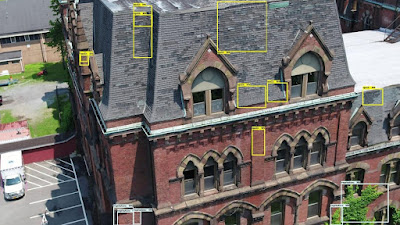
Drones are becoming increasingly popular for conducting building inspections, as they provide a quick and efficient way to assess the condition of a building and identify any defects or issues. However, in order to extract the maximum value out of autonomous building inspections, drones must be combined with computer vision and data visualization.

Figure 1: Aerial Perspective of Drone Inspection Survey

Drone technology allows significantly more area to be inspected in a fraction of the time. Additional technologies such as LIDAR and infrared cameras and AI analysis can help supplement visual inspection information. AI analysis can be particularly useful to alert inspection professionals or their clients where there are red-flag conditions that need to be addressed immediately. 


The combination of reality capture and AI analytics software is now used throughout the architectural, engineering and construction space. This technology is being put to use for construction progress inspection, regulatory compliance, historic preservation, risk management and for general repair and maintenance purposes.


Capturing and Visualizing Large Datasets


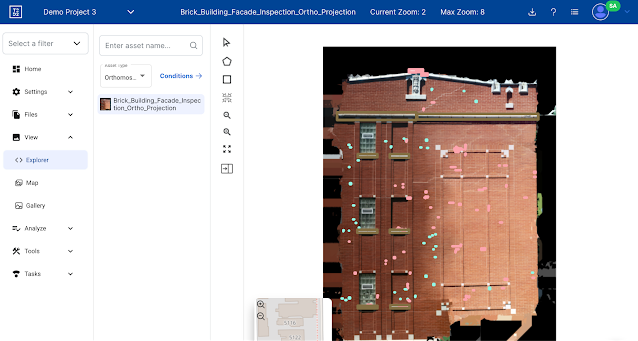
While drones may be an attractive solution, anyone who uses them must remember not only the need for an accompanying analytics solution, but also data visualization. The hundreds or thousands of images captured by a drone can be processed through a technology called photogrammetry to deliver a 3D model depicting the as-built condition through a simple 3D visualization, minimizing the need to review thousands of photos. 


Owners are realizing that owning their inspection data can be beneficial. Owners can leverage this inspection data to extract insights about adjustments to R&M plans, to increase efficiencies. For example, it might be more efficient to focus maintenance activities more regularly in a specific area on-demand when deterioration is identified rather than on a periodic basis across a whole building.


Figure 2: Data Visualization and Photogrammetry Tools Together (t2d2.ai)

Inspection data is also valuable when it comes to claims. Performing a complete 100% building envelope inspection can allow for much faster insurance claims processing if the state of a property is documented before a severe weather event. This is also useful when documenting existing conditions prior to adjacent construction. Essentially, this “date stamp” digital-twin of a property’s condition can prove useful in many scenarios, either when there are legal implications or when any building stakeholder has a need to refer back to any point on a building at that time. 


Case Studies


In one example, a cooperative 40-story concrete residential tower was able to use drones and AI to perform a cost-benefit analysis weighing their annual “patch-and-repair” program against a more comprehensive building envelope capital project. Drones provided a comprehensive building assessment that would have taken the engineering firm weeks to complete. 


In another example, a large cathedral used drones to monitor exterior conditions on an ongoing basis after completing a significant repair project to minimize deferred maintenance by making sure that conditions do not deteriorate beyond a certain point. 


In a third case, a building that recently completed construction used a drone analysis to “date stamp” the building and repeatedly monitor against the baseline to investigate and warranty claims that need to be made prior to the warranty period expiring.


Conclusion


Together, all of these technologies are making AEC professionals, building owners and other property stakeholders better equipped to maintain state-of-good-repair, process claims and take the guesswork out of past conditions.


Author Jonathan Ehrlich is the Chief Executive Officer of T2D2, the artificial intelligence asset inspection software platform. T2D2 is used by engineers, architects and building owners to make their inspection workflow faster, cheaper and more accurate. 


Editor Thanh Do is an Associate in the Forensics practice at Thornton Tomasetti, Inc. As a structural engineer, structural failure analyst and investigator, Dr. Thanh Do examines building and infrastructure inadequacies and determines the root cause of the alleged failures. He specializes in design and construction defect evaluations, collapse investigations, Design-Build project delivery, and standard of care assessment.


Thursday, November 2, 2023

Toolbox Talk Series Recap – Using a Measured Mile Analysis to Compare Productivity on a Construction Project

In the October 26, 2023 edition of Division 1’s Toolbox Talk Series, Andrew Vicknair and David Ponte gave an informative presentation on measuring productivity loss on construction projects. Specifically, they covered the factors that lead to productivity loss, the various options available to calculate productivity loss, and when a measured mile approach can be used. 

As covered by Vicknair’s slides from the presentation, factors leading to productivity loss on construction projects include:

  • Schedule Compression
  • Multiple contractors working in same space
  • Defective Design
  • Change Orders
  • Out of Sequence Work
  • Changes in crew size
  • Poor workmanship
  • Excessive overtime
  • FM events
  • Scheduling issues
  • Weather – not enough to stop work, but enough to slow progress

When a construction project incurs any of the above impacts, a claim for production loss needs support from a quantitative analysis. Ponte described how a measured mile analysis, if possible, is the “gold standard.” A measured mile analysis is a comparison of production in an unimpacted period to the productivity in an impacted period. The primary requirement for a measured mile approach is the existence of an unimpacted period of time to establish a baseline productivity for the given construction project. Ponte explained how there is typically a learning curve in the initial work performed, regardless of how typical the work is or how experienced the workers. In the initial days, weeks, or even months of a project, productivity increases until it reaches a plateau. The unimpacted period needs to be sufficiently large to get beyond the learning curve and reach the plateau in order to be representative.

In addition to the duration of the unimpacted period, a measured mile analysis also requires adequate documentation to establish productivity. Vicknair and Ponte highlighted records showing labor hours in specific areas with specific quantities as a prerequisite to allow the analyst to determine how much time was spent and how much production was achieved in each area for each day.

In Ponte’s experience, a measured mile analysis is not possible the majority of the time. Smaller subcontractors and general contractors often do not keep sufficient records and might not realize they have been impacted until it is too late. In these cases, alternatives included a Total Cost approach or a Modified Total Cost approach. In a Total Cost approach, which courts frown upon, the claimant compares the total cost of the work performed to the estimated cost of the same. A Modified Total Cost approach has the same starting point as a Total Cost approach, but makes adjustments for underbidding, other bid corrections, change orders, and other factors impacting productivity. For either approach, courts generally require, among other things, that a party establish that a measured mile could not be used, that the estimated cost (often the bid) was reasonable, and that the costs incurred were reasonable.

Thank you to Vicknair and Ponte for the valuable information on measuring productivity loss. 

Click here to view the discussion in its entirety.  


Author Douglas J. Mackin is a construction attorney with Cozen O’Connor in Boston, Massachusetts. Douglas counsels owners, developers, contractors, and subcontractors in all phases of a construction project, from contract negotiation through to completion, including disputes, litigation and arbitration. Douglas can be contacted at dmackin@cozen.com.

Tuesday, October 24, 2023

News Alert: Forum Members Complete Construction Litigation Mock Arbitration

In September 2023, members of the Forum on Construction Law completed a comprehensive mock arbitration event hosted by FTI Consulting at its office in New York City. Attorneys from three law firms and several consultants participated in the event which was designed to give developing construction attorneys and experts an authentic arbitration experience before a three-member arbitration panel.

The mock disputes included three parties: an owner, an architect, and a contractor. Approximately six months before the trial, an information pack was provided to the participants detailing the facts of the dispute, including items contributing to project delays and increased design and construction costs. The issues described in the event’s information pack detailed many items central to construction disputes, including differing site conditions, concurrent delays, work stoppages, design changes, remedial construction costs, and time-related damages.

Each of the parties was assigned a one or two attorney legal team and two construction experts to focus on the delay and damage components of the dispute. Each expert issued a written expert opinion and then provided a response to the opposing expert opinions. In total, the experts issued 12 expert reports. The issues and dispute background resulted in diverse opinions between the opposing experts.

Following the issuance of expert reports, the attorney took depositions of each expert. The depositions were recorded not only for use as part of the mock trial, but also for review and training opportunities. Each participant was assigned a mentor with significant trial experience as part of the event. The participants had an opportunity to review the depositions with their mentors for feedback on questions, responses, style, and body language before live questioning during the mock trial. 

The mock trial was held in person over two days and provided the feel of an actual arbitration. Counsel provided opening and closing arguments for each party. The experts provided direct testimony and were subjected to cross-examination by each opposing attorney. The panel heard a Daubert argument, actively questioned the experts, and ruled on objections. At each hearing stage, the parties were subject to time constraints. 

The panel provided immediate feedback to the participants after the hearing. Additionally, the hearing was recorded, allowing for additional training opportunities with a review between the participants and their mentors following the event.  

The in-depth nature of the event required a significant commitment from the participants. However, it provided an excellent opportunity for the attorneys to gain first-chair experience and for the experts to face live questioning from an adverse side. The teaming nature of the event also fostered relationships among and between the different parties. All involved participants spoke to the value of the event, and the participating firms are looking forward to similar opportunities in the future to develop their staffs and foster a new generation of construction attorneys and experts.

With the significant current caseloads carried by ABA Construction Forum members, a comprehensive mock trial may seem overwhelming; However, long-term planning and a commitment by the participants make it possible. Additionally, the experience that the participants gained provided immediate developments in their ability to support litigations while positioning them to step up to additional responsibilities sooner because of the event. 

The participating firms included: Fox Rothschild, LLP, Holland & Knight LLP, Peckar & Abramson, P.C., and FTI Consulting. 


Author Chris Sammon is a Senior Director in FTI’s Construction, Projects & Assets Group. With twenty years of experience in construction as a contractor and consultant, Chris provides consulting services related to construction delays and damages across the construction industry.

Tuesday, October 17, 2023

Meet the Forum's In-House Counsel: RACHEL CLANCY

Company: Lobar, Inc. 
Email: rachel.clancy@lobar.com 
Website: www.lobar.com
College: York College of Pennsylvania (Bachelor of Science in Marketing, 2001)
Graduate School: Florida Institute of Technology (MBA in Acquisition and Contract Management, 2004)
Law School: Penn State University, Dickinson School of Law (JD 2007)
States Where Company Operates/Does Business: Headquarters are in Dillsburg, PA; construction projects located in Pennsylvania, Maryland, New York, and West Virginia

Q: Describe your background and the path you took to becoming in-house counsel.

A: Before law school, I spent three years as a Contract Specialist writing construction contracts for the Department of Defense, Naval Facilities Command in New Jersey. I had no idea I'd eventually find my way back to construction. After law school, I spent five years in the business department of a local law firm handling corporate formations, a variety of commercial contracts, and learning some real estate law. After another four years in-house with a data and marketing company in Harrisburg, I accepted my current position with Lobar, where I've been for the last seven years. 

Q: How does working in-house compare or differ from firm life? 

A: As a business major in college, I always pictured myself as part of a business – one member of the team.  Although that was technically true in my years as an associate (I was one part of the law firm business), I noticed and was bothered by how minimally I was connected to the business of each client.  Depending on the needs of any particular client, I was able to glimpse only a small part of that business.  I handled a specific matter at the request of the client, but I did not have insight into other parts of the business, which I think is a disadvantage as counsel.  As in-house counsel I see all aspects of the business.  I can see how my decisions, actions, and work affect other employees and departments. I didn’t have that same opportunity or awareness as an associate in a law firm.  But, honestly, I didn’t have it during my first few years as in-house counsel.  It takes the right company and the right culture to feel like an integral part of the business. 

Q: What kind of work does your company do? Do you focus on specific sectors, states or regions? 

A: Lobar is a general contractor for public construction projects, handling primarily K-12 schools, water/wastewater treatment plants, and municipal facilities. We also have contracts with state and federal agencies. Our work is primarily within Pennsylvania, but we also have projects in New York, Maryland, and West Virginia. 

Q: How and when do you use outside counsel? In what kinds of matters? 

A: We use outside counsel for all disputes that go beyond negotiations and for specific areas where I lack expertise.

Q: What do you or your company take into consideration when vetting and/or selecting outside counsel? 

A: Most importantly, we are almost always searching for someone who has experience with public construction (even if the issue is not directly related to public construction).  Beyond that, we want to work with one attorney (or a small team) who will continuously and directly be involved with the legal matter for which we need assistance.  The law firm economics of origination and billable time should not be evident.  As a family-owned company, we seek consultants and counselors who can be part of our team.  We expect outside counsel to understand our culture, because that culture often dictates how we handle legal matters.  Therefore, we look for an attorney (or team) who has the expertise and will be the one(s) doing the work.

Q: What is the biggest problem that you see when working with outside counsel? 

Me and my two daughters.
A: Lack of communication.  I am rarely provided with documents being exchanged between the parties, and I do not have access to the document system used by outside counsel.  I end up having to use monthly invoices as a means of staying up to date (and updating the Board of Directors) on the status of a legal matter.  However, I understand that it is a challenge for outside counsel to determine how much to communicate because every communication is a cost to the client.

Q: What are some of your interests or hobbies?

A: I have been a soccer player since the age of six (and played through college). Despite a few years since then when I was raising children, I have continued to play in either an indoor coed league or an outdoor women's league. I’m also always in the midst of reading a book (or 2 or 3).  I drive almost 90 minutes roundtrip for my commute, so some of my “reading” is accomplished by listening to audiobooks.  Plus, I have more podcast episodes downloaded than I will ever have time to digest, even with my daily commute.  When I’m not with my daughters, playing soccer, working or sleeping, I’m learning something.


Assistant Editor-in-Chief Jessica Knox is an Associate in the Minneapolis office at Stinson LLP. She represents owners, general contractors, and subcontractors in litigation disputes. Jessica can be contacted at jessica.knox@stinson.com. 

Tuesday, October 3, 2023

TOP TAKE-AWAY SERIES: The 2023 Fall Meeting in Washington, D.C.

Over 500 construction lawyers, experts, and consultants descended on Washington last week for the Forum’s 2023 Fall Meeting. Newly minted Forum Chair John Cook and Program Coordinators Catherine Delorey and Brian Zimmerman put together a stellar program focused on navigating government construction. For this installation of the post-meeting post, I'm teaming up with guest contributor, Jennifer Kanady, to bring you 10 of our top take-aways from this unique program. 

10. Contracting with the government is replete with risk that could easily trap the unwary. Nobody likes to be taken advantage of. But hell hath no fury like the U.S. Government scorned. Erin Cannon-Wells and Aaron Silberman, gave a (truly) delightful, Indiana-Jones-inspired presentation on the regulations that can doom the unwitting contractor who is less than perfectly forthright in its dealings. The government has created financial incentives for members of the public to report your company’s violations as part of a qui tam action. When you consider the number of potential whistleblowers in the bidding process and the contracting chain, a qui tam action would seem more likely than not. Add to that the sanctions contractors might face for even innocent errors either by their own companies or their downstream subs, and government contracting begins to sound increasingly like the Temple of Doom. Oh, and in case you were only focused on affirmative claims, beware the “reverse false claim” which is concealing information that would rightfully entitle the government to a credit…

9. The federal infrastructure act ("IIJA") can fund projects focused on clean water, clean school busses, and everything in between. Contractors who are clamoring to get their piece of the IIJA pie will need to make sure they can live by the government’s rules, chief among them being the Davis-Bacon Act (“DBA”). The DBA, among other things, requires contractors and subcontractors on federally funded construction projects to pay local prevailing wages and fringe benefits to laborers and mechanics. While this high-level aim may sound easy enough to achieve, there are several ancillary requirements built into the DBA that mandate that contractors must, for example, pay workers weekly and maintain adequate records for three years after completion of the work. It was for good reason that the DBA was one of the potential traps lying in wait for federal contractors discussed by Erin and Aaron (see Take Away No. 10 above). But during the Division 3 lunch program, Rob McDonald and Tamara McNulty advised attendees that the DBA is about to see the most significant and comprehensive changes it has seen in 40 years. Those changes to the DBA go into effect on October 23, 2023 so be on the lookout.

8. The U.S. Government is using its massive purchasing power to force sustainable construction. The U.S. Government is the largest purchaser of goods and services in the world. On an annual basis, it spends over $550 billion, with more than $24 billion of that spent on construction. According to James Nagle, the government is attempting to wield this purchasing power to force the "greening" of construction. Contractors who wish to bid on government projects are not just going to be evaluated on technical merit, key personnel, and price. They are also going to be assessed on their carbon footprint. The impact of these requirements on the bottom line has yet to be seen but will likely be substantial.

7. “Language connects us and shapes our most significant moments.” Attendees of the fall meeting were invited to a networking reception hosted at the Planet Word Museum where they sampled the culinary contributions of different immigrant cultures and were given free access to several floors of exhibit halls. Opened in 2020, Planet Word is the only museum in the country dedicated to inspiring a love of language. The museum’s mission is ever more critical given the fact that literacy rates in this country are actually declining; Planet Word reports that there are 32 million adults in the U.S. who can’t read. The museum's immersive exhibits had an amazing way of bringing words—whether signed, spoken, written, or sung—to life. Be sure to check out the video below to watch John Cook connecting with his karaoke skills!

6. Government contractors who fall victim to cyber-attack can find themselves subject to government sanctions as a result.  This is the word on the street by B. Stephanie Siegmann and Alex Trafton who gave an insightful workshop on the evolution of the threat to cybersecurity. The most startling statistic was that the vast majority of companies have experienced some form of cyber-attack over the last 12 months. To match the risk, federal rules requiring companies to provide adequate security and to report cyber incidents are being implemented. As if the loss of the data were not punishment enough, government contractors and grant recipients that fail to follow cybersecurity standards may be held accountable to the government for putting U.S. information and systems at risk.

5. When it comes to the government claims process, "two roads diverged in a yellow wood…" If you or your clients don’t agree with the contracting officer’s response to your claim for time and money, you have two paths to appeal: (i) the Court of Federal Claims and (ii) the Boards of Contract Appeals. Andrew D. Ness, Michelle D. Coleman, Timothy C. Tozer, and David Wonderlick gave an interactive presentation on the claims process and their perspectives about which of the roads should be taken depending on the circumstances. The Boards of Contract Appeals are presided over by administrative law judges and will be less formal. They allow pro se litigants, have accelerated processes available for claims under $100,000, and hew more closely to what you would expect to see in arbitration. If that doesn’t sound appealing (or if you miss the 90-day window to appeal with the Board), the Court of Federal Claims might be for you, although there's no guarantee that road will be less traveled by.

4. Attorneys can request—but not direct—their client’s current (but not former) employees not to speak to opposing counsel. This was just one of several ethical minefields we navigated with the help of Thomas E. Spahn. Other nuanced take-aways: (i) while it could be considered malpractice not to search the social media of an adverse witness, you can cross the line by attempting to “friend” them; and (ii) while most jurisdictions require you to return documents inadvertently sent by opposing counsel whether it is ethical to look at metadata that is inadvertently disclosed is highly state specific. Research the rules in the state where you are licensed so you don’t run afoul of them.

3. Engaging in ADR with the feds is a delicate—but possible!—process. It is always important to understand how a federal construction project might differ from a private one, particularly when it comes to resolving disputes. While historically the government was not willing to engage in ADR, this is no longer the case according to the Hon. Jeri Somers, Adrian P. Bastianelli, III, and Scott N. Flesch. Just because the possibility of ADR with the feds is on the table does not mean it should be pursued without careful planning. Harry Potter fans know it would be unwise to approach a Hippogriff with too much haste; so, too, a contractor must be patient and respectful in approaching the contracting officer with a proposed meditation plan. In order to set the stage for successful mediation with the government, a contractor should: (i) understand who has authority to bind the government; (ii) give the government rep time to understand and evaluate the case before requesting a mediation; (iii) be prepared and willing to select a mediator from the government’s preferred panel of judges; (iv) understand whether settlements will be paid from the Judgment Fund (which covers liabilities of the government); and (v) be prepared to establish some exposure that will justify settlement and recognize that the government will never settle for nuisance value. 

Tom Dunn, Jessica Knox,
and Chris Caddell at the Puttery

2. You can discover more about someone in an hour of play than in a year of conversation. That lesson was never better illustrated than at the divisional socials on Thursday evening. Divisions 1 and 6 teed off for a few friendly rounds of mini golf at the Puttery. Some were fortunate to experience the unparalleled exhilaration of a hole in one. Others mastered using the reverse side of the putter to chip balls over the obstacles instead of around. While the debate continues to swirl as to whether this technique was in the “spirit” of the game, fun was nevertheless had by all.

1. Dare to dream big. While Jackie Robison wasn’t considered the best African American player to come out of the Negro League, he became the first to break the Major League color line in 1947. This was the act that Bob Kendrick -- President of the Negro Leagues Baseball Museum in Kansas City, Missouri -- credits with igniting the civil rights movement. Until that time, the Negro League was the only option open to African American men (and women) who wanted to play professional baseball in this country. The fact that the athletes in the Negro League faced profound discrimination and adversity did not prevent them from competing at the highest levels. While they certainly weren't given their due respect contemporaneously with their achievements, a total of 35 Negro League players have now been inducted into the Major League Hall of Fame, including: (i) Andrew “Rube” Foster, credited with inventing the screwball; (ii) “Cool Papa” Bell, who could circle the bases home to home in 12 seconds flat; and (iii) Josh Gibson, aka “the Black Babe Ruth” who is reported to be the only player (of any color) to ever hit a ball out of old Yankee Stadium. They are the ultimate testament to the fact that if you dream big, there is no limit to what you can achieve!


Co-author Marissa L. Downs is a construction attorney in Chicago, Illinois where she has been practicing law since 2009. Marissa is a partner at Laurie & Brennan, LLP and represents owners, general contractors, and subcontractors in all phases of project procurement, claim administration, litigation, and arbitration/trial. Marissa can be contacted at mdowns@lauriebrennan.com.

Co-author Jennifer M. Kanady is Senior Counsel at FAC Services, LLC, a professional services firm with over 40 years of experience providing high quality, timely and trusted business services to architecture, engineering and construction management firms. Jennifer focuses her practice on design professional practice management and construction litigation and can be reached at JKanady@facfin.com.