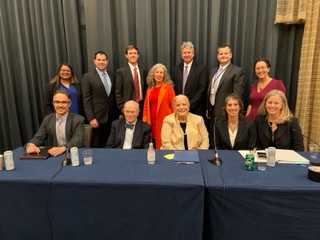
As the litigation and dispute resolution of the Forum, D1 members deal with a variety of aspects of construction law and many are discussed on the Forum’s podcast “Construction Law Today.” This
podcast was established in 2019 and created by Buzz Tarlow,
one of D1’s ADR neutrals. As a benefit to members, the D1 blog is
spearheading a series summarizing the podcast episodes.
Episode23: Building Codes and Building Safety
(Click episode title for the full podcast episode)
This is a summary of the podcast discussion with noted
attorney, Linda
Pieczynski, who is a former prosecutor, consultant, instructor
and author, in the field of building safety code enforcement. Tragically, on
June 24, 2021, the Champlain Towers South, a 12-story residential condominium
in the Miami, Florida suburb of Surfside, collapsed, killing 98 people. According to the Engineering News records,
the Champlain met all building codes in effect in 1979, which is when the
building’s construction was completed. Furthermore,
the Champlain was in the process of a forty-year recertification process,
required by Miami Dade County, at the time it collapsed. But still, the building failed. With this tragedy in mind, this episode focused
on building codes, how they work to make buildings safe, how and when they are
enforced and the impacts and limitations of these codes?
Why did the Champlain fail? After all, during the 40-year
recertification process, an engineer inspected the building and prepared a
report citing numerous repairs that needed to be made with the foundation and
pool areas. Firstly, the repairs were
expensive, probably in the five figures for each owner, and there was likely
pushback on the Board of Directors by the owners that did not want to come up
with the expensive assessments, so the work was delayed. Second, no one seemed to fully appreciate the
urgent nature of the repairs. Third, a
New York Times report indicated that some other potential causes of the
building’s failure were flaws in its design, like columns that were too narrow
and deteriorating concrete, which can happen when the rebar in the cement is
not properly coated causing them to rust and weaken the foundation, etc. Fourth, water was not properly draining away
from the building since its initial construction. Finally, the New York Times reported that
during the time of the construction of the Champlain some of the city building officials
received campaign contributions to help move the project along, which could
have caused undue pressure from politicians for building inspectors to approve
things quickly. In fact, there were numerous grand juries convened in the 80's
and 90's in Florida because of shoddy inspections conducted by city building inspectors.
How is urgency conveyed by those involved
in code enforcement?
Generally, if a building is in urgent need of repair,
a city inspector can issue an order of condemnation to the owner and residents
noting that unless repairs are made by a specific date, condemnation will occur. If the structure is immediately unsafe or there
is an emergency, the building could be outright placarded. Unfortunately, with Champlain, the emergent
nature of the situation was not appreciated. On a more positive note, the tragedy of Champlain has spurred the
inspection of many buildings to ensure there are no hazardous issues similar to
what occurred with Champlain.
How do attorneys prosecute housing code
violations?
The building official/inspector sees a problem and
sends notice to the owner or tenant to rectify the situation. If they do not rectify the situation, a
complaint or ticket is issued requiring then to come to court. This is the point at which an enforcement
attorney typically becomes involved, however an enforcement attorney may review
the case before hand to advise whether an administrative search warrant should
be issued to collect more evidence, etc.
How do enforcement attorneys teach courts?
The judges switch calendars regularly, so it is
important to educate the presiding judge, through the use of experts, on the purpose
of the ordinances that are being enforced. Most ordinances are created to address a safety concern and with the
intent of ensuring structural integrity of a building is maintained. For example, an ordinance requiring that windowsills
be painted was enacted because unpainted windowsills allow water to penetrate
the sill and rot the wood, which will eventually destroy the building’s
structure.
How do enforcement attorneys deal with the
owner or Home Owner Association (HOA) that is being prosecuted?
Some people come into court and think they do not have
to do anything. However, once they
realize that they can be fined for each day the violation exists, it motivates
many to act. Some HOAs are very
unskilled in this area as well. Sometimes
an HOA does not even exist because it has been allowed to be dissolved over the
years. In those cases, the enforcement
attorney will encourage some of the more responsible owners to form a new HOA
so that the enforcement attorney will not have to prosecute each owner
individually—which can be quite complicated. Usually, where an HOA exists, it is represented by an attorney. The enforcement attorney can then explain to
the HOA attorney what the declaration states about the responsibilities of the owners
versus the HOA, explain what needs to be fixed, and that they prefer not to impose
fines but need the HOA to come up with a reasonable plan that both parties
agree on, to fix the issue in a timely fashion.
Which of the numerous
building codes apply to a particular structure and what are the jurisdictional
boundaries of codes?
The oldest building code we know of
was on clay tablets found in ancient Iraq and it provided that if a builder
built a home and it collapsed and killed the owner, the builder would be put to
death. However,
it was insurance companies that really pressed for uniform building safety
codes to be created, to save money because insurance companies were losing a
lot of money paying out claims related to fires. For example, a prominent area of Chicago burned
down in the infamous “Great Chicago Fire”. After paying out claims related to this fire, insurance companies spurred
legislation that required new construction be made of brick and stone.
The first model code that
an insurance company pressed for was the Uniform Building Code (UBC), which was
passed around 1905, and the insurance companies urged various states to adopt
this as their own code. The UBC was
mainly focused on the West and MidWest. The Building Officials and Code Administrators International, Inc. (BOCA)
code was mostly in the Northeast, and then there was the Southern building
code. In 2000, those three groups merged together and formed the International
Code Council (ICC), which is the organization that promulgates most of the
uniform building safety codes, except the electrical codes. The National Electrical Code (NEC) is
promulgated by the National Fire Protection Agency. Most states adopt the NEC.
For
new construction, the International Business Code (IBC) applies to commercial
buildings, or anything that is larger than townhouses. The Residential code deals with new
residences and one-or-two story townhouses. The international property
maintenance code applies to existing buildings. There are also separate codes that cover how you construct the
electrical system, plumbing system and mechanical system.
Some states have state building codes
that they allow local municipalities and counties to adopt and enforce, as long
as they don’t weaken the code with amendments. Some states have no state
building code, which is rare, in those cases the towns have their own
codes. Other states, like Ohio or
Minnesota, are very regimented about enforcing the code from the state down to
the local municipalities. Lawyers in this field are responsible to know
what code is in force and the code at the time the incident at issue occurred,
as the code may have changed, and the new provision may not apply.
How has the requirement for sprinklers
in new construction evolved?
Codes get amended approximately
every three years, as safer technologies become available. However, technology
moves more quickly than the law does. For example, sprinklers were created but it
took a while for the model code to mandate that commercial buildings of a
certain size and occupancy have sprinklers—the same with residential codes. Model
codes require single family residences have sprinklers, but often these
provisions are amended out by the municipalities due to cost. The increase in
safety often increases cost and creates a constant tug of war between developers,
realtors, and the municipalities who want to assure that buildings have minimum
safety standards.
What is the future of codes in light
of climate change and green construction?
Earthquakes, hurricanes, natural
disasters, etc. cause codes to change for the better in terms of safety. However, codes cannot keep up with the speed
and impact of climate change. In fact,
climate change probably played a role in Champlain, with the infiltration of
sea water. The codes try to keep up with
those environmental changes, but they are revised every three years or so and
can’t keep up. A real challenge for building inspectors and contractors
is how can they prevent destruction from natural disasters from occurring. With forest fires, for example, we know how to build with upgraded fire
retardants to decrease damage, but it increases cost, and where insurance
companies will only pay a certain amount to rebuild, there are not enough funds
to cover the increased cost of more effective fire retardants.
Green energy and green construction
are huge right now. There are specialty codes
that the ICB has promulgated for green energy and green construction. There is also a lot of continuing education programs
for building inspectors to take to ensure they are up to date on the latest
types of construction.
How did the Champlain tragedy occur, when
these safety codes exist?
The codes dictate the minimum safety standard at the
time it is drafted, so the Champlain was built to minimum code standards, and
the standards do not guarantee a building will be absolutely perfectly safe, as
they cannot—the code writers are not architects or engineers so they have to
rely on other people to build buildings and human beings are fallible. Furthermore, there have been many code cycles
since the Champlain was constructed, which have upgraded safety measures. The code writers also did not anticipate the
climate change that would occur in Florida that would cause a lot of erosion
and infiltration of water. Also, a lot of beautiful buildings have beautiful
finishes, but the minimum standards for the important stuff like the plumbing
and foundation, etc. If there is a
tradeoff for where money will be spent there will be a struggle between constructing
a building with beautiful finishes and developing the infrastructure of the
building. You can do the construction cheaply and pass the minimum building safety
code standards in existence at that time, but that does not mean forty years in
the future, it is going to be in the same condition that it was when
constructed, especially if there is a lack of maintenance. Lack of maintenance is a common problem with
condo associations that fail to spend the money to get the annual reports
necessary to appreciate the state of a building and set aside adequate reserves
to make repairs. A code enforcement attorneys’ job is often to prevent this by
catching small building safety code violations before they become major safety
code violations.
Blog contributor Kanita Williams is the Principal at The Law Office of Kanita C.
Williams, PC, in Washington, DC. Her practice is criminal litigation, real
estate and landlord/tenant matters, and construction law.