Thursday, February 24, 2022

Advanced Mediation Advocacy Practicum in San Diego on February 23, 2022


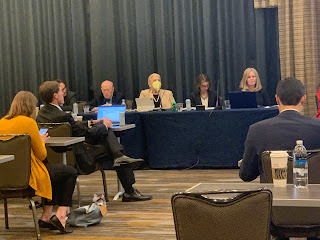
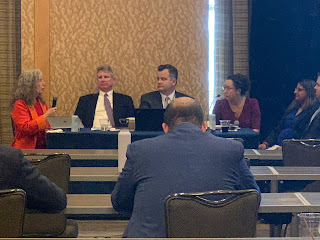
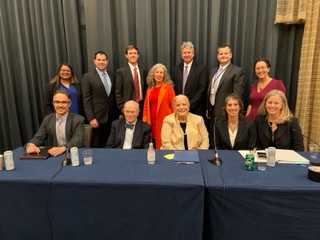
The ABA FCL MidWinter Meeting in San Diego kicked off with a bang with an Advanced Mediation Practicum.  Nearly 50 attendees participated with a content-rich discussion on how to effectively mediate complex construction cases. Brenda Radmacher of Akerman, LLP coordinated the practicum and led the panel discussion with Judge Gail Andler (Ret.) at JAMS, Anne Goyette of Griffiths Goyette, Robbie MacPherson of Cokinos Young, and Chad Wilson of PSOMAS. The panel’s presentation was highlighted by demonstrative role plays led by mediator Deborah Bovarnick Mastin and her “players” Jessica Bogo (Pillsbury), Catherine DeLorey (Gordon & Rees), Michael Murray (Lanak & Hanna), Rob Ruesch (Verrill), and Joe Hellenbrand (Capital Project Management, Inc).  

The panel covered issues on how to prepare for mediation including key issues of mediator selection, timing, and briefs. Issues on opening sessions and strategies for effective caucuses were addressed in-depth. There was also a robust discussion regarding differences in how mediation of construction cases is done regionally as well as issues regarding memorializing and enforcing settlements. 

Feedback from attendees included comments like, “The pointers and tips were so on point that I can go and implement them immediately.” And “I am an experienced mediator and really learned a lot from the session.”  The attendees were so engaged that they stayed 20 minutes past the published end time!


Tuesday, February 22, 2022

View from the Field Part 3 - Interface Management

This series of blog posts provides a practitioner’s view of the management processes and challenges associated with megaprojects as well as large and complex projects. Addressed by both Edward W. Merrow of Independent Project Analysis, Inc. and construction lawyer Andy Ness at a recent ABA Forum on Construction Law conference, their high-level perspectives are elaborated herein. This multi-part series has and will expand upon some practical aspects of the many challenges facing managers as well as highlight suggestions for implementation by inside or outside counsel.

Mr. Merrow’s High-Level Findings

In Mr. Merrow’s presentation, he addressed Contracting Approaches, Contract Types and Project Outcomes.  His findings are captured in these (his) diagrams:


Relative to other Contracting Approaches (i.e., Engineer, Procure, Construct (EPC) Lump Sum, Reimbursable EPC, Integrated Project Delivery), adjustments and accommodations to ways of working for “Mixed” are needed.  In “Mixed,” the risk profile is changed.

Mr. Ness’ High-Level Findings

Mr. Ness wrote a paper Why Megaprojects Fail So Often and Why You Should Care, No Matter the Size of Your Project and focused on business decisions in “4. Business Decisions That Hurt Prospects for Project Success.”  Regarding the discussion, Mr. Ness’ key point is:

Analysis of IPA’s database demonstrates that the form of the contract actually has very little impact on project success…And IPA’s database demonstrates that attempts to transfer risk wholesale to the contractor – such as by using a tough contract that has few holes and assigns the contractor responsibility for most everything – is simply ineffective.

Mr. Ness continues “The monumental mistakes usually belong to the business side.”

Why Consider Interface Management and Risk?

Given Mr. Merrow’s findings and Mr. Ness’ perspectives, it is legitimate to question the value of “Mixed” since most projects, although they may be large and/or complex, are not industrial megaprojects.  The reasons:

  • Large & Complex success rate is 60%+, therefore, failure rate is 30%+.  However,
  • The use of Mixed Contracting Approach (over, for example, EPC) significantly increases the number and complexity of interfaces and, as a consequence, risks.
  • Interface management represent a valuable tool for planning and execution of large and complex projects (as well as megaprojects).

View from the Field – The Front-End

Interface Management – This skillset is elevated to a very high importance. Under “Mixed,” the number and complexity of the interfaces increase, possibly dramatically. The potential for managerial system breakdowns, delays, gaps and other issues is much larger (than EPC, for example).

Interface AuditsProspective audits of all significant interfaces are effective managerial tools. These audits include: management, scope, technical, project controls, administration and others. Interface audits aid in the creation of robust interface definitions as well as reveal gaps and inconsistencies.

Resources include PMI Project Management Body of Knowledge (PMBOK), Project Integration, as well as Kerzner, Project Integration Management. The Responsibility Matrix (aka RACI) tool provides excellent interface definition when developed in a collaborative environment.  Alignment can be achieved using these (and other) processes. Some include RM/RACI work products as contract documents. The processes can be implemented within the Project Execution Plan (PEP, also known as Project Plan, Project Management Plan and other titles) using an extensive PEP workshop process.

Stakeholders such as inside or outside counsel may achieve insight into the preparation for Interface Management by attending a few workshop sessions and/or reviewing the PEP deliverables.

Owner Project Management Teams (PMT’s) – Under “Mixed,” Owner PMT staffing requirements are more extensive and demanding to manage or interface (quality, quantity, complication) with contractors and stakeholders. However, newly hired personnel often lack skills to manage interfaces.

Asset Performance – Ultimately, an Owner cares about the proper performance of its investment (e.g. plant, facilities).  Under EPC strategies, performance guarantees are generally obtainable from Prime Contractors.  This, since the prime(s) are in a position to assume and manage this risk.  Under mixed strategies, responsibilities and resulting liabilities can become so diffused that performance guarantees are difficult (if not impossible) to obtain and enforce.

Completion Management – With multiple parties and interfaces, the sequence and timing of commissioning and start-up is challenging.  Lack of competence in this process is a constant problem.  By default, completion management responsibility tends to fall upon the owner.  If in-house resources and expertise are limited, owner may need to hire a specialty contractor to perform this work.  Of course, that creates another interface that requires managerial skills and bandwidth.

Scope of Work – Under EPC strategies, the concept of “scope wrap” (a high-level contract provision that makes the contractor responsible for all scope necessary to complete the work) is viable, if not common.  With “Mixed,” this becomes increasingly complex.  Effective techniques for scope of work management are needed.  Interface audits are extremely valuable.

Deliverables Quality, Completeness and Timing – Deliverables (e.g., technical, documents, materials, equipment, lists and models), must be defined in terms of quantities, timing and quality.  The quality of the deliverables can impact the labor and related work necessary for the construction contractor(s) in fabrication and erection of the work.  Since these deliverables are typically the output of a predecessor contractor and defined by the related contract, the precession with which they are defined can have a large impact on the successor contractor.

The timing of deliverables must be carefully defined.  The timing of deliverables must be carefully defined.  The timing of the successor contractor’s receipt of deliverables influences the successor contractor’s ability to perform effectively and efficiently.  The sequence of these deliverables further exacerbates this influence.

Time Management / Schedule – The parties / stakeholders take on new roles, responsibilities and risks.  The project duration and delay to individual parties / stakeholders are decoupled.  Cause and effect for delays is difficult to isolate. The collection, status, controls and management of progress is highly complex. Critical paths for one contractor / stakeholder may not be the same for successor parties.  Time management problems tend to present themselves later in the project execution.  Interface audits are extremely valuable.

Conclusions (Part 3)

Interface management becomes increasingly complex and challenging when “Mixed” Contracting Approach is selected for project delivery. Prospective interface audits are essential tools needed to support interface management. Since the developmental processes are all the responsibility of the owner, owners must recognize and accept this role in order to implement Mr. Merrow’s most successful contract approach – “Mixed.” 

View from the Field – Supply Chain Management (Part 4)

Part 4 of this series will address the challenges of Supply Chain Management that is required when using “Mixed” contracting approach.

Author George T. McLaughlin PMP CCM has worked worldwide in this industrial marketplace since the early 1980’s. He serves Owners, Prime Contractors, and Subcontractors. For the most part, Mr. McLaughlin’s work is performed on-location where the relevant work is being performed hence the title “view from the field.” Mr. McLaughlin is a principal of McLaughlin & McLaughlin out of Austin, Texas.

Monday, February 14, 2022

Meet D1’s Neutrals Series: WENDY KENNEDY VENOIT


Company: Cozen O'Connor
Location: Boston, MA
Law School: Pace University School of Law, JD 1996
Types of ADR services offered: Arbitration and Mediation
Geographic area served: Domestic/International (no limitations)
ADR panels: AAA Construction Panel, ICDR International Panel, AAA Construction Mega Projects Panel, and CPR Construction Panel
Email: wkvenoit@sbcglobal.netWVenoit@cozen.com
Firm Webpagehttps://www.cozen.com
LinkedInhttps://www.linkedin.com/in/wendy-kennedy-venoit-4984346/
AAA https://apps.adr.org/constructionmegapanel/faces/FeaturedPanelists 


Q:Describe the path you took to becoming an ADR neutral.

A: I was an advocate in several large domestic and international arbitrations.  I was encouraged by an AAA Administrator (Cathy Shanks) to apply for the AAA panel, which I did. After that, I was a regular panelist, as well as a presenter at AAA and ICDR events.  I was invited to join the ICDR panel, and more recently the Mega Projects Panel.

Q: What percentage of your current legal practice is spent on ADR work?

A: Approximately 30%. I typically handle 3-4 cases per year as a neutral.  When not serving as a neutral, I serve as an advocate in construction disputes.

Q: What should attorneys and their clients take into consideration when vetting or selecting an arbitrator?

A: I prefer an evaluative mediator for most of my cases – someone who will identify and convey the strengths and weaknesses of the case in a candid way.

Q: What are your thoughts on requiring mediation as a contractual prerequisite to litigation or arbitration?

A: I do not believe it should be a firm requirement (because mediation can only be successful if both parties are onboard and engaged), but it should be encouraged in most cases.

Q: When do you recommend parties in a dispute attempt mediation?

A: There are often various “windows of opportunity” for settlement including (i) before suit/arbitration is filed; (ii) before significant discovery takes place; (iii) after discovery takes place; (iv) before the start of hearings.

Q: Do you recommend individual preparatory meetings with the parties and counsel prior to the joint session, and why or why not?

A: I prefer preparatory meetings because they avoid having to spend time educating the mediator during the joint session. Also, the parties can have candid discussions with the mediator outside the joint session. Finally, it gives the client an opportunity to “vent” outside of the joint session where such venting may have a negative result.

Q: What can attorneys do to best position their clients for a successful mediation outcome?

A: Attorneys should be candid in their assessment of the case and likely outcomes if settlement is not achieved. Attorneys should also educate their clients about the process; and make clear that emotional outbursts or other overt emotional responses can have a negative influence. They should emphasize that the parties should approach the process with an open/receptive mind.

Q: What experience do you have arbitrating construction cases?

A: I have been arbitrating construction cases as an advocate both domestically and internationally since 1999. I have served as an arbitrator at least 15 times since joining the AAA/ICDR panels roughly 10 year ago. My cases have been a mix of domestic and international. I tend to get picked for larger cases, often out of my immediate geographic area. I have served as both a solo arbitrator and as a member of a three-arbitrator panel.

Q: What advice do you have for parties when considering whether to choose a single arbitrator or a panel?

A: Whether to choose a single arbitrator or a 3-member panel will typically depend on the size and complexity of a matter. Smaller, less complex matters should not require a 3-member panel. When there is a single arbitrator, parties will often pick a lawyer to serve, as opposed to a non-lawyer industry professional.

Q: What measures do you take as an arbitrator to ensure arbitration is less costly and more efficient to litigation?

A: From the first procedural conference, I encourage parties to look for (and agree upon) ways to make the process speedy and efficiently. Consistent with the AAA Discovery Guidance, I encourage the parties to be judicious with discovery and to keep it proportionate to the size and complexity of the case. I generally discourage “court-style” discovery that is inconsistent with the objectives of efficiency. I also like to set time limits on the hearings, and strongly encourage the use of a chess clock to ensure that the hearings are completed within the time allotted.

Q: Do you think limits should be placed on discovery in the arbitration context?

A: Absolutely – consistent with the AAA Discovery Guidance and the goals of arbitration.

Q: What role should traditional rules of evidence play in the arbitration hearing?

A: Unless the parties agree to apply the traditional rules of evidence, I typically will not apply them – with exceptions for “privilege” and similar issues.  The arbitrator generally does not need to serve as a “gate keeper” for the evidence, as is necessary in traditional litigation.

Q: In what way do you use technology in the arbitration process?

A: I like to use all available technology – including trial presentation software; electronic evidence (in lieu of paper) to the extent possible; real-time court reporting; etc.

Q: What are some of your interests or hobbies outside of your ADR Neutral practice?

A: Skiing, Waterskiing, Golf, and Boating.

Tuesday, February 8, 2022

Podcast Highlights (No. 2): Building Codes and Building Safety

As the litigation and dispute resolution of the Forum, D1 members deal with a variety of aspects of construction law and many are discussed on the Forum’s podcast “Construction Law Today.” This podcast was established in 2019 and created by Buzz Tarlow, one of D1’s ADR neutrals. As a benefit to members, the D1 blog is spearheading a series summarizing the podcast episodes.

Episode23: Building Codes and Building Safety 

(Click episode title for the full podcast episode)

This is a summary of the podcast discussion with noted attorney, Linda Pieczynski, who is a former prosecutor, consultant, instructor and author, in the field of building safety code enforcement. Tragically, on June 24, 2021, the Champlain Towers South, a 12-story residential condominium in the Miami, Florida suburb of Surfside, collapsed, killing 98 people. According to the Engineering News records, the Champlain met all building codes in effect in 1979, which is when the building’s construction was completed. Furthermore, the Champlain was in the process of a forty-year recertification process, required by Miami Dade County, at the time it collapsed. But still, the building failed. With this tragedy in mind, this episode focused on building codes, how they work to make buildings safe, how and when they are enforced and the impacts and limitations of these codes?  

Why did the Champlain fail? After all, during the 40-year recertification process, an engineer inspected the building and prepared a report citing numerous repairs that needed to be made with the foundation and pool areas. Firstly, the repairs were expensive, probably in the five figures for each owner, and there was likely pushback on the Board of Directors by the owners that did not want to come up with the expensive assessments, so the work was delayed. Second, no one seemed to fully appreciate the urgent nature of the repairs. Third, a New York Times report indicated that some other potential causes of the building’s failure were flaws in its design, like columns that were too narrow and deteriorating concrete, which can happen when the rebar in the cement is not properly coated causing them to rust and weaken the foundation, etc. Fourth, water was not properly draining away from the building since its initial construction. Finally, the New York Times reported that during the time of the construction of the Champlain some of the city building officials received campaign contributions to help move the project along, which could have caused undue pressure from politicians for building inspectors to approve things quickly. In fact, there were numerous grand juries convened in the 80's and 90's in Florida because of shoddy inspections conducted by city building inspectors.

How is urgency conveyed by those involved in code enforcement?

Generally, if a building is in urgent need of repair, a city inspector can issue an order of condemnation to the owner and residents noting that unless repairs are made by a specific date, condemnation will occur. If the structure is immediately unsafe or there is an emergency, the building could be outright placarded. Unfortunately, with Champlain, the emergent nature of the situation was not appreciated. On a more positive note, the tragedy of Champlain has spurred the inspection of many buildings to ensure there are no hazardous issues similar to what occurred with Champlain.

How do attorneys prosecute housing code violations?

The building official/inspector sees a problem and sends notice to the owner or tenant to rectify the situation. If they do not rectify the situation, a complaint or ticket is issued requiring then to come to court. This is the point at which an enforcement attorney typically becomes involved, however an enforcement attorney may review the case before hand to advise whether an administrative search warrant should be issued to collect more evidence, etc.

How do enforcement attorneys teach courts?

The judges switch calendars regularly, so it is important to educate the presiding judge, through the use of experts, on the purpose of the ordinances that are being enforced. Most ordinances are created to address a safety concern and with the intent of ensuring structural integrity of a building is maintained. For example, an ordinance requiring that windowsills be painted was enacted because unpainted windowsills allow water to penetrate the sill and rot the wood, which will eventually destroy the building’s structure.

How do enforcement attorneys deal with the owner or Home Owner Association (HOA) that is being prosecuted? 

Some people come into court and think they do not have to do anything.  However, once they realize that they can be fined for each day the violation exists, it motivates many to act. Some HOAs are very unskilled in this area as well. Sometimes an HOA does not even exist because it has been allowed to be dissolved over the years. In those cases, the enforcement attorney will encourage some of the more responsible owners to form a new HOA so that the enforcement attorney will not have to prosecute each owner individually—which can be quite complicated. Usually, where an HOA exists, it is represented by an attorney. The enforcement attorney can then explain to the HOA attorney what the declaration states about the responsibilities of the owners versus the HOA, explain what needs to be fixed, and that they prefer not to impose fines but need the HOA to come up with a reasonable plan that both parties agree on, to fix the issue in a timely fashion.

Which of the numerous building codes apply to a particular structure and what are the jurisdictional boundaries of codes?

The oldest building code we know of was on clay tablets found in ancient Iraq and it provided that if a builder built a home and it collapsed and killed the owner, the builder would be put to death. However, it was insurance companies that really pressed for uniform building safety codes to be created, to save money because insurance companies were losing a lot of money paying out claims related to fires. For example, a prominent area of Chicago burned down in the infamous “Great Chicago Fire”. After paying out claims related to this fire, insurance companies spurred legislation that required new construction be made of brick and stone.

The first model code that an insurance company pressed for was the Uniform Building Code (UBC), which was passed around 1905, and the insurance companies urged various states to adopt this as their own code. The UBC was mainly focused on the West and MidWest. The Building Officials and Code Administrators International, Inc. (BOCA) code was mostly in the Northeast, and then there was the Southern building code. In 2000, those three groups merged together and formed the International Code Council (ICC), which is the organization that promulgates most of the uniform building safety codes, except the electrical codes. The National Electrical Code (NEC) is promulgated by the National Fire Protection Agency. Most states adopt the NEC.

For new construction, the International Business Code (IBC) applies to commercial buildings, or anything that is larger than townhouses. The Residential code deals with new residences and one-or-two story townhouses. The international property maintenance code applies to existing buildings. There are also separate codes that cover how you construct the electrical system, plumbing system and mechanical system.

Some states have state building codes that they allow local municipalities and counties to adopt and enforce, as long as they don’t weaken the code with amendments. Some states have no state building code, which is rare, in those cases the towns have their own codes. Other states, like Ohio or Minnesota, are very regimented about enforcing the code from the state down to the local municipalities. Lawyers in this field are responsible to know what code is in force and the code at the time the incident at issue occurred, as the code may have changed, and the new provision may not apply.

How has the requirement for sprinklers in new construction evolved?

Codes get amended approximately every three years, as safer technologies become available. However, technology moves more quickly than the law does. For example, sprinklers were created but it took a while for the model code to mandate that commercial buildings of a certain size and occupancy have sprinklers—the same with residential codes. Model codes require single family residences have sprinklers, but often these provisions are amended out by the municipalities due to cost. The increase in safety often increases cost and creates a constant tug of war between developers, realtors, and the municipalities who want to assure that buildings have minimum safety standards.

What is the future of codes in light of climate change and green construction?

Earthquakes, hurricanes, natural disasters, etc. cause codes to change for the better in terms of safety. However, codes cannot keep up with the speed and impact of climate change. In fact, climate change probably played a role in Champlain, with the infiltration of sea water. The codes try to keep up with those environmental changes, but they are revised every three years or so and can’t keep up. A real challenge for building inspectors and contractors is how can they prevent destruction from natural disasters from occurring. With forest fires, for example, we know how to build with upgraded fire retardants to decrease damage, but it increases cost, and where insurance companies will only pay a certain amount to rebuild, there are not enough funds to cover the increased cost of more effective fire retardants.

Green energy and green construction are huge right now. There are specialty codes that the ICB has promulgated for green energy and green construction. There is also a lot of continuing education programs for building inspectors to take to ensure they are up to date on the latest types of construction.

How did the Champlain tragedy occur, when these safety codes exist?

The codes dictate the minimum safety standard at the time it is drafted, so the Champlain was built to minimum code standards, and the standards do not guarantee a building will be absolutely perfectly safe, as they cannot—the code writers are not architects or engineers so they have to rely on other people to build buildings and human beings are fallible. Furthermore, there have been many code cycles since the Champlain was constructed, which have upgraded safety measures. The code writers also did not anticipate the climate change that would occur in Florida that would cause a lot of erosion and infiltration of water. Also, a lot of beautiful buildings have beautiful finishes, but the minimum standards for the important stuff like the plumbing and foundation, etc. If there is a tradeoff for where money will be spent there will be a struggle between constructing a building with beautiful finishes and developing the infrastructure of the building. You can do the construction cheaply and pass the minimum building safety code standards in existence at that time, but that does not mean forty years in the future, it is going to be in the same condition that it was when constructed, especially if there is a lack of maintenance. Lack of maintenance is a common problem with condo associations that fail to spend the money to get the annual reports necessary to appreciate the state of a building and set aside adequate reserves to make repairs. A code enforcement attorneys’ job is often to prevent this by catching small building safety code violations before they become major safety code violations.

Blog contributor Kanita Williams is the Principal at The Law Office of Kanita C. Williams, PC, in Washington, DC. Her practice is criminal litigation, real estate and landlord/tenant matters, and construction law.
Monday, January 24, 2022

Meet D1’s Neutrals Series: KENNETH C. GIBBS


Company: JAMS

Office Location: Los Angeles, CA

Email: kgibbs@jamsadr.com

Website: https://www.jamsadr.com/gibbs/

Law School: UCLA (JD - 1974)

Types of ADR services offered: Mediation and Neutral Evaluation

Geographic area served: USA


Q: Describe the path you took to becoming an ADR neutral.

A: I was the lead/name partner in a law firm specializing in representing clients in construction and engineering matters. After 25 years of doing this, I segued to working as a neutral on construction/engineering disputes.

Q: Describe your background and experience with construction ADR.

A: I have mediated more than 2,500 cases and arbitrated over 200 cases in 25 states over the course of my career. I feel honored to have been designated with the highest-level ranking (Band 1) in construction mediation by Chambers USA every year since the inception of the publication in 2005.

Q: Mediators are oftentimes described as “facilitative,” “evaluative,” or “transformative.” What is your style?

A: Evaluative.

Q: What should attorneys and their clients take into consideration when selecting a mediator?

A: Subject matter experience.

Q: What are your thoughts on requiring mediation as a contractual prerequisite to litigation or arbitration?

A: This is a bad idea. Mediation should be consensual after a dispute has arisen. Not just a “check the box” process.

Q: What can attorneys do to best position their clients for a successful mediation outcome?

A: Give them an honest “best case, worst case, and most likely case” opinion before the mediation.

Q: How can neutral evaluation be used in the context of the mediation process?

A:  It can be used either before mediation takes place or when the parties are at impasse. Most often, I use it at the outset before "formal" mediation takes place—it gives the parties some "context" in which to conduct the mediation.  Obviously, it is a consensual process and there are many variations as to how the neutral evaluation will be conducted.

Q: Are there particular types of matters that lend themselves to the “mediation-evaluation” process described above?

A:  It is a good tool to use where public entities or insurance carriers (often professional liability carriers) are involved. I make my non-binding rulings in writing and for a public entity it provides a quasi-judicial ruling which can be used as justification to resolve a matter. For insurance carriers it gives them additional reasoning by a neutral for internal risk analysis purposes.

Q: What are the pros and cons of employing this sort of process?

A:  The pros are as stated above—a non-binding, quasi-judicial ruling. The cons are cost and time.

Q: What sort of construction disputes lend themselves well to neutral evaluation (either in conjunction with mediation or separately)?

A:  Because of the cost and time involved to conduct a neutral evaluation it is best reserved for "high-value" disputes. Construction/Engineering disputes involving public entities lend themselves well to the process. I have used it many times on Design-Build disputes where standard of care issues are present.


Editor Marissa L. Downs is a construction attorney in Chicago, Illinois where she has been practicing law for over a decade. Marissa is a partner at Laurie & Brennan, LLP and represents owners, general contractors, and subcontractors in all phases of project procurement, claim administration, litigation, and arbitration/trial. Marissa can be contacted at mdowns@lauriebrennan.com.

Friday, January 14, 2022

Don't Miss this CLE Webinar by D1 Veterans on Construction Trials! (Jan 19 at 1-2:30 pm ET)

Looking to fine-tune your next construction trial or arbitration?  Click here to register now for the CLE Webinar: Navigating through Key Aspects of a Construction Trial or Arbitration presented by Division 1 veterans Tony Lehman, Luis Prats, Kelsey Funes, and Michael Lane, contributing authors and editors of the recently published Construction Trial Deskbook.

The ABA will seek 1.50 hours of General CLE credit in 60-minute states and 1.80 hours of General CLE credit for this program in 50-minute states. Credit hours are estimated and are subject to each state’s approval and credit rounding rules.

*Florida Bar regulators have stated that attorneys will not receive Florida credit for this ABA program, even if they self-apply.


Note: Online Registration will close at 10AM ET January 19. Anyone that registers afterwards with the ABA Service Center may not receive their confirmation email with their dial in instructions before the start of the webinar.

Tuesday, December 28, 2021

What’s Up With Division 1 (No. 14)

This year my family chose somewhat of an atypical holiday photo.  We proudly feature the Division 1 branded umbrella!  You can see the #1 logo just over my daughter's shoulder.  


I hope you and your family/friends are having a wonderful holiday season.  I know how busy 2021 felt for many of our D1 members and we all deserve some down time before we ramp back up in 2022! 

Even with the heavy workloads and crazy, evolving work life balance decisions we had to make in 2021, I am so proud of the efforts Division 1 members made this year to engage, educate, and network with each other.  Here is a listing of some of the programs and events we conducted:

  • Virtual Escape Room (Feb. 2021) with Divisions 7/9
  • Napa Valley Wine School Online Class (March 2021)
  • Return on Investment of Construction Claims (March 2021) 

  • Privilege Walk (April 2021) with the Forum's D+I Committee and NAWIC
  • Charting Your Path to an ADR Practice (June 2021) with the Section of Litigation's Construction Litigation Committee, NAWIC, and the AAA

In addition, we scheduled eight Division 1 Toolbox Talk Series programs this year.  Our TTS Planning Team has demonstrated incredible creativity and effort to get this series off the ground.  Big thanks to Jade Davis, Patricia Thompson, David Ponte, Daya Naef, and the other TTS team members / discussion leaders that put on these programs!  We are going to continue strong in 2022. Contact me (rtdunn@PierceAtwood.com) if you want to get involved. 


Finally, Catherine Delorey and The Dispute Resolver editorial staff published nearly 40 posts in 2021.  Great job TDR Team!

Looking forward, our next TTS program is scheduled for Thursday, January 27, 2022 at 12:00PM ET.  Sakib Kahn will be co-leading a discussion about thorny topic of litigating design delegation issues.  Registration page and promotion of that will be sent out next week.  

We also are conducting a second Building Results program for the Forum/D1's law student membership on February 2, 2022 at 5PM ET. The Forum's law student liaison and D1's YLD liaison, Lexie Pereira and I will co-moderate this program with excellent panelists: Jeff Cruz, Leslie O'Neil, Carmela Mastrianni, and Richard Wittbrodt.  


The Forum's midwinter meeting is in San Diego on February 23-25, 2022.  Division 1 events will include:

  • Division Lunch - A Perfect Storm: The Engineering and Legal Lessons Learned in the 10th Year Anniversary of the Indiana State Fair Stage Collapse."  Our speakers will be Kurt Hoigard, an engineer with Raths, Raths, Johnson (RRJ) and John Van Winkle, Van Winkle Baten Dispute Resolution.  Thanks to Marissa Downs for taking the lead on this lunch.   

  • Practicum - Advanced Advocacy Skills in Mediation Practicum | Wednesday, February 23, 2022, 1:00PM – 4:00PM, San Diego, CA.  Construction cases are complex and often involve not only complex technical issues, but also numerous parties, voluminous documents, and a myriad of claims and counter-claims.  Many construction cases are resolved through mediation – and nearly all of them will at least attempt mediation voluntarily, or be required to by contract.  However, a successful mediation of complex construction cases requires a skilled neutral and experienced advocates. This Mediation Practicum will provide advanced mediation and negotiation insights and skills for construction lawyers, construction companies, and neutrals alike to maximize the potential to effectively mediate and resolve complex construction cases.  This practicum will be an interactive event with the attendees including participating in and observing role plays and learning from some of the top construction lawyers and mediators.

After the midwinter meeting, the ABA Forum on Construction Law is conducting 3 additional meetings in 2022:
  • New York City - May 4-7, 2022
  • Lake Tahoe - July 26-28, 2022
  • Memphis - October 2022
Happy Holidays and looking forward to working with you all next year!!  


Tom Dunn, Division 1 Chair
Pierce Atwood LLP
rtdunn@pierceatwood.com


Tuesday, December 21, 2021

View from the Field Part 2 - The Front-End Makes the Megaproject

This series of blog posts provides a practitioner’s view of the management processes and challenges associated with megaprojects as well as large and complex projects. Addressed by both Edward W. Merrow of Independent Project Analysis, Inc. and construction lawyer Andy Ness at a recent ABA Forum on Construction Law conference, their high-level perspectives are elaborated herein. This multi-part series has and will expand upon some practical aspects of the many challenges facing managers as well as highlight suggestions for implementation by inside or outside counsel.

Mr. Merrow’s High-Level Findings

In Mr. Merrow’s presentation, he advised and emphasized that only about 35% of Megaprojects are successful. By contrast, Major Projects less than $500 million have a success rate of approximately 63% (hence even these projects experience a failure rate of one-third). Key metrics are: Cost Index, Cost Growth, Execution Schedule Index, Execution Schedule Slip, and Production Problems. Mr. Merrow’s theme for success – “The Front-end Makes the Megaproject.”

The summary, highest level findings (regarding Megaprojects) of Mr. Merrow’s presentation are:

  • The Front-end Makes (or breaks) (is essential for success of) the Megaproject
  • Sponsors of Megaprojects have three critical responsibilities:
    • Shaping – shape the project such that stakeholders are aligned
    • Basic Data – technical data are correct and complete
    • Front-end Loading – fully define the project before starting execution
  • All of these are owner responsibilities alone (i.e., not contractors).

Mr. Ness’ High-Level Findings

Mr. Ness wrote a paper Why Megaprojects Fail So Often and Why You Should Care, No Matter the Size of Your Project and focused on business decisions in “4. Business Decisions That Hurt Prospects for Project Success.” Several key points follow:

Business-driven actions or inactions…

These include under-investing in up-front project development, failing to assign the full required team to the project, untimely changes to the project’s scope, demands to shave the budget or compress the deadline for completing the project without reducing the scope, and involving the company’s purchasing organization in the process of selecting key project contractors and other participants.

Mr. Ness continues “The monumental mistakes usually belong to the business side.” Hence, this is not “The Field” (defined below).

Why Study Industrial Megaprojects?

Given Mr. Merrow’s findings and Mr. Ness’ perspectives, it is legitimate to question the value since most projects, although they may be large and/or complex, are not industrial megaprojects. The reasons are:

  • Problems are similar on large & complex (not megaprojects) projects – lessons learned are valuable
  •  Large & Complex success rate is 60%+, therefore, failure rate is 30%+
  • Formulas and managerial methodologies for success are valuable models for planning and execution of large and complex projects (not megaprojects).

View from the Field – The Front-End

What is the Field? In this case, we define “The Field” as any Project Management Team (PMT): owner, contractor(s) (including engineering, architectural, construction and specialty), suppliers and vendors. I have had all of these roles in large and complex projects, some megaprojects.

Shaping (shape the project such that stakeholders are aligned) – Stakeholder Alignment managerial process is addressed in several industry standards. These resources include PMI Project Management Body of Knowledge (PMBOK), Stakeholder Management and Project Management, as well as Kerzner, Stakeholder Relations Management. Stakeholder Alignment can be achieved using these (and other) processes. The processes can be implemented within the Project Execution Plan (PEP) (also known as Project Plan, Project Management Plan, and other titles) using an extensive PEP workshop process.

In Leading Complex Projects, Mr. Merrow describes the PEP as:

A project execution plan (PEP) is a document that is produced by almost all project teams in all of our clients across all industrial sectors. It is a ubiquitous document that is, in theory, supposed to tell the expected story of the project and its execution. Some PEP’s we see are very good and some of the PEP’s are utterly horrid.

Stakeholders such as inside or outside counsel may achieve insight into the status of Stakeholder Alignment by attending a few workshop sessions and/or reviewing the PEP deliverable.

Basic Data – requires specialized and suitably credentialed Subject Matter Experts (SME’s).  I have encountered these situations and made the decisions to acquire suitable SME’s. Credentialed SME’s should deliver a report assessing basic data status and readiness to proceed into the project development process.

Front-end Loading – How does the project team evaluate readiness (suitable front-end loading)? A creditable tool is Construction Industry Institute (CII) Project Development Readiness Index (PDRI). These tools are available for various industries. Business unit representatives/SME’s (not merely the PMT) provide creditable expertise for representing/contributing business interests, values and requirements. Further, stakeholders such as inside or outside counsel, could assess the status by attending working sessions and/or reviewing standard reports.

Conclusions (Part 2)

The Front-end makes the large and complex project. The developmental processes are all the responsibility of the owner. Hence, owners (including owner PMT’s) need to make sure that this process is robust and complete. Contractors need to evaluate the degree of completeness during the bidding process. Inside and outside counsel can use the managerial processes and deliverables as assessment tools in order to evaluate the large and complex project readiness for further development (or readiness for passage through the next stage gate).

View from the Field – Interface Management

Part 3 of this series will address the challenges of Interface Management that is required when using “Mixed” contracting approach.

Author George T. McLaughlin PMP CCM has worked worldwide in this industrial marketplace since the early 1980’s. He serves Owners, Prime Contractors, and Subcontractors. For the most part, Mr. McLaughlin’s work is performed on-location where the relevant work is being performed hence the title “view from the field.” Mr. McLaughlin is a principal of McLaughlin & McLaughlin out of Austin, Texas.

Monday, December 13, 2021

Meet D1’s Neutrals Series: CLIFFORD J. SHAPIRO

Company: Shapiro Dispute Resolution LLC

Office Location: Chicago, IL

Email: clifford@shapiroadr.com

Website: www.shapiroadr.com

Law School: George Washington University, JD 1982

Affiliated ADR Organization: AAA National Panel - Construction and Commercial Claims

Types of ADR services offered: Arbitration & Mediation

Geographic area served: United States


Q: Describe the path you took to becoming an ADR neutral.

A: I have been a construction litigation attorney for more than 35 years, and for the past 13 years I was an equity partner and chair of the Construction Law Practice Group at Barnes & Thornburg, an AmLaw 100 firm with 20 U.S. offices.  In that capacity, I handled just about every kind of construction claim that exists, and I worked to resolve those claims through litigation, arbitration, and mediation.  About five years ago, I decided to become an arbitrator and mediator. I spent quite a bit of time obtaining formal and informal training, and I was selected by the American Arbitration Association to be a member of its National Roster of Neutrals for construction and commercial claims.

Q: What percentage of your current legal practice is spent on ADR work?

A: As of January 1, 2021, I am working 100% as an arbitrator and mediator.  I primarily handle complex construction disputes and related insurance claims, as well as commercial disputes.

Q: Mediators are oftentimes described as “facilitative,” “evaluative,” or “transformative.” Do you have a style?

A: Each mediation is different, but generally I begin mediations in a more “facilitative” role and progress to a more “evaluative” role when it is appropriate to do so.  Particularly if a party requests it, I will share my thoughts about the risk analysis of the claim.

Q: What should attorneys and their clients take into consideration when selecting a mediator?

A: I think subject matter expertise is important in construction cases.  Also, in a complex, multi-party case, it helps to have a mediator who has successfully handled those kinds of claims both as an advocate and as a mediator.  It can also be important for the mediator to understand and be able to handle the numerous kinds of insurance issues that often arise in connection with construction claims. 

Q: Are virtual mediations as effective as in-person mediations? Do you anticipate that mediations will continue to be conducted virtually post-pandemic?

A: I handled quite a few virtual mediations and arbitrations during the pandemic, and they were all successful.   Frankly, I was surprised at how well these proceedings worked.  However, as we move out of the pandemic, most counsel and parties are telling me they want to have in-person mediations and arbitrations again, or at least to have “hybrid” proceedings at which the key parties and counsel appear in person and other participants can appear virtually.

Q: What role do you think videoconferencing will play in the arbitration landscape post-pandemic?

A: I now regularly use video conference technology for preliminary meetings.  Particularly with respect to mediations, I highly recommend having a virtual meeting with counsel and the key client representatives for each party in advance of the first mediation session.  These meetings almost always provide important information that is not found in the written submissions, and they are a great way to begin the process of building the trust and respect that is critical to a successful mediation. In addition, these meetings often make it possible to forego having opening statements or presentations at the start of the mediation.

Q: Can you describe one of the more notable arbitration matters that you have handled?

A: The most memorable case I had this past year was a AAA arbitration matter where I served on a panel for a large, complex dispute that involved more than 40 different construction claims exceeding $35 million in claimed damages.  The dispute arose out of a luxury apartment building project and involved more than five parties.  The claims were presented to the panel during two weeks of live hearings in St. Louis and then three weeks of virtual hearings via Zoom during the pandemic.  The panel issued a 46-page award.

Q: What are some of your interests or hobbies outside of your ADR Neutral practice?

A: I am a road bike cyclist (who used to be faster), and I play acoustic and electric guitar.  My wife and I also like to visit our grown daughter and her family, and we like to travel.

Monday, December 6, 2021

Irreconcilable Differences and the Right to Cure (Terminating Construction Contracts - Part 1)

In this series we will provide a brief summary of a very complex topic: the termination of construction contracts. Termination should be a last resort on a difficult construction project. There are a myriad of reasons why termination can backfire if not executed carefully and thoughtfully.

This series will scratch the surface of selected legal issues arising from contractual terminations. Although much of this analysis is from the perspective of an owner, we hope the discussion will also be of use for other parties, including design professionals, general contractors and subcontractors.

Complex construction projects can be long, difficult and frustrating endeavors. Inevitably, things go wrong. Delays happen, unforeseen circumstances arise and costs increase. After months of interaction both on-site and during project meetings, personalities clash and patience wears thin. 

In this charged atmosphere with large amounts of capital at risk, it can be tempting to consider the merits of terminating certain contracts. As we counsel our frustrated clients regarding the potential benefits of termination, and more importantly the potential pitfalls and liabilities that could end up in protracted litigation or arbitration, sometimes the best service we can provide is simply letting an exasperated client blow-off steam while reminding them to maintain written records of project-related communication and a back-up set of all project documents. Termination may sound viable in the heat of the moment, but it is hardly a decision that should be made without careful planning and detailed scrutiny of all the legal and practical implications. 

Irreconcilable Differences and Practical Considerations

Unfortunately, certain differences are irreconcilable. In these circumstances, termination may be the only viable option to finish a project. However, even when a material breach occurs, clients should be counseled regarding several important practical considerations before even reaching the litany of legal concerns.

For example, even assuming an owner has the right to terminate a contractor for cause, the owner may not have an adequate replacement ready to assume the remaining contractual obligations. Or perhaps the owner has a replacement, but in order to assume the remaining obligations and walk onto the project and accept the risks of “cleaning up someone else’s mess,” the replacement is prohibitively expensive. In these scenarios, the termination “medicine” may be worse than the “disease” of maintaining a difficult relationship with an underperforming party.

A second critical decision is whether a client wants to deal with the stress and expense of mediation, arbitration or litigation. Further, the client should be advised to consider termination in the context of its relationship with the lender. Because construction projects are capital intensive, lenders may retain leverage, literally and figuratively, over significant project details. Making a unilateral decision without considering the lender is rarely a good idea.

Materiality and Termination For Cause

The law generally disfavors termination. Termination is a drastic remedy and the law has developed several hurdles before a party can justify terminating a contract for cause. First, the breach must be material. Second, the breach must be not be excused. Third, the breach must have been neither cured nor waived.

Many modern construction contracts contain “breach conversion” provisions. These powerful devices convert breaches from breach of contract claims into claims for relief under the contract. Breach conversion clauses may address common issues such as changes, owner’s misrepresentation of site conditions or suspension of work.

Not all breaches are material. While a material breach may provide grounds for a for cause termination, defining the outer limits of materiality is notoriously complicated. Hopefully the contract documents are detailed enough to provide specific guidance regarding triggering events, cure provisions and compensation. Contractual termination clauses are usually the starting point of the analysis.

Most standard form contracts appoint the architect or another design professional as the “Initial Decision Maker” pursuant to their construction administration responsibilities. The Initial Decision Maker essentially acts as the earliest referee of the formal dispute process. They may be forced to consider for cause grounds for terminations including defective work, excessive delays, the non-payment of subs or insufficient labor on-site. Another example may be determining when a work stoppage amounts to abandonment. Nothing can be more frustrating than a work-stoppage when a project is already behind. However, clients should be counseled that a court may not agree that a given work stoppage amounts to abandonment.

The stakes of deciding to terminate a contract due to a material breach are high. If an owner makes the wrong decision, they can open themselves up to significant liability. It goes without saying that an owner’s wrongful failure to pay is itself a material breach. Wrongful termination can lead to the discharged party receiving lost profits and other damages. In many jurisdictions, a bad faith termination can lead to extracontractual damages.

The Right to Cure

Even when a breach has occurred, most standard contract documents will provide important limitations on the right to terminate. One of the most significant limitations is the right of a breaching party to cure any material breaches capable of being remedied.

The right to cure provides the breaching party with the opportunity to address their mistakes. Sometimes this isn’t practical for logistical reasons, but the legal principle is important. For example, most jurisdictions won’t let a landlord evict a residential tenant without notice of default and other legal safeguards developed over time. The same basic concept applies to construction contracts. The right to cure is a common law concept grounded in the equitable principle that notice is an element of fairness and can promote the informal resolution of disputes.

A “cure notice” must be given by the non-breaching party. There are only limited exceptions to this general rule, including when a material breach clearly cannot be cured in time. Most standard form construction contracts will clearly specify that a cure notice must be given by the non-breaching party prior to termination. Independent of the explicit contractual language, courts usually find that unless expressly waived, a right to cure is implied in every construction contract as a matter of law.

The cure notice must adequately apprise the breaching party of the specific failures which, if not remedied, may lead to termination.

Providing cure notice is an essential prerequisite to a valid termination. If the contractor fails to cure or otherwise provide adequate assurances that it will do so within a reasonable period, the architect of record may certify that sufficient cause exists for termination.

But wait, there’s more. Waiver, mitigation and other defenses will be the topic of Part II of this series.  

Author Patrick McKnight is an associate in the Litigation Department of Fox Rothschild LLP. He can be reached at pmcknight@foxrothschild.com.